
Tour Hassan, the unfinished Almohad giant of Rabat
Published on 08/30/2026 at 13:31 | Editorial responsibility: Rafael Müller, Editor-in-Chief AD HOC NEWS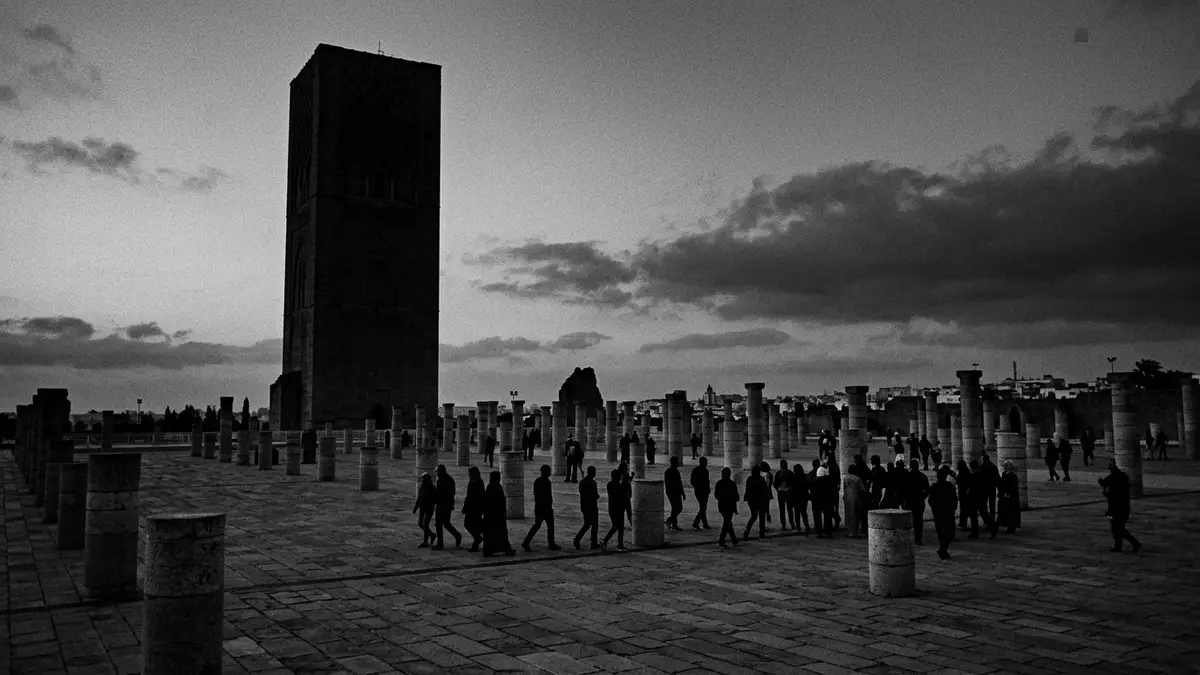
Tour Hassan in Rabat is the massive red sandstone minaret of an unfinished twelfth?century mosque, a square tower whose halted construction left an entire prayer hall reduced to low walls and forest?like rows of stubs and columns around it. Commissioned under the Almohad caliph Abu Yusuf Yaqub al?Mansur in the 1190s, it still anchors a ceremonial plateau between the Bouregreg River and the Atlantic, facing the modern Mausoleum of Mohammed V across paved terraces and planted gardens.
An Almohad minaret frozen mid?construction
Tour Hassan was begun in 1195 as the minaret of a grand congregational mosque ordered by Sultan Yacoub al?Mansour, third caliph of the Almohad dynasty, who ruled from 1184 to 1199.Sultan Yacoub al?Mansour ordered the construction The project aimed to place a monumental mosque and minaret on a site overlooking the Bouregreg estuary, on an axis aligned conceptually with the Koutoubia Mosque in Marrakesh and the Giralda in Seville, two other major Almohad works.Almohad architecture linking Rabat, Marrakesh and Seville
The tower was only partially completed when Yacoub al?Mansour died in 1199, and building work on the mosque stopped, leaving the minaret much lower than its intended height.Construction halted after the caliph’s death The minaret rises to about 44 m (144 ft), built in red sandstone that has taken on an ochre tone over centuries, while the abandoned prayer hall spreads around it as a grid of low pillars and truncated columns defining the footprint of the vast mosque that was never roofed.The 44 m red sandstone tower
Architecture in red sandstone and carved stonework
The plan of Tour Hassan follows the square form typical of Almohad minarets, with four façades decorated in geometric reliefs, arcaded panels and interlacing stonework that echo the ornament of its sister towers in Marrakesh and Seville.An example of Almohad architecture The masonry is predominantly red sandstone, cut into ashlar blocks and heavily carved, creating layered surfaces where shallow niches, bands of friezes and stylised motifs catch the light differently across the day.Red sandstone and geometric decoration
Inside, the tower uses gently sloping ramps rather than staircases, a feature found in other Almohad minarets and described as having allowed the muezzin to ride up to the top on horseback to call to prayer.Ramps instead of stairs Around the base, the outlines of the mosque remain legible in the rhythm of surviving stone columns and bases, marking aisles and courtyards of a building that, if completed, would have ranked among the largest mosques of the western Islamic world in the thirteenth century.Remains of the unfinished mosque
A ceremonial plateau and UNESCO?listed ensemble
The tower, the mosque remains and the adjacent Mausoleum of Mohammed V form a single monumental ensemble on Rabat’s riverside plateau, laid out with marble paving, pools and gardens that frame views towards the Bouregreg River and the Atlantic Ocean.Complex with Mausoleum of Mohammed V The broader historic site, including this area, is inscribed as part of the “Rabat, modern capital and historic city” World Heritage property, recognising its blend of Almohad heritage and twentieth?century ceremonial architecture.World Heritage inscription
On a visit, Tour Hassan appears both as a dominant skyline marker and as a fragment of an unrealised plan. The square minaret rises from a wide terrace, with the mausoleum’s white marble dome and ornate pavilion across the way, while beyond the balustrades the ground falls towards the Bouregreg, where the opposite bank of Salé and the estuary open a broader landscape context for the Almohad monument.
Visiting Tour Hassan: what travellers from Western Europe should know
- Tour Hassan stands on a raised terrace in central Rabat, north of the modern administrative quarters and close to the Bouregreg River estuary, reached by city streets used by taxis and other road traffic.
- The site consists of open paved platforms, planted gardens and steps leading up from street level to the terrace, with further steps and ramps within the complex and uneven stone surfaces around the mosque remains.
- Tour Hassan is in Morocco, where the official language is Arabic and the currency is the Moroccan dirham.
- Entry requirements depend on your nationality; UK travellers can check the FCDO travel advice at gov.uk/foreign-travel-advice, Irish travellers the Department of Foreign Affairs at ireland.ie.
Searching for Tour Hassan on social platforms
These links open searches for Tour Hassan on each platform.Frequently asked questions about Tour Hassan
Where is Tour Hassan located within Rabat?
Tour Hassan stands on a prominent terrace near the Bouregreg River estuary in Rabat, on the Atlantic coast of Morocco, north of the city’s modern centre.
What can visitors expect when they reach Tour Hassan?
Visitors find a square red sandstone minaret surrounded by the low remains of an unfinished twelfth?century mosque, paved platforms, steps, gardens and the nearby Mausoleum of Mohammed V.
What makes Tour Hassan distinctive among Islamic monuments?
Tour Hassan is distinctive as an Almohad minaret whose construction stopped at about 44 m (144 ft), leaving a visibly incomplete yet monumental mosque complex that became part of Rabat’s World Heritage ensemble.


