
Tour Hassan and the unfinished grand mosque of Rabat
Published on 09/01/2026 at 15:39 | Editorial responsibility: Rafael Müller, Editor-in-Chief AD HOC NEWS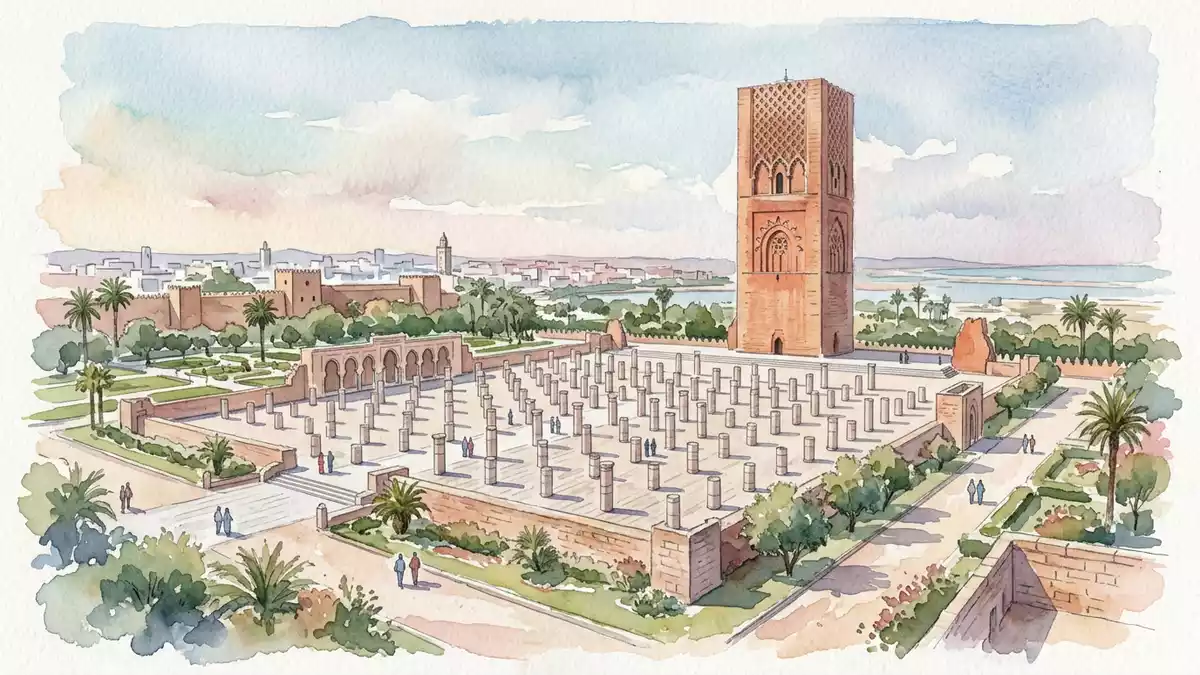
On a rise above the Bou Regreg estuary in Rabat, Tour Hassan stands as an unfinished Almohad minaret surrounded by the traces of a vast mosque that was never completed. Commissioned by the Almohad caliph Abu Yusuf Yaqub al-Mansur in the late twelfth century, the project left a monumental footprint even in its incomplete state, with the tower reaching 44 m (144 ft) and a wide prayer hall marked by hundreds of stubby columns.the minaret of an incomplete mosque
An Almohad ambition frozen in stone
Tour Hassan belongs to the final decades of the twelfth century, a period when the Almohad Empire projected its power across the western Islamic world and used monumental mosques to anchor its capitals.construction began in the 1190s Abu Yusuf Yaqub al-Mansur, who ruled from 1184 to 1199, ordered a mosque at Rabat that was planned on an exceptional scale, intended to rival the great congregational structures of Samarra and other major cities.an Almohad leader commissioning grand mosques
Building works on the complex started in the 1190s and came to a halt soon after Yaqub al-Mansur’s death in 1199, leaving only the minaret and the beginnings of the prayer hall in place.works stopped after the caliph died in 1199 The tower itself reached roughly half of its planned height; a number of sources describe an intended height of around 86 m (282 ft), while the built structure rises to 44 m (144 ft), giving it a truncated form that has become part of its character.44 m, about half of the intended height
The architecture of Tour Hassan and its mosque platform
The tower follows the Almohad minaret type, built in warm-coloured stone with a square plan and robust walls articulated by shallow surface reliefs and ornamental panels.a red stone minaret of Almohad date Inside the minaret, a gently rising ramp curls upwards, wide enough for a rider on horseback, which reflects a pattern also seen in other great Almohad towers such as the Koutoubia minaret in Marrakesh and the Giralda in Seville.an internal ramp for the muezzin
At the base, Tour Hassan stands on a broad terrace that accommodated the projected mosque, whose prayer hall and courtyard were laid out on a large rectangular plan. Only the lower parts of the mosque survive, in the form of fragments of sandstone walls and rows of short column stubs that map out the intended bays of the hall.the minaret of an incomplete mosque Many sources note around 200 to more than 300 column fragments across the platform, marking a forest of supports that never carried its full roof.columns from the unfinished hall
From earthquake damage to a ceremonial landscape
In the eighteenth century, an earthquake associated with the Lisbon event of 1755 caused considerable damage to structures across the western seaboard, and accounts describe the mosque at Tour Hassan among the buildings that lost much of their standing fabric.earthquake damage in 1755 The minaret remained upright on its platform, surrounded by broken columns and partial walls, which gave the site its distinctive ruin-like appearance framed by later landscaping.
In the twentieth century, the area around Tour Hassan was reshaped into a ceremonial ensemble when the Mausoleum of Mohammed V was built on the edge of the platform, creating a composition in which the Almohad tower and the modern mausoleum face one another across a paved expanse.a monumental ensemble with Mohammed V’s mausoleum The ensemble, including the tower and mausoleum, is recognised as part of the heritage zone of Rabat that was inscribed on the UNESCO World Heritage List in the 1990s.listed on the UNESCO World Heritage List
Visiting Tour Hassan: what travellers from Western Europe should know
- Tour Hassan rises on a hill in the Quartier Hassan district of Rabat, overlooking the Bou Regreg estuary between the city and Salé; the platform lies north of Rabat’s medina and can be reached by road or on foot from the centre.
- The site consists of a paved terrace with low mosque remains and the standing minaret, so walking involves exposed open ground with steps and level changes between the prayer hall area and the surrounding approaches.
- The Bou Regreg river flows nearby, and from the terrace around Tour Hassan there are wide views towards the estuary, the Kasbah of the Udayas and the city of Salé on the opposite bank.
- The official language is Arabic and the currency is the Moroccan dirham.
Searching for Tour Hassan on social platforms
These links open searches for Tour Hassan on each platform.Frequently asked questions about Tour Hassan
Where is Tour Hassan located within Rabat?
Tour Hassan stands in the Quartier Hassan district of Rabat on a hill overlooking the Bou Regreg estuary, north of the old medina and close to Mohammed V’s mausoleum.
What can visitors expect to see at Tour Hassan?
Visitors encounter the square stone minaret of the twelfth-century Almohad mosque, together with an expansive terrace marked by low sandstone column fragments and the neighbouring Mausoleum of Mohammed V.
What makes Tour Hassan distinctive among historic sites?
Tour Hassan is distinctive as an unfinished Almohad minaret that rose only to about half its planned height, standing above the remains of a vast mosque platform later integrated into a ceremonial ensemble with a royal mausoleum.


