
Tour Hassan and the unfinished Almohad mosque of Rabat
Published on 08/26/2026 at 07:24 | Editorial responsibility: Rafael Müller, Editor-in-Chief AD HOC NEWS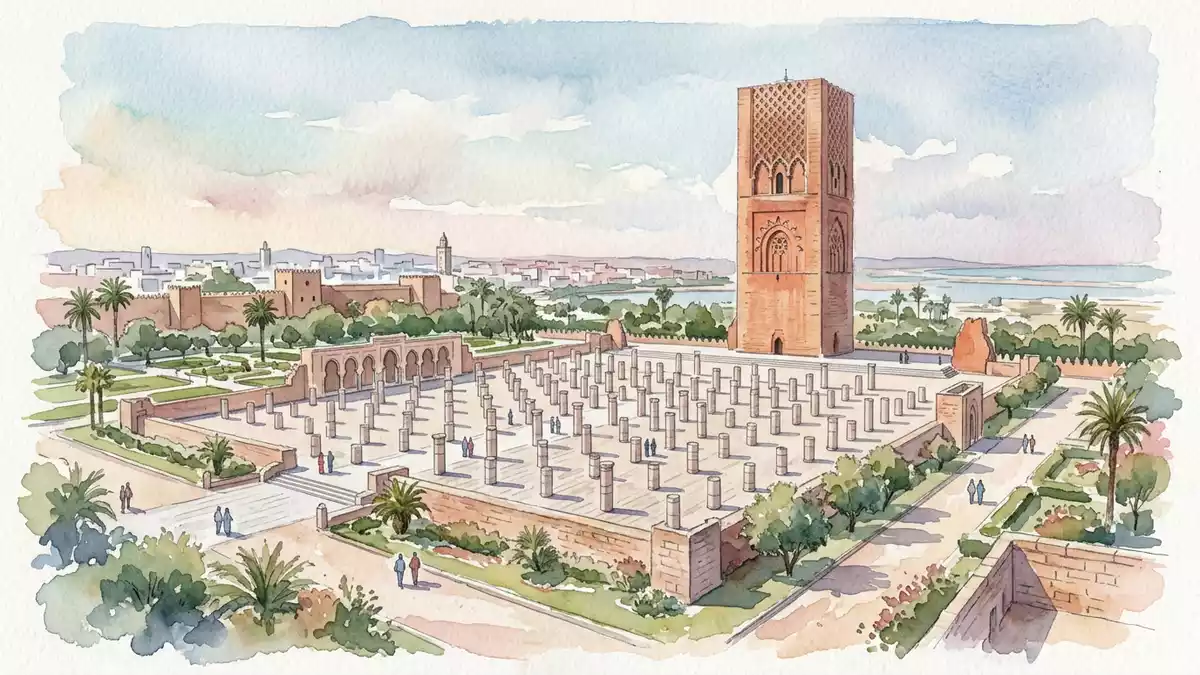
On a plateau above the Bouregreg estuary in Rabat, Tour Hassan stands as the red stone minaret of a mosque that was never completed, its truncated height overlooking a field of stone remains from an ambitious Almohad project of the twelfth century.
An Almohad tower above the Bouregreg
Tour Hassan is the surviving minaret of the Hassan mosque, an incomplete congregational mosque laid out during the Almohad period when Rabat formed part of an imperial network of cities in Morocco.the Hassan mosque The tower stands on a terrace that looks towards the mouth of the Bouregreg River, with the Atlantic coastline beyond the urban edge of Rabat and its neighbouring city Salé.
Construction of Tour Hassan began in 1195 under the Almohad caliph Abu Yusuf Yaqub al?Mansur, who ruled from 1184 to 1199 and commissioned a series of major religious buildings across his realm, including the minaret of the Koutoubia mosque in Marrakesh and the Giralda in Seville.construction of this architectural treasure began in 1195 The Hassan mosque was laid out as an exceptionally large prayer hall, designed in the same broad Almohad style that linked the major mosques of the western Islamic lands at that time.
Architecture in red sandstone and unfinished stone
Tour Hassan rises to around 44 m (144 ft), its upper section never completed to the full height that was originally planned for the minaret.Hauteur 44,3 m The tower is built largely in red sandstone, giving its facades a warm ochre tone that catches the light and distinguishes it from the paler stone used in many later monuments around Rabat.Main material used Unlike slender minarets that taper sharply, Tour Hassan has a broad, robust silhouette, with its faces articulated by shallow relief patterns and blind arches typical of Almohad ornament.
Inside the minaret, ramps were built in place of tight staircases, forming inclined passages that allowed the muezzin to reach the upper levels without climbing narrow steps.inside the tower, it has ramps Around the base of the tower, the remains of the Hassan mosque spread across the platform in the form of low walls and rows of stone columns, marking the outlines of aisles, courtyards and the intended prayer hall. The scale of these foundations gives a sense of the vast area the mosque would have covered had the project reached completion.
Mausoleum, memory and UNESCO protection
The plateau of Tour Hassan today forms a single monumental ensemble together with the Mausoleum of Mohammed V, constructed in the twentieth century to honour the monarch associated with Morocco’s independence and placed alongside the Almohad ruins as a modern royal tomb.Mausoleum of Mohammed V The open expanse around the minaret, with its regular grid of columns, forms a ceremonial forecourt for the mausoleum and connects the older Almohad stonework with the white marble and green?tiled domes of the later structure.
Tour Hassan and the adjacent area, including the mosque remains and the Mohammed V Mausoleum, are part of the wider heritage ensemble of Rabat that has been inscribed on the UNESCO World Heritage List as a modern capital and historic city, recognising both the Almohad foundations and the twentieth?century planning of the Moroccan capital.UNESCO World Heritage list in 2012 The site’s history includes damage from the Lisbon earthquake of 1755, which destroyed much of the Hassan mosque and left the minaret standing alone among broken walls and toppled columns.an earthquake in 1755
Visiting Tour Hassan: what travellers from Western Europe should know
- Tour Hassan stands in the Quartier Hassan district of Rabat on a terrace above the Bouregreg estuary, a short distance north?east of the medina and the city’s historic riverfront.
- The site consists of the minaret, extensive low remains of the Hassan mosque and the Mausoleum of Mohammed V, set on paved terraces with steps and open spaces between the structures.
- The surroundings are largely level, but reaching the platform involves walking across broad paved areas with some staircases and ramps linking different levels.
- The official language is Arabic and the currency is the Moroccan dirham.
Searching for Tour Hassan on social platforms
These links open searches for Tour Hassan on each platform.Frequently asked questions about Tour Hassan
Where is Tour Hassan in Rabat?
Tour Hassan stands in the Quartier Hassan district of Rabat on a terrace above the Bouregreg estuary, north?east of the historic medina and riverfront.
What should visitors expect on a visit to Tour Hassan?
Visitors encounter the red sandstone minaret, extensive stone remains of the Hassan mosque and the Mausoleum of Mohammed V arranged around paved terraces with open spaces and steps.
What makes Tour Hassan distinctive among Moroccan monuments?
Its unfinished Almohad minaret rising to about 44 m and the vast grid of mosque columns beside a modern royal mausoleum create a rare combination of twelfth?century foundations and twentieth?century commemoration.


