
Tour Eiffel: the iron lattice shaping Paris
Published on 09/23/2026 at 02:49 | Editorial responsibility: Rafael Müller, Editor-in-Chief AD HOC NEWS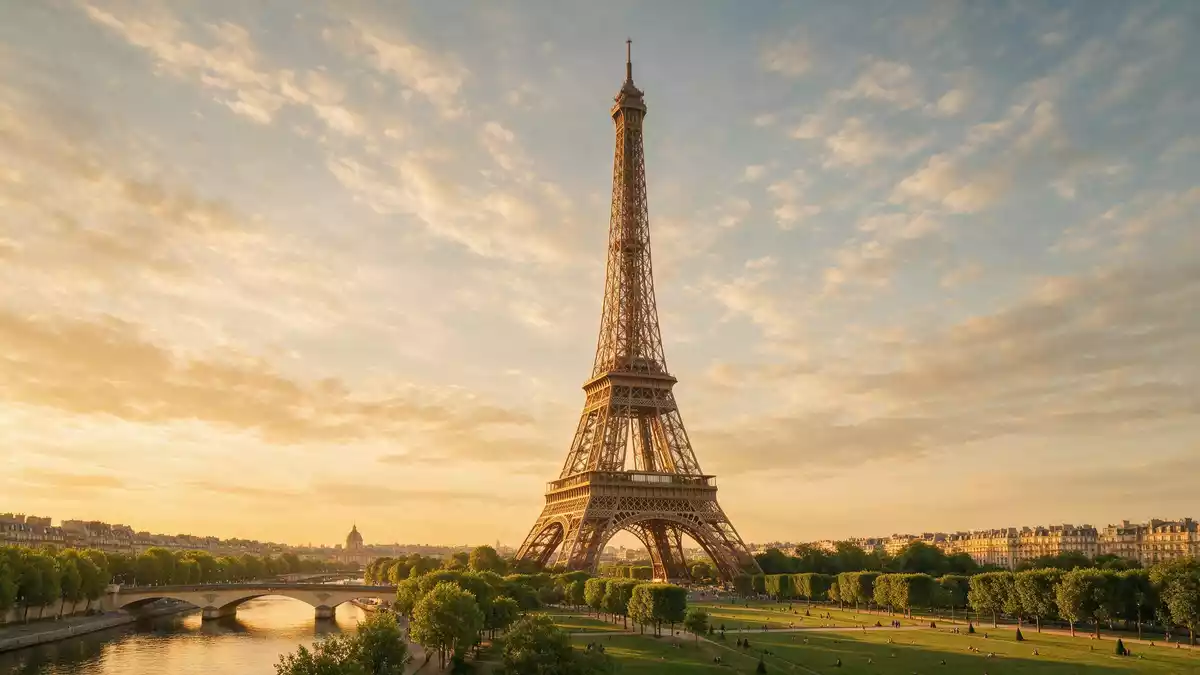
Tour Eiffel rises above the Champ de Mars as an immense open-lattice structure of wrought iron. Designed by Gustave Eiffel’s company and completed in 1889, it turns metal, height and empty space into a recognisable Parisian landmark.
Tour Eiffel and the engineering of open space
The tower is made almost entirely of open-lattice wrought iron. Its four broad supports meet above the Champ de Mars, while curved metal members narrow towards the summit.
The current height is 330 m (1,083 ft), including its aerials. The original structure reached about 300 m (984 ft), with later aerials changing the measured height. From ground level, the tower reads as a framework rather than a solid mass, with Paris visible through its ironwork.
Gustave Eiffel and the 1889 exposition
Construction began in January 1887 and the metal structure was completed on 31 March 1889. Construction was completed in 1889, after work on the foundations and the assembled metal sections.
Tour Eiffel formed the entrance gateway to the Exposition Universelle of 1889, held in Paris to mark the centenary of the French Revolution. Gustave Eiffel was a bridge engineer, and his knowledge of metal arches and trusses appears in the tower’s large curved supports.
From exhibition structure to Paris landmark
The tower’s relationship with the city extends beyond its original exhibition role. Its wrought-iron frame contains platforms, stairs, lifts, restaurants and technical installations, while the upper levels open broad views across Paris.
Britannica records the tower as a 330-metre structure designed and built between 1887 and 1889. Tour Eiffel also forms part of the UNESCO World Heritage setting of the Banks of the Seine in Paris, inscribed in 1991.
Visiting Tour Eiffel: what travellers from Western Europe should know
- Tour Eiffel stands on the Champ de Mars in Paris, beside the Seine. Paris Métro stations include Bir-Hakeim and Trocadéro, while RER line C serves Champ de Mars–Tour Eiffel.
- The tower rises through broad lower pillars and elevated platforms. A visit involves stairs, lifts or both, with exposed views from the upper levels.
- The official language is French and the currency is the euro.
Searching for Tour Eiffel on social platforms
These links open searches for Tour Eiffel on each platform.
Frequently asked questions about Tour Eiffel
Where is Tour Eiffel?
Tour Eiffel stands on the Champ de Mars in Paris, beside the Seine and near the Trocadéro district.
What does a visit involve?
A visit combines open-air platforms, internal stairways, lifts and views across Paris from a wrought-iron structure.
What makes Tour Eiffel distinctive?
Its identity comes from the combination of 330 m (1,083 ft) height, wrought iron and an open lattice that leaves the city visible through the frame.


