
Tour Eiffel in Paris, an iron lattice tower above the Seine
Published on 09/15/2026 at 11:34 | Editorial responsibility: Rafael Müller, Editor-in-Chief AD HOC NEWS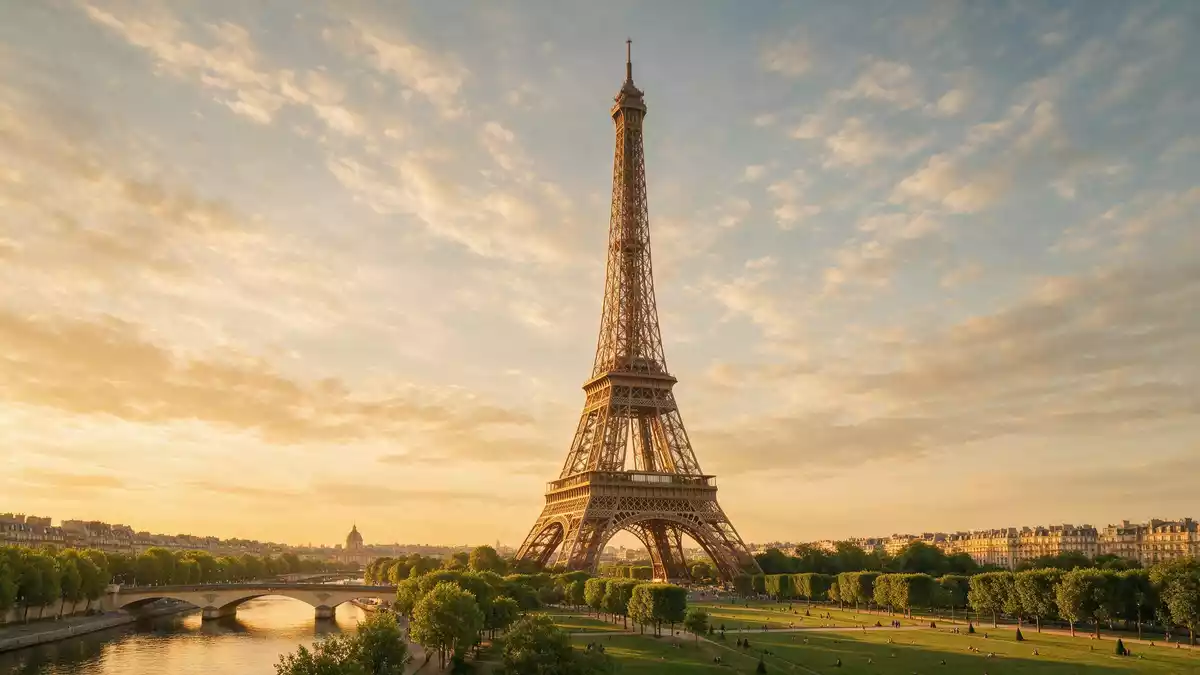
Tour Eiffel in Paris is an iron lattice tower rising above the Seine, completed in 1889 under the direction of engineer Gustave Eiffel for the Exposition Universelle.completed in 1889 Standing about 330 m (1,083 ft) tall including antennas, it has become a defining structure of the nineteenth century’s industrial engineering.330 m (1,083 ft)
An iron tower built for the 1889 Exposition Universelle
Tour Eiffel was designed and built between 1887 and 1889 by Gustave Eiffel and his collaborators Maurice Koechlin, Émile Nouguier and architect Stephen Sauvestre.Gustave Eiffel and his collaborators Construction began in January 1887 and the structure was completed on 31 March 1889 after just over two years of work, a remarkably short time for its scale.completed on 31 March 1889
Rising from the Champ de Mars on the Left Bank, the tower was originally known as the “300 m Tower”, referring to its structural height of about 300 m (984 ft) before later antenna additions increased its overall elevation.“300 m Tower” Built as the showpiece of the Exposition Universelle of 1889, which marked the centenary of the French Revolution, it showcased wrought iron construction on a scale not previously seen in Paris.Exposition Universelle of 1889
Structure, levels and lattice geometry
Tour Eiffel consists of four great iron supports anchored in masonry foundations, which curve inwards and join into a single vertical tower above the lower platforms.four great iron supports The ironwork is made from many thousands of prefabricated metal pieces, connected by millions of rivets to form the open lattice that gives the tower its characteristic transparency.prefabricated metal pieces
Three levels are open to visitors, with expansive platforms on the first and second levels and a smaller viewing stage near the top beneath the antenna mast.three levels are open The highest public level stands well above the roofs of Paris, giving long views along the Seine, across the historic core of the city and towards distant suburbs.
The tower’s evolving height and skyline presence
When Tour Eiffel was completed in 1889, its structural height was about 300 m (984 ft), and with a flag mast it reached just over 312 m (1,024 ft) above the Champ de Mars.312 m (1,024 ft) Later additions of radio and television antennas raised the overall height to around 324 m (1,063 ft), and further antenna work has brought the figure to about 330 m (1,083 ft).around 324 m (1,063 ft)
For decades after its opening, Tour Eiffel was the tallest structure in Paris and one of the tallest man-made structures in the world, marking a decisive moment in the history of large-scale iron construction.tallest man-made structures Its silhouette, with the wide arch where the legs meet the ground and the tapering upper stages, has become tightly associated with the city’s riverside skyline.
Visiting Tour Eiffel: what travellers from Western Europe should know
- Tour Eiffel stands at the Champ de Mars on the Left Bank of the Seine in the 7th arrondissement of Paris, close to avenue Anatole France.Champ de Mars location
- The ascent uses staircases and lifts inside the iron structure, and the higher levels are exposed to altitude and wind compared with the streets below.
- The official language is French and the currency is the euro.
Searching for Tour Eiffel on social platforms
These links open searches for Tour Eiffel on each platform.Frequently asked questions about Tour Eiffel
Where is Tour Eiffel located in Paris?
Tour Eiffel stands beside the Seine at the Champ de Mars in the 7th arrondissement, close to avenue Anatole France and central Paris landmarks.
What should visitors expect when ascending the tower?
Visitors move through staircases and lifts inside the iron framework to reach three levels, with higher platforms offering wide views and greater exposure to wind and altitude.
What makes Tour Eiffel distinctive among Paris landmarks?
Its height of about 330 m (1,083 ft), open iron lattice structure and nineteenth-century engineering origins for the 1889 Exposition Universelle give the tower a singular presence above the Seine.


