
Tour Eiffel and the geometry of Paris in iron
Published on 09/22/2026 at 14:52 | Editorial responsibility: Rafael Müller, Editor-in-Chief AD HOC NEWS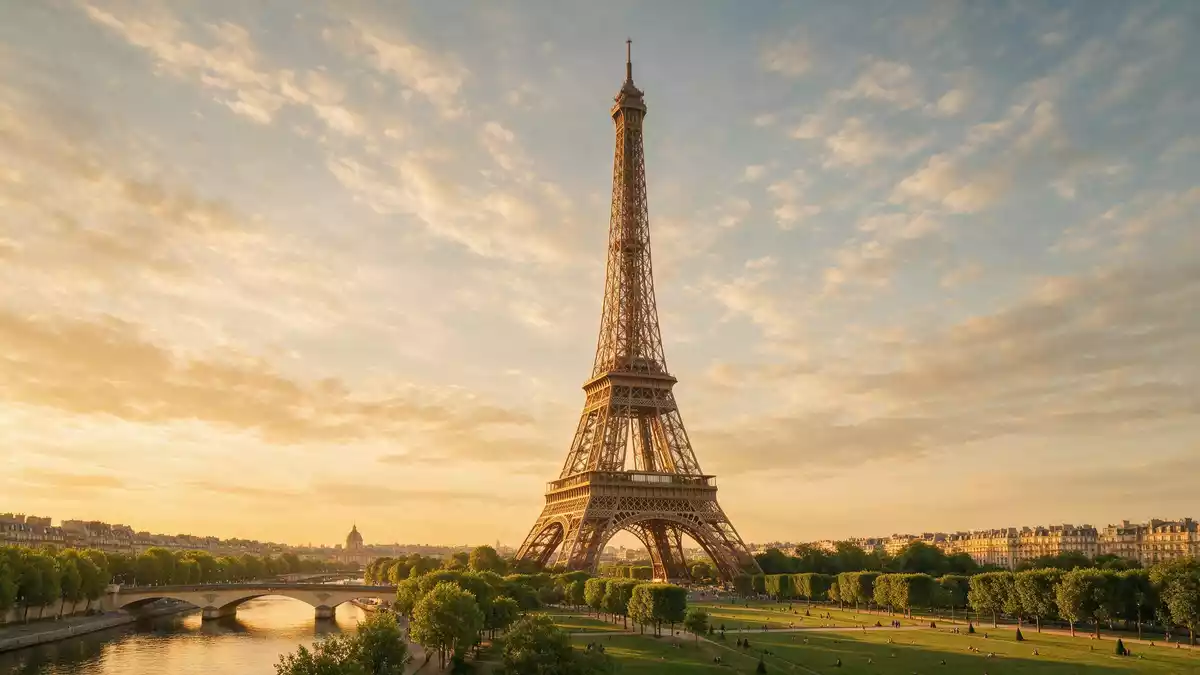
Tour Eiffel rises above Paris as an open lattice of iron, its four broad supports narrowing towards a high summit. Gustave Eiffel’s tower was completed in 1889 for the Exposition Universelle, and its visible framework remains the defining feature of the Champ de Mars.
Four iron supports, one rising frame
The tower is made almost entirely of wrought iron. Its structure begins with separate supports at ground level, then gathers into a single vertical form above the upper platforms. Curved members, diagonal braces and riveted connections remain exposed across the exterior.
Tour Eiffel reaches 330 metres (1,083 ft), including its antennas. Its original height was 300 metres (984 ft), a figure that gave the completed monument its early identity. The official tower dimensions and figures record the changing height and the breadth of its base.
Gustave Eiffel and the 1889 exposition
The tower belongs to the industrial culture of late nineteenth-century France. Gustave Eiffel, Maurice Koechlin, Émile Nouguier and Stephen Sauvestre were associated with its design, combining engineering, architectural drawing and metal construction.
Work began in 1887 and the tower was completed on 31 March 1889. It served as the entrance gateway to the International Exposition of 1889, held in Paris for the centenary of the French Revolution. The monument’s construction history and design connect its name with the engineers and architect involved in the project.
From exhibition structure to Paris landmark
Tour Eiffel changed function after its exhibition role. The tower became a public monument with viewing platforms, restaurants, technical installations and spaces associated with Parisian culture.
Its iron frame can be read from several parts of the city, while the Champ de Mars provides a long urban setting for the structure. From below, the supports create large open passages. Higher up, the platforms divide the ascent and frame views across Paris.
The tower has also served scientific and communications purposes. Radio transmission, observation and broadcasting form part of its history, alongside its public role. Its silhouette appears on maps, signs, artworks and city images, while the building itself remains a working part of Paris.
Visiting Tour Eiffel: what travellers from Western Europe should know
- Tour Eiffel stands on the Champ de Mars in Paris, beside the Seine and opposite the Trocadéro district. Metro, RER, bus and river transport connect the surrounding area.
- The structure has lifts and stair routes between its public levels. The lower supports, metal flooring and exposed framework form part of the visit.
- The official language is French and the currency is the euro.
Searching for Tour Eiffel on social platforms
These links open searches for Tour Eiffel on each platform.
Frequently asked questions about Tour Eiffel
Where is Tour Eiffel?
Tour Eiffel stands on the Champ de Mars in the seventh arrondissement of Paris, beside the Seine.
What can visitors expect inside the tower?
Visitors encounter lifts, stair routes, viewing platforms, restaurants and exposed iron framework across the tower’s levels.
What makes Tour Eiffel distinctive?
Its identity comes from the open wrought-iron lattice, the four tapering supports and the 330-metre height associated with Paris.


