
Tottori Sakyu, Japan’s sea-edge desert of shifting sand
Published on 09/07/2026 at 16:17 | Editorial responsibility: Rafael Müller, Editor-in-Chief AD HOC NEWS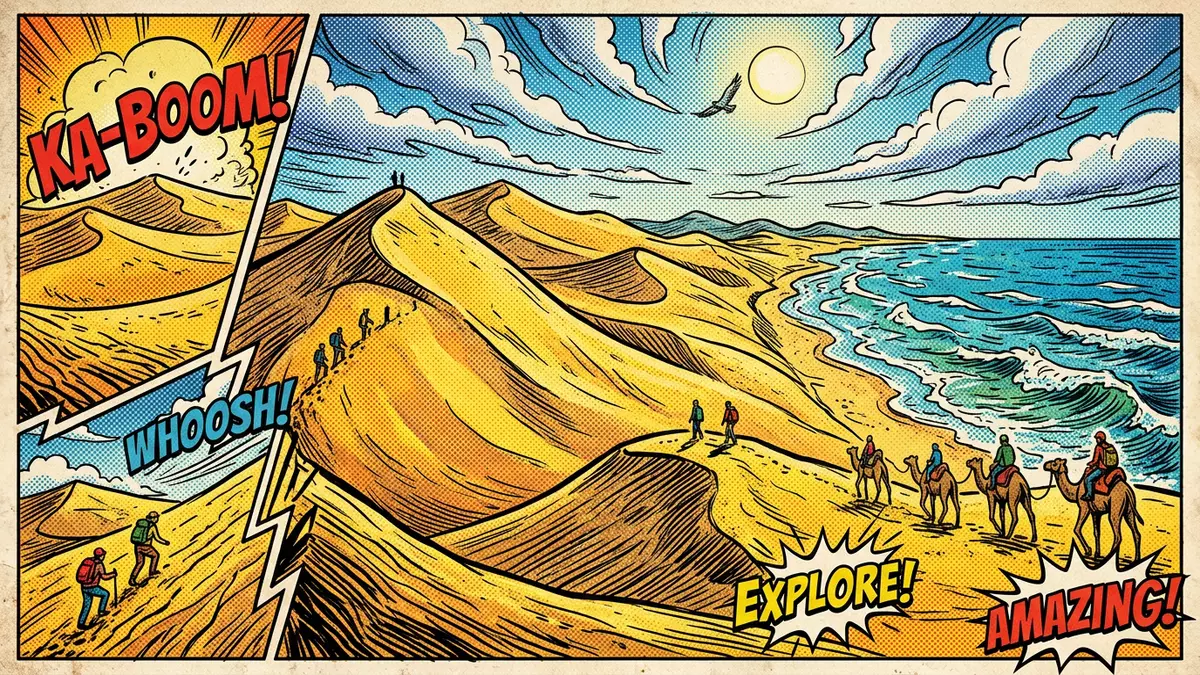
Tottori Sakyu, known in English as the Tottori Sand Dunes, is a broad band of coastal sand on the Sea of Japan just outside Tottori City in western Honshu. Formed over tens of thousands of years by the interaction of river-borne sand, waves and prevailing winds, it has become Japan’s best-known expanse of desert-like dunes on the seashore.
A desert-like dune field beside the Sea of Japan
The defining impression at Tottori Sakyu is the sudden transition from settled city to wide-open sandy relief along the Sea of Japan coast. The dunes occupy a strip of shoreline in Tottori Prefecture, where the Sendai River reaches the sea and sand has accumulated into slopes, crests and hollows on a striking scale.The Tottori Sand Dunes extend for roughly 16 km east to west and up to around 2.4 km north to south, forming Japan’s largest coastal dune field open to visitors.stretching 2.4km north to south and 16km east to west
The relief within this band of sand varies from gentle undulations near the shore to steeper dune faces that rise to heights of several tens of metres above sea level.They span roughly 16 kilometers of coast On clear days the contrast between the pale sand and the dark blue of the Sea of Japan is particularly evident, and the openness of the dune plateau leaves long uninterrupted sightlines along the coast.
Shaped over geological time by river, waves and wind
Beneath the surface of Tottori Sakyu lies a story of long-term geological processes. Sand and gravel from the Chugoku Mountains to the south have been carried down the Sendai River to the Sea of Japan, where waves and coastal currents have reworked the material and pushed finer granules back towards the shore.granite and other rocks from the Chugoku Mountains Over more than 100,000 years this cycle has built up a coastal terrace of sand, which prevailing northwesterly winds have then driven inland to form the dunes seen today.The Tottori sand dunes were shaped over tens of thousands of years
The surface of Tottori Sakyu is marked by undulations and depressions created as wind lifts and deposits sand across the field. Some hollowed areas, known locally as “suribachi”, reach considerable depths and give the dunes a varied profile when viewed from different points along the ridge line.large undulations and vast depressions known as suribachi The dune system forms part of the San’in Kaigan Geopark, a coastal zone recognised for its geological heritage and included in the UNESCO Global Geoparks network.part of the San'in Kaigan Geopark
History, film and scientific interest
Archaeological finds indicate that human communities have made use of the dune environment for many centuries. Pottery and stone vessels associated with the prehistoric Yayoi period, broadly dated to between 300 BCE and 300 CE, and the Kofun period suggest that the dunes may once have served as hunting grounds and coastal vantage points.pottery and stone vessels from the prehistoric Yayoi In the late nineteenth and early twentieth centuries, during the First Sino-Japanese War of 1894–1895 and the Russo-Japanese War of 1904–1905, the open terrain was used for military training, a role that continued at intervals until the end of the Second World War in 1945.used for military training
Beyond its historical uses, Tottori Sakyu has drawn scientific and cultural attention. The area’s flora and fauna have adapted to the sandy, coastal conditions, and the combination of large-scale dune forms and specialist plant communities underpins its designation as a national natural monument.designated a national natural monument In cinema, the dunes gained international visibility when used as a location for Teshigahara Hiroshi’s 1964 film “Woman in the Dunes”, which relied on the stark sandy landscape as a central visual element.Used as the location for Teshigahara Hiroshi's classic 1964 film
Visiting Tottori Sakyu: what travellers from Western Europe should know
- Tottori Sakyu lies on the Sea of Japan coast north-east of central Tottori City in Tottori Prefecture, with access from JR Tottori Station by local buses that run towards the dune area.
- The terrain consists of loose sand slopes and ridges, with some steeper faces rising to several tens of metres; moving across the dunes involves walking on soft, shifting surfaces rather than paved paths.
- The dunes form part of the San’in Kaigan Geopark on the Sea of Japan, and the surrounding coastline includes other coastal features such as rocky outcrops and small bays visible from higher points on the sand.
- Japanese is the official language and the currency is the yen.
- Entry requirements depend on your nationality; UK travellers can check the FCDO travel advice at gov.uk/foreign-travel-advice, Irish travellers the Department of Foreign Affairs at ireland.ie.
Searching for Tottori Sakyu on social platforms
These links open searches for Tottori Sakyu on each platform.
Frequently asked questions about Tottori Sakyu
Where is Tottori Sakyu located?
Tottori Sakyu is on the Sea of Japan coast just outside Tottori City in Tottori Prefecture, on the northern side of western Honshu.
What should visitors expect when exploring the dunes?
Visitors encounter extensive sandy slopes, undulating ridges and depressions shaped by wind, with wide coastal views and a landscape that differs markedly from the surrounding urban area.
What makes Tottori Sakyu distinctive among Japanese landscapes?
The combination of a large coastal dune field, its geological formation over tens of thousands of years and its role within the San’in Kaigan Geopark gives Tottori Sakyu a distinctive place in Japan’s natural heritage.


