
Torri di San Gimignano and the medieval skyline of Tuscany
Published on 08/26/2026 at 07:47 | Editorial responsibility: Rafael Müller, Editor-in-Chief AD HOC NEWS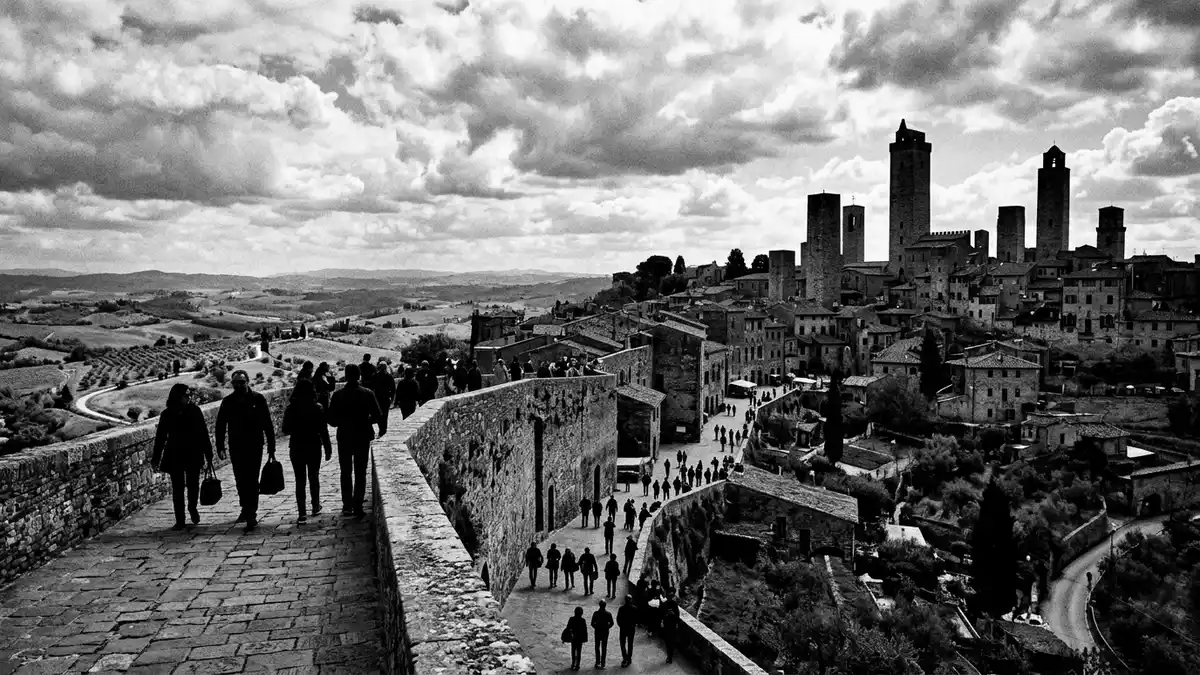
Torri di San Gimignano are the medieval tower houses that give the Tuscan hill town of San Gimignano its distinctive skyline, a cluster of stone shafts rising above encircling walls on a ridge in central Italy. In the historic centre, recognised as a UNESCO World Heritage Site since 1990, a group of surviving towers from the thirteenth and fourteenth centuries still punctuate the townscape, making the vertical dimension as important as the winding streets below.
The town of beautiful towers
San Gimignano stands in northern Tuscany, south of Florence, and grew as a fortified hill town along the Via Francigena, the long-distance route used by travellers and pilgrims moving between northern Europe and Rome. The historic centre occupies the crest of a hill, enclosed by medieval walls, with the towers rising from stone and brick houses and palaces to form what Italian descriptions call “San Gimignano delle belle torri”, the city of beautiful towers.Historic Centre of San Gimignano
The settlement is documented as a commune by the late twelfth century, with independence recorded in 1199, and its period of greatest economic strength came in the thirteenth century when trade in agricultural produce and the steady movement of people along the Via Francigena brought wealth to local families.economic might in the thirteenth century Prosperity can still be read in the density of substantial stone buildings in the old town and, above all, in the number of towers that crowd its skyline.
Medieval tower houses and their heights
The towers of San Gimignano were built as fortified residences by patrician and aristocratic families, emerging in the eleventh and twelfth centuries and multiplying into the thirteenth and fourteenth centuries as wealth increased. Medieval sources and later surveys indicate that around seventy or more tower houses stood in the town at their peak, a figure often given as seventy-two, each rising high above the street frontage and attached dwellings.around 72 tower-houses In other Tuscan towns much of this vertical architecture was removed or reduced, but in San Gimignano a notable group survived, preserving an outline that still resembles the layered profiles described in medieval accounts.
Fourteen towers remain in the historic centre, distributed among the main streets and squares and rising above later roofs; some are plain stone shafts while others incorporate projecting elements and variations in height.fourteen surviving towers Among them, Torre Grossa, completed in 1311 beside the Palazzo Comunale on Piazza Duomo, reaches about 54 m (177 ft), making it the tallest of the group and a clear anchor for the vertical composition of the town.Torre Grossa built in 1311 Other named towers, including Torre Rognosa and the pair known as Torri dei Salvucci, contribute different heights and proportions, giving the skyline an irregular, almost serrated profile when seen from the surrounding countryside.
Streets, squares and the skyline experience
Inside the walls, San Gimignano is organised around a web of narrow streets that climb and fall with the contours of the hill, meeting at lively squares such as Piazza Duomo and Piazza della Cisterna. In these spaces, towers stand close to communal buildings and stone houses, sometimes grouped in pairs or small clusters, so that the vertical forms are experienced at very short range, with masonry surfaces and narrow apertures rising from arcades and doorways at ground level.centro storico di San Gimignano
From outside the town, the towers read as a compact group above the ridge line, framed by cultivated fields and vineyards that extend across the surrounding hills of Tuscany.well-preserved medieval Tuscan townscape The combination of medieval urban fabric, agricultural landscape and stone verticals is part of what led to the inscription of the historic centre on the World Heritage List in December 1990, under criteria that recognise architectural quality and the town’s role as an exceptional testimony of medieval civic life.inscribed on the World Heritage List in 1990
Visiting Torri di San Gimignano: what travellers from Western Europe should know
- Torri di San Gimignano stand within the walled historic centre of San Gimignano in Tuscany, reached by road from nearby cities such as Florence and Siena and by regional buses from surrounding towns.
- The town occupies a hilltop, and visiting the towers involves walking on stone paving with gradients and stairways between the lower gates and the higher squares.
- San Gimignano lies in Italy, where the official language is Italian and the currency is the euro.
- Entry requirements depend on your nationality; UK travellers can check the FCDO travel advice at gov.uk/foreign-travel-advice, Irish travellers the Department of Foreign Affairs at ireland.ie.
Searching for Torri di San Gimignano on social platforms
These links open searches for Torri di San Gimignano on each platform.
Frequently asked questions about Torri di San Gimignano
Where are Torri di San Gimignano?
Torri di San Gimignano are the medieval towers in the historic centre of San Gimignano, a hill town in Tuscany in central Italy, south of Florence.
What should visitors expect when exploring the towers?
Visitors encounter narrow medieval streets, stone houses and palaces, and groups of tall towers rising above squares such as Piazza Duomo and Piazza della Cisterna.
What makes Torri di San Gimignano distinctive among Italian towns?
The concentration of surviving medieval towers, including Torre Grossa from 1311, gives San Gimignano a rare vertical skyline that has led to UNESCO World Heritage recognition.


