
Torre di Pisa, the marble bell tower that leans over Pisa
Published on 08/21/2026 at 19:43 | Editorial responsibility: Rafael Müller, Editor-in-Chief AD HOC NEWS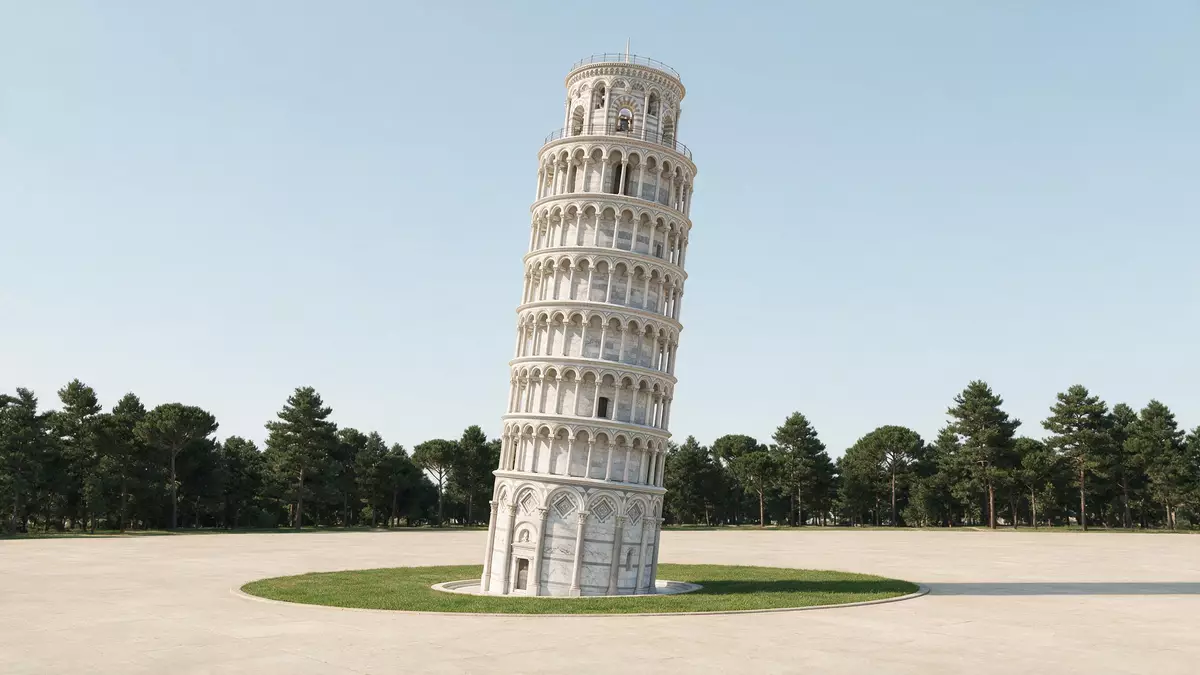
Torre di Pisa, known in English as the Leaning Tower of Pisa, is a freestanding bell tower of white marble rising above Piazza dei Miracoli in Pisa, Italy. Built as part of the city’s medieval cathedral complex from 1173 into the fourteenth century, it is renowned for its pronounced tilt and for the layered arcades that wrap around its shaft.
A medieval campanile that tilted into history
Construction of Torre di Pisa began on 9 August 1173 beside Pisa’s cathedral, as the campanile of the Romanesque complex that also includes the Baptistery and Camposanto.Construction of Torre di Pisa began on 9 August 1173 The tower was built over nearly two centuries, with long pauses that stretched its completion into the 1300s.its realisation over about 200 years The identity of the original architect is uncertain, though medieval and modern sources frequently attribute the first phase to Bonanno Pisano, with later work overseen by Giovanni di Simone and Tommaso di Andrea Pisano.architects Bonanno Pisano, Giovanni di Simone and Tommaso di Andrea Pisano
The tower’s lean emerged early in its history when several storeys had already been erected on shallow foundations resting on soft ground. Over time the structure acquired the characteristic inclination that defines its silhouette against the lawns of Piazza dei Miracoli.the lean appeared during construction Today Torre di Pisa stands around 56 m (about 183 ft) high on its lowest side, with a slightly greater height measured on the higher side due to the tilt,height around 55.86 m making it one of the most recognisable bell towers in Europe.
Marble arcades and a spiral interior
Torre di Pisa is built of pale stone and marble, rising in stacked arcades that repeat the same rhythm around each level. The lower part has a robust base with blind arches and engaged columns, above which run several storeys of open loggias carried by clusters of columns. This succession of arcaded rings gives the tower a strong vertical pattern that contrasts with the diagonal line of the lean.loggias supported by marble columns
Inside the shaft a spiral staircase winds upward between the outer wall and an inner core. The ascent passes simple stone landings and narrow passages that follow the curve of the tower, eventually reaching the belfry where bells hang above the square. From the upper levels there are clear views across Piazza dei Miracoli, taking in the cathedral’s nave roof, the round Baptistery and the long enclosure of the Camposanto set around the green expanse.
Piazza dei Miracoli and a UNESCO-listed ensemble
Torre di Pisa stands in Piazza dei Miracoli, the walled square that gathers Pisa Cathedral, the Baptistery, the Camposanto and the tower itself into a single ensemble. The cathedral, dedicated to Santa Maria Assunta, is a large Romanesque basilica clad in bands of marble; the Baptistery is a circular structure begun by Diotisalvi; and the Camposanto is a cloistered cemetery lined with arcades. The four monuments share materials and decorative language, tying the leaning campanile visually to the church it serves.part of the city’s cathedral complex
The square, including Torre di Pisa, forms part of the UNESCO World Heritage site “Piazza del Duomo, Pisa”, recognised for its medieval religious architecture and for the way the tower’s inclination illustrates the relationship between construction and terrain.UNESCO World Heritage listing for Pisa’s Piazza del Duomo Set slightly apart from the surrounding streets, the lawns and stone paths of Piazza dei Miracoli frame the tower at various angles, so that its lean can be seen both against open sky and against the façades of neighbouring buildings.
Visiting Torre di Pisa: what travellers from Western Europe should know
- Torre di Pisa stands in Piazza dei Miracoli on the northern edge of central Pisa, a short walk north from the Arno river and within reach of Pisa Centrale railway station.
- The tower’s interior is reached by a spiral stone staircase with many steps and confined turns, and the levels near the top are exposed to the elements.
- The lawns and paved paths of Piazza dei Miracoli are level, but the entrances to the monuments involve thresholds and changes in floor surface that require care.
- The official language is Italian and the currency is the euro.
Searching for Torre di Pisa on social platforms
These links open searches for Torre di Pisa on each platform.
Frequently asked questions about Torre di Pisa
Where is Torre di Pisa and what surrounds it?
Torre di Pisa stands in Piazza dei Miracoli in Pisa, in western Italy, alongside the city’s cathedral, Baptistery and Camposanto.
What should visitors expect when entering Torre di Pisa?
Visitors who enter the tower climb a narrow spiral staircase of stone steps inside the shaft, emerging on upper levels with open views across the square.
What makes Torre di Pisa distinctive among European bell towers?
The tower’s visible lean, its layered marble arcades and its position within the concentrated ensemble of Pisa’s cathedral square together give it a distinctive character.


