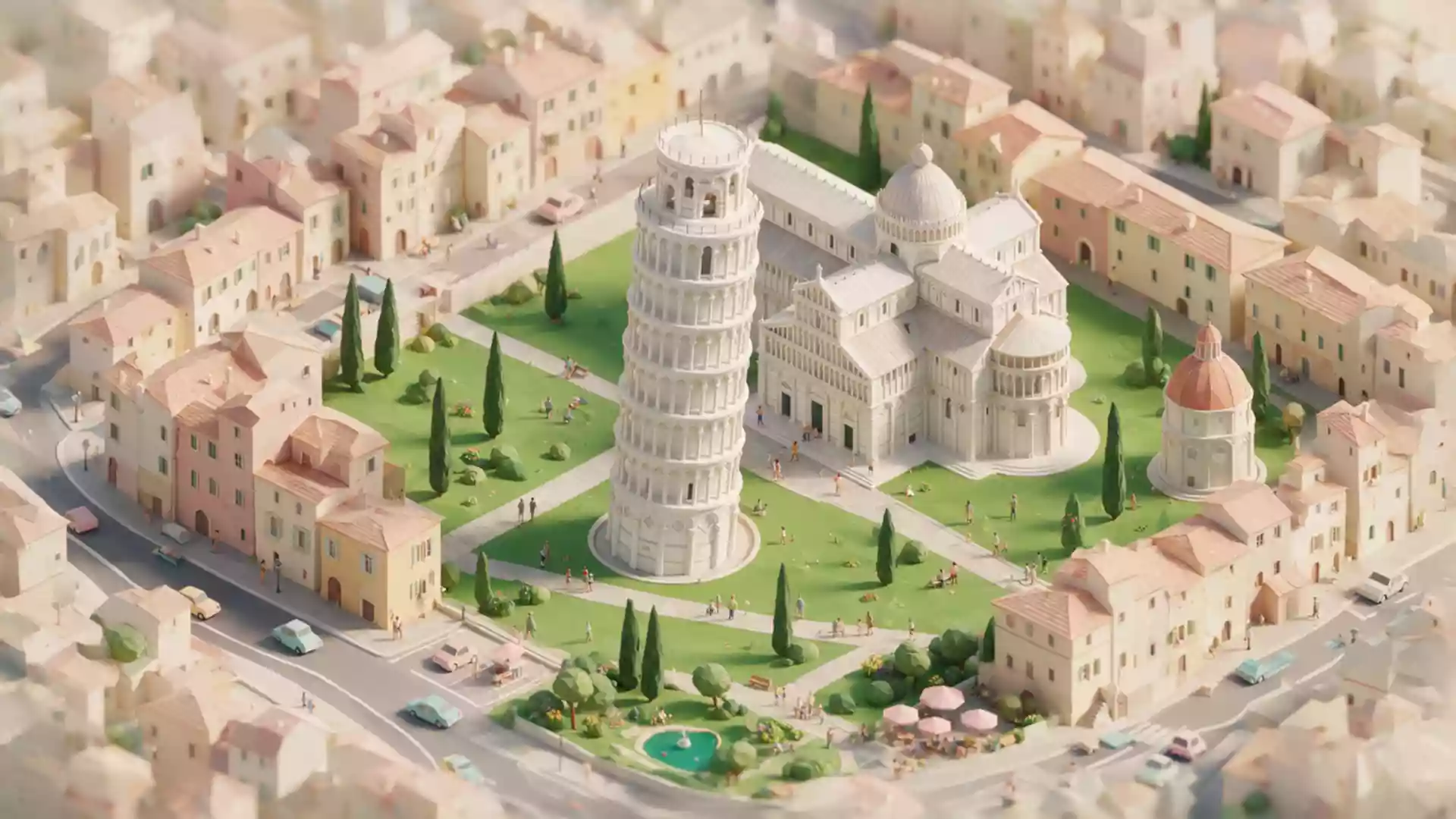
Torre di Pisa and the marble campanile that leans into history
Published on 08/24/2026 at 14:47 | Editorial responsibility: Rafael Müller, Editor-in-Chief AD HOC NEWS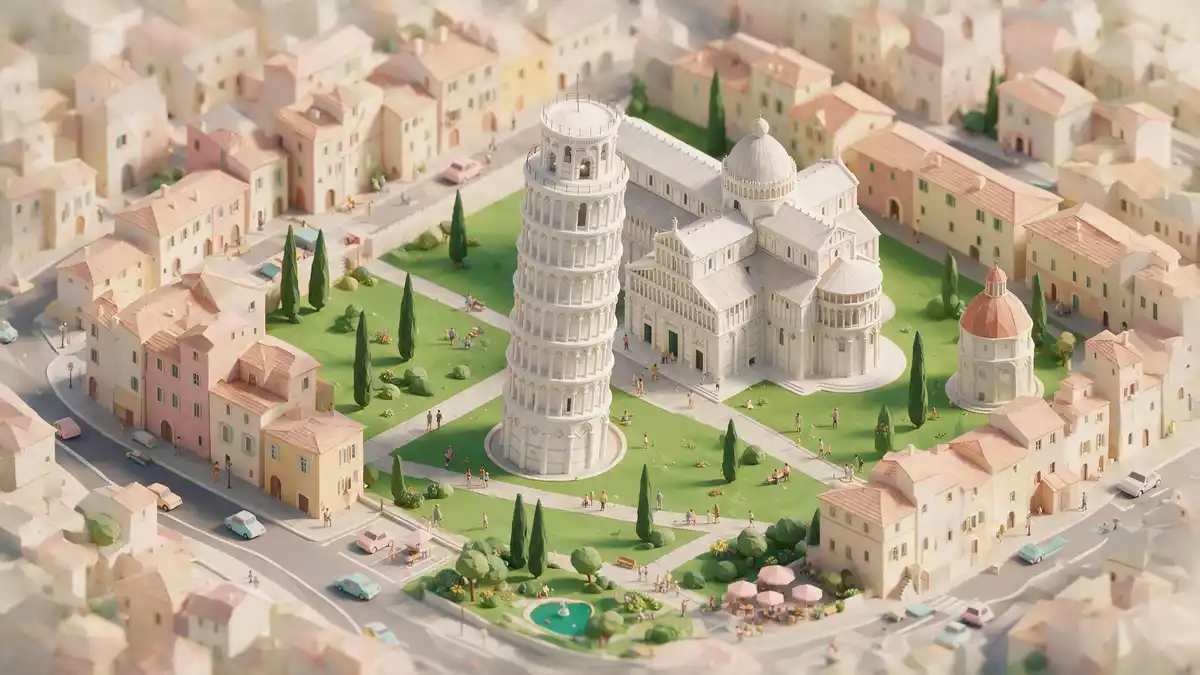
Torre di Pisa, better known in English as the Leaning Tower of Pisa, is the freestanding bell tower of the cathedral in Pisa’s Piazza dei Miracoli, a medieval marble campanile famous for its pronounced tilt.
A marble tower beside the cathedral
The Torre di Pisa stands in the Piazza del Duomo, also called Piazza dei Miracoli, on the northern edge of the historic centre of Pisa in Tuscany.Piazza dei Miracoli Around it, the cathedral of Santa Maria Assunta and the baptistery form a compact ensemble of white masonry on a broad lawn. The tower’s role is practical as well as symbolic: it is the campanile of the cathedral complex and was built to house its bells rather than to serve any defensive function.part of the religious complex
The structure is clad in pale marble arranged in arcades and decorative bands, echoing the Romanesque style of the cathedral next to it.Romanesque campanile From the cathedral square the tower rises in stacked storeys ringed by columns and arches, giving it a rhythmic, almost lace-like outer surface. Its lean is clearly visible against the horizontal lines of the lawn and surrounding buildings, turning a straightforward bell tower into an object that appears to defy verticality while still remaining stable.
Construction over two centuries and a stubborn tilt
Construction of the Torre di Pisa began in 1173, in the high medieval period when Pisa was a maritime republic and investing heavily in monumental architecture.construction began in 1173 Work proceeded in phases and was interrupted several times, so the tower reached completion only in the fourteenth century, after nearly two hundred years of intermittent building.completed in the fourteenth century Several architects contributed to its form over this long span, adjusting details while retaining the basic circular plan and ringed arcades. The identity of the original architect is not definitively documented, though medieval sources and later research mention names such as Bonanno Pisano and Gherardo din Gherardo in connection with the first phase of work.Bonanno Pisano mentioned
The tower’s tilt began early in this process. After only a few storeys had been built, the ground beneath one side of the foundation started to settle, and the structure began to lean away from the perpendicular.ground began to give way The subsoil under the Piazza del Duomo consists of clay, fine sand and shells, and the foundation is relatively shallow, so the immense weight of the marble tower pressed unevenly into the earth. Builders continued in stages and made small geometric adjustments to the upper levels, but the lean remained as a defining characteristic and gradually increased over the centuries until modern stabilisation projects reduced it while preserving the tower’s recognisable slant.stabilisation reduced the tilt
Height, materials and the setting of Piazza dei Miracoli
Torre di Pisa reaches a height of close to 60 m (around 197 ft) from its foundations to the level of the bell chamber, a figure that varies slightly depending on whether one measures on the lower or higher side of the lean.height from foundations The tower’s plan is circular, with an inner core containing stairways and an outer ring of arcades stacked one above another. Each level carries columns and arches carved from marble, and the surface alternates between white and slightly darker stone, creating stripes and patterns that catch the light. The bell chamber crowns the top, with openings for the bells to sound out over Piazza dei Miracoli and the city beyond.bell tower of the cathedral
The tower stands on a green expanse framed by the cathedral, the baptistery and the Camposanto monumentale, all part of the UNESCO World Heritage Site that covers Pisa’s cathedral square.UNESCO inscription From the lawns around the campanile the lean is visible from many angles, and the relationship between the slanting tower and the straight lines of the cathedral façade is especially clear. The marble surfaces contrast with the grass and the Tuscan sky, and the ensemble presents a compact summary of medieval Pisan architecture: a basilica-plan cathedral, a central-plan baptistery and a tall campanile aligned along the same axis.
Visiting Torre di Pisa: what travellers from Western Europe should know
- Torre di Pisa stands in Piazza del Duomo on the northern side of Pisa’s historic centre, within walking distance of the city’s railway station and the River Arno.
- The tower rises on a lawn beside the cathedral, and approaching it involves crossing open grass and paved paths, then climbing internal steps if ascending the campanile.
- Pisa lies in Tuscany in central Italy; the official language is Italian and the currency is the euro.
- Entry requirements depend on your nationality; UK travellers can check the FCDO travel advice at gov.uk/foreign-travel-advice, Irish travellers the Department of Foreign Affairs at ireland.ie.
Searching for Torre di Pisa on social platforms
These links open searches for Torre di Pisa on each platform.
Frequently asked questions about Torre di Pisa
Where is Torre di Pisa located?
Torre di Pisa stands in Piazza del Duomo, also known as Piazza dei Miracoli, in the city of Pisa in the Tuscan region of Italy.
What can visitors expect when they see the tower?
Visitors encounter a tall marble campanile with a clearly visible lean beside the cathedral, set on a broad lawn within a compact ensemble of medieval religious buildings.
What makes Torre di Pisa distinctive among bell towers?
The tower combines Romanesque marble arcades, a circular multi-storey form and a pronounced tilt caused by settling ground, all within a UNESCO-listed cathedral square setting.