
Torre di Pisa and the long line of white marble
Published on 08/31/2026 at 08:10 | Editorial responsibility: Rafael Müller, Editor-in-Chief AD HOC NEWS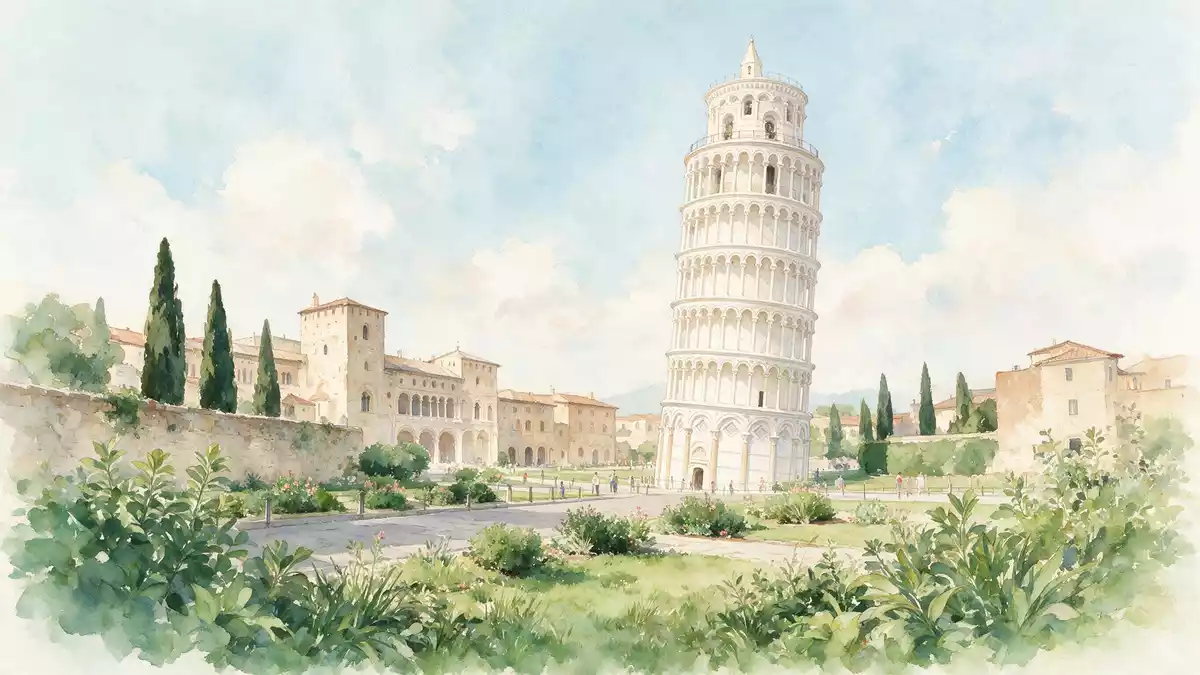
Torre di Pisa is the freestanding bell tower of Pisa Cathedral, set in Pisa’s Piazza dei Miracoli in Tuscany. Its white marble shaft leans against the sky, and that tilt is the feature most people notice first.
A bell tower made for the cathedral complex
The tower belongs to the cathedral ensemble and stands apart from the church itself as a separate campanile. Construction began in 1173 and finished in 1372, giving the building a long medieval span that is part of its identity.
Its form is Romanesque, with stacked arcades, marble cladding and a cylindrical body that rises above the square. The tower is linked to Pisa Cathedral as a vertical companion rather than as an attached wing.
The lean that defines the profile
The tower’s inclination is the trait that makes its silhouette instantly recognisable, and the figure changed through stabilisation work that reduced the tilt from its earlier state. The visible slant is part of the outer form, not a separate addition.
The tower reaches 55.86 m (183 ft 3 in) on its lower side and 56.67 m (185 ft 11 in) on its higher side. That difference in height is a direct measure of the lean, and it gives the tower an asymmetrical outline even from a distance.
Marble, arcades and the Pisan Romanesque
The exterior is faced in white marble, with arcaded galleries wrapping the body in repeated rings. The architectural language belongs to Pisan Romanesque, the local medieval style seen in the cathedral complex around it.
The tower’s long construction produced a layered monument rather than a single-phase design. Later work brought the upper stages to completion in 1372, and the finished building remains tied to the civic and religious centre of medieval Pisa.
Visiting Torre di Pisa: what travellers from Western Europe should know
- The tower stands in Piazza dei Miracoli in Pisa, close to the cathedral and baptistery. The city’s main rail station is Pisa Centrale, and the square is reached from the historic centre on foot or by local transport.
- The tower rises as a narrow vertical structure with internal stairs. The staircase is steep, and the interior is arranged around the hollow core of the building.
- The setting is a cathedral square framed by marble monuments. Torre di Pisa is part of a religious complex rather than a stand-alone tower in open ground.
- The official language is Italian and the currency is the euro.
Searching for Torre di Pisa on social platforms
These links open searches for Torre di Pisa on each platform.
Frequently asked questions about Torre di Pisa
Where is Torre di Pisa?
It stands in Pisa, in the Piazza dei Miracoli, beside Pisa Cathedral and the baptistery. The setting is a marble cathedral complex in Tuscany.
What does a visit involve?
The tower is read first as architecture: marble arcades, a cylindrical body and a marked lean. Inside, the stair ascent follows the tower’s narrow vertical structure.
What makes Torre di Pisa distinctive?
Its defining feature is the visible tilt, combined with its medieval Romanesque design. The tower is also one of the best-known elements of Pisa’s cathedral ensemble.


