
Torre di Pisa and the geometry of a leaning bell tower
Published on 09/02/2026 at 08:30 | Editorial responsibility: Rafael Müller, Editor-in-Chief AD HOC NEWS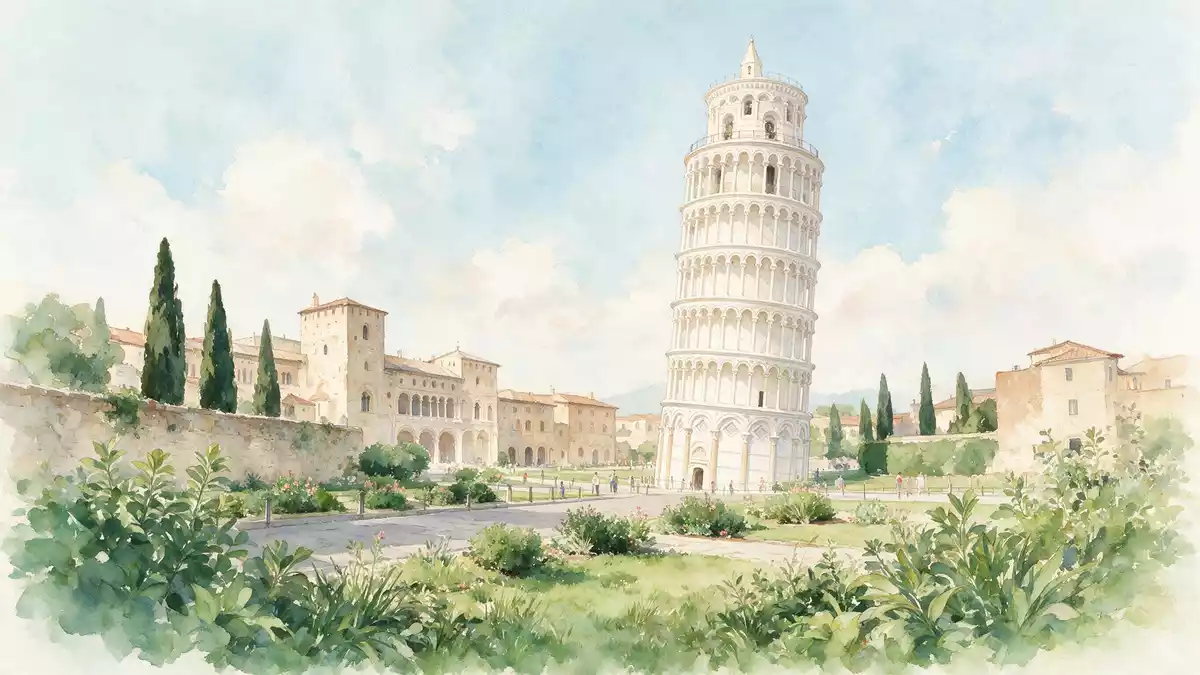
Torre di Pisa, known in English as the Leaning Tower of Pisa, is a free?standing campanile in Pisa whose regular arcades rise around a visible lean above the cathedral square. Built in white marble between the twelfth and fourteenth centuries as part of the Piazza del Duomo ensemble, it reaches about 56 m (184 ft) in height and serves as the bell tower for Pisa Cathedral.
A marble tower in a medieval cathedral field
Torre di Pisa stands on the northern edge of the Piazza del Duomo, also known as Piazza dei Miracoli, beside Pisa Cathedral and facing the Baptistery in a planned ensemble of medieval religious buildings.third and final structure of the city of Pisa’s cathedral complex The campanile is constructed in pale stone commonly described as white marble, its outer elevation arranged in stacked galleries of arches resting on columns.columns in white marble with classic capitals
Construction of Torre di Pisa began in 1173, when foundations were laid on the soft ground of the cathedral field, and continued in phases until the fourteenth century, with work dates commonly stated around 1372 for completion of the bell chamber.construction of the Leaning Tower of Pisa began in August 1173 The tower rises to a height given in many sources as about 55.9 m (183.3 ft) on its lower side, slightly more on the higher side of the lean, and forms part of a cathedral complex that is listed as a UNESCO World Heritage Site together with the neighbouring cathedral, baptistery and cemetery.UNESCO declared Patrimony of the Humanity to the whole patrimonial group of the Cathedral Square
Design, architects and the geometry of the lean
Torre di Pisa is laid out as a circular bell tower with an inner core and an outer ring of arcades stacked in tiers, each level repeating the rhythm of arches and columns that ring the shaft.height of the tower is 55.86 metres from the ground on the low side Inside the masonry shell, a spiral stair runs upwards between the outer wall and the inner cylinder, its steps following the curve of the tower and leading to the bell chamber at the top.
The question of authorship is not entirely settled, but medieval and modern accounts name Bonanno Pisano and Diotisalvi among potential designers, with later phases linked to Giovanni di Simone and Tommaso di Andrea Pisano.Bonanno Pisano and Gherardo din Gherardo The lean that defines Torre di Pisa developed during construction because of the shallow foundation and compressible subsoil under one side of the base, so that as further storeys were added from 1173 onwards the vertical axis drifted away from the perpendicular and gave the tower its characteristic inclination.shallow foundation and the soft ground caused the tower to lean
Climbing the campanile and reading its setting
Torre di Pisa functions as the bell tower of Pisa Cathedral, with a bell chamber at its summit housing a set of bells that mark liturgical time over the Piazza del Duomo.the Tower is finished in 1372 Visitors who enter the base encounter a stone interior whose staircase winds upwards along the curvature of the wall, emerging at the bell level where the arcades open towards the surrounding square and the roofs of Pisa.
Seen from the Field of Miracles, the tower’s lean is set against the more orthogonal lines of the cathedral and the baptistery, giving a layered view of Romanesque architecture in white marble rising from a flat lawn. The Piazza del Duomo composition places Torre di Pisa as one element in a planned sacred landscape, its tilt and cylindrical form easily recognised against the skyline of Pisa and the low urban fabric beyond the square.
Visiting Torre di Pisa: what travellers from Western Europe should know
- Torre di Pisa stands in the Piazza del Duomo on the northern edge of central Pisa, around the cathedral complex that also includes the Baptistery and Camposanto Monumentale.
- The tower is approached on foot across level paving and grass within the Piazza del Duomo, and the interior ascent to the bell chamber uses a narrow spiral staircase with a substantial number of stone steps.
- Pisa lies in central Italy’s Tuscany region and is reached by rail connections that link Pisa Centrale station with other Italian cities; from there, local transport and walking routes lead towards the Piazza del Duomo.
- The official language is Italian and the currency is the euro.
Searching for Torre di Pisa on social platforms
These links open searches for Torre di Pisa on each platform.
Frequently asked questions about Torre di Pisa
Where is Torre di Pisa located?
Torre di Pisa stands in the Piazza del Duomo in the city of Pisa, in the Tuscany region of central Italy.
What should visitors expect inside Torre di Pisa?
Inside Torre di Pisa, visitors encounter a stone interior with a spiral staircase that climbs along the curved wall to the bell chamber at the top.
What makes Torre di Pisa distinctive among bell towers?
Torre di Pisa is distinctive for its pronounced lean, which developed as its white?marble structure rose above a shallow foundation on soft ground beside Pisa Cathedral.


