
Torre de Belem, a stone gateway on the Tagus in Lissabon
Published on 08/26/2026 at 22:57 | Editorial responsibility: Rafael Müller, Editor-in-Chief AD HOC NEWS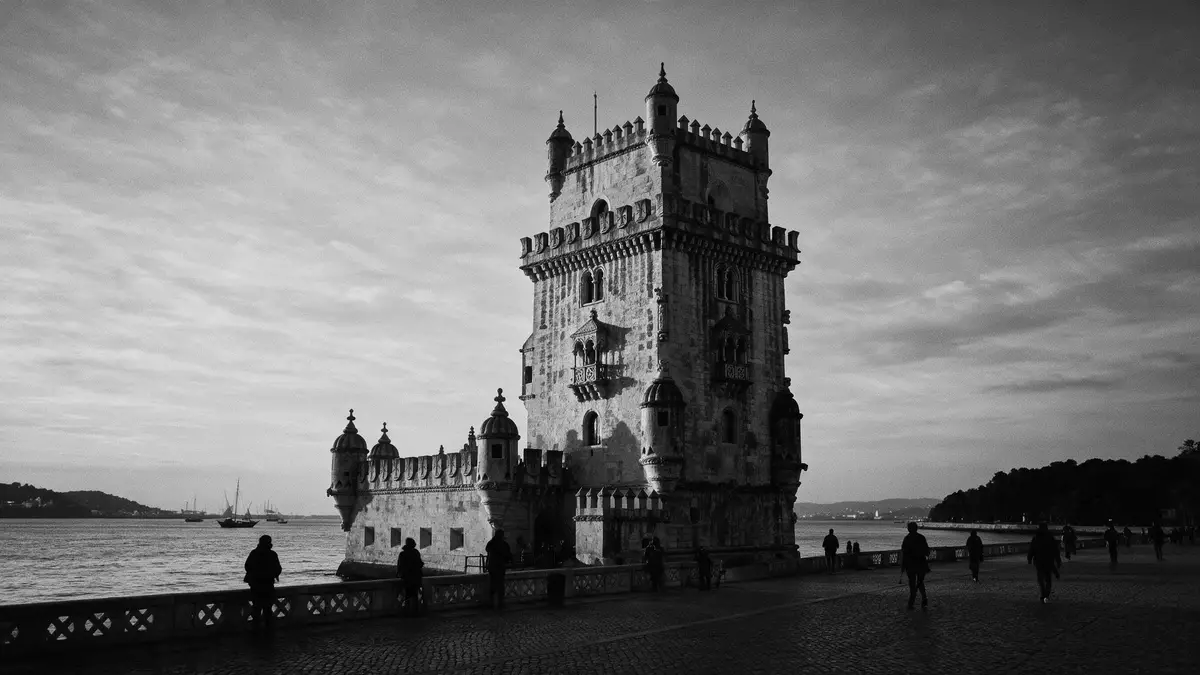
Torre de Belem in Lissabon is a compact riverside fortress whose carved limestone and layered history turn a small tower into a dense record of Portugal’s seafaring age. Rising beside the Tagus estuary in the district of Belém, it combines a tall keep with a low riverside bastion, marking the western approach to the city that once sent fleets towards Africa, Asia and the Americas.
A Manueline tower on the Tagus
The Torre de Belem stands on the northern bank of the Tagus River in the civil parish of Santa Maria de Belém, west of central Lissabon, linked to the shore by a short walkway over the water.Northern bank of the Tagus It forms part of a wider ensemble of monuments in Belém, close to the Monastery of the Hieronymites, with which it shares a formal acknowledgement as a World Heritage Site by UNESCO.World Heritage inscription
Construction of the tower falls in the early sixteenth century, under King Manuel I, when Portugal was projecting power abroad through maritime expeditions and coastal fortifications.Reign of Manuel I The tower is associated with the architect Francisco de Arruda, known for military works in Portugal’s Atlantic territories and North Africa, and is widely recognised as one of the clearest examples of Manueline architecture applied to a defensive structure.Manueline architecture
Stone lacework and layered defences
At first glance the Torre de Belem appears almost ornamental, with walls of pale limestone lifted directly from the river, pierced by openings and edged with delicate mouldings. The profile is defined by two main volumes: a square tower that rises above several levels of interior chambers, and a lower bastion that spreads towards the water, originally conceived to carry artillery facing the estuary. The bastion’s plan has projecting turrets at its corners, a layout often linked to fortifications in Morocco where Arruda also worked, bringing a visual echo of Moorish watchtowers into a Portuguese context.Turrets on the bastion
Closer exploration reveals the vocabulary of the Manueline style carved into balustrades, portals and shields. Nautical and royal symbols appear repeatedly: ropes rendered in stone, armillary spheres, crosses associated with the Order of Christ and coats of arms tied to Manuel I’s reign.Maritime motifs in stone Inside the tower, stone staircases rise through narrow passages to higher platforms, where visitors can look out across the river mouth and towards the Atlantic. The upper platform functions as an open-air viewpoint, giving a sense of how the tower commands the river channel and the adjoining shore.Upper level as viewpoint
From river fortress to museum
Historically, Torre de Belem formed part of a defensive system guarding access to Lissabon’s harbour, working in concert with other fortifications along the Tagus to control shipping entering and leaving the city.Defensive network on the Tagus It also functioned as a ceremonial marker, associated with voyages such as Vasco da Gama’s journey to India at the end of the fifteenth century, and later took on administrative roles in customs and health inspections for arriving vessels.Ceremonial and customs roles
In its present form the Torre de Belem operates as a museum and monument, with interior rooms opening to the public and exhibition elements explaining its architectural and historical context.Current museum function The tower’s status within a joint World Heritage listing alongside the Monastery of the Hieronymites underlines its role as a symbol of Portugal’s era of maritime expansion, while its modest footprint on the riverbank makes that history accessible at close range through stone, water and views along the Tagus.Shared World Heritage property
Visiting Torre de Belem: what travellers from Western Europe should know
- Torre de Belem stands on Avenida de Brasília in the Belém district of Lissabon, on the Tagus riverfront, reached by tram or suburban train from central stations.
- Access to the interior involves climbing stone staircases between levels, including a narrow spiral route to the upper platform, which requires steady footing.
- The riverside setting exposes the tower to Atlantic weather systems; wind and spray can affect the exposed walkways and viewpoints, especially during unsettled conditions.
- Belém also contains the Monastery of the Hieronymites and riverside promenades, making the area a compact concentration of historic and waterfront sites.
- The official language is Portuguese and the currency is the euro.
Searching for Torre de Belem on social platforms
These links open searches for Torre de Belem on each platform.
Frequently asked questions about Torre de Belem
Where is Torre de Belem located in Lissabon?
Torre de Belem stands on the northern bank of the Tagus River in the Belém district, west of central Lissabon, beside Avenida de Brasília.
What can visitors expect inside Torre de Belem?
Visitors move through stone chambers and staircases inside the tower, reaching higher levels and an open platform that offers views along the Tagus and across Belém.
What makes Torre de Belem distinctive among Lissabon’s monuments?
The combination of Manueline stone carving, compact fortress form and riverside position gives Torre de Belem a character that tightly links architecture with Portugal’s maritime history.


