
Topkapi Sarayi, the layered Ottoman heart of Istanbul
Published on 09/16/2026 at 19:31 | Editorial responsibility: Rafael Müller, Editor-in-Chief AD HOC NEWS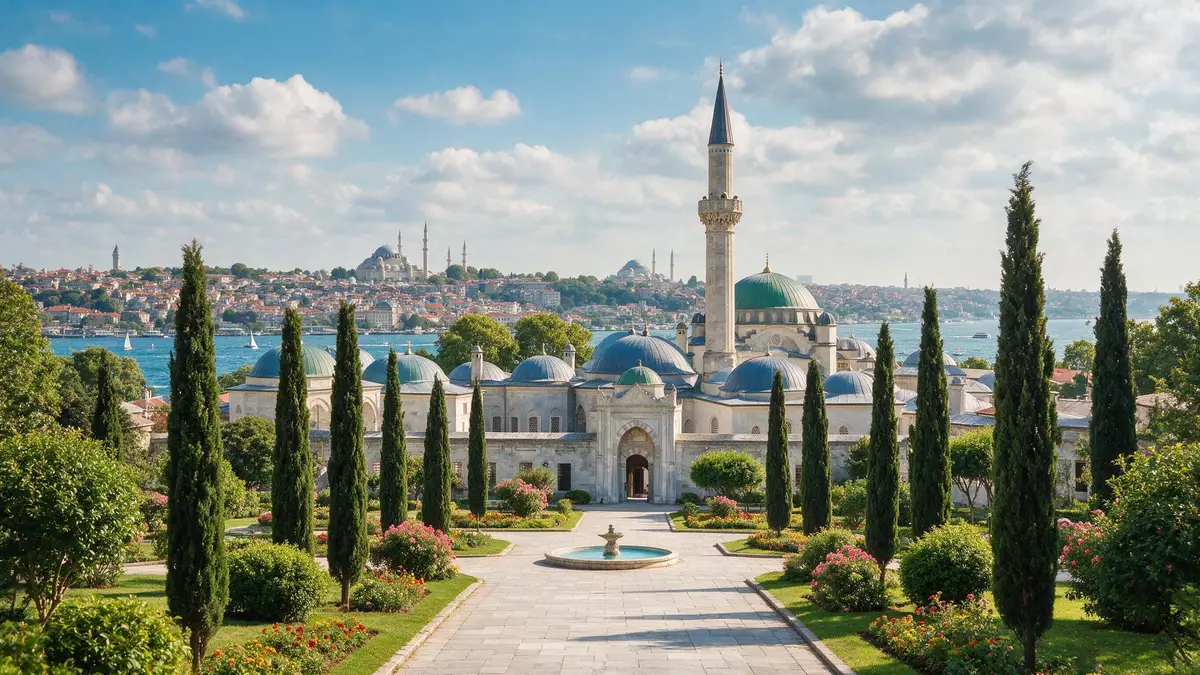
Topkapi Sarayi, widely known in English as Topkapi Palace, crowns the historic peninsula of Istanbul between the Bosphorus, the Golden Horn and the Sea of Marmara, with a sequence of courtyards and pavilions that once formed the core of Ottoman power. Its foundations go back to the reign of Sultan Mehmed II, the fifteenth-century conqueror of Constantinople, and it has served as both imperial residence and, since 1924, as a museum presenting the material world of the Ottoman court.
From imperial residence to museum complex
The story of Topkapi Sarayi begins in the fifteenth century, when Sultan Mehmed II ordered the construction of an imperial palace on the headland known as Seraglio Point, shortly after his conquest of Constantinople in 1453.Sultan Mehmed II ordered the construction Work on the complex started in the late 1450s and reached an initial completion in the 1470s, establishing a residence and administrative centre for the expanding Ottoman Empire.Construction began in 1460 and was completed in 1478 Over roughly four centuries, Topkapi Sarayi functioned as the seat of the sultans and the venue where state ceremonies, imperial audiences and daily court life unfolded within a protected precinct.served as the administrative centre of the Ottoman Empire for some 400 years
The palace complex lost its role as primary royal residence in the nineteenth century, when Sultan Abdülmecid I moved the dynasty to Dolmabahçe Palace on the Bosphorus in 1856.The dynasty moved to Dolmabahçe Palace in 1856 After the establishment of the Republic of Turkey in 1923, a decree of 1924 transformed Topkapi Sarayi into a museum, opening its former private and ceremonial spaces to visitors and establishing collections of manuscripts, jewels, arms and religious relics within the rooms of the old palace.a government decree dated 3 April 1924 transformed Topkap? into a museum
Courtyards, gates and the layout of power
Topkapi Sarayi is organised around a progression of courtyards, each reached through monumental gates and each associated with a different degree of access to the sultan and his household.The canopied Gate of Felicity leads to the third courtyard The First Courtyard, enclosed by walls and once shared with public buildings such as churches and gardens, forms the outer approach to the palace. Beyond it, the Second Courtyard holds the former administrative core, including council halls and kitchens, and marks the boundary between the more public functions of government and the inner life of the court.
Through the Gate of Felicity lies the Third Courtyard, traditionally reserved for the sultan’s private residence and the inner palace school, where pages were trained for service.housed the private residence of the sultan and the inner palace school Off this innermost precinct extend suites of rooms and small pavilions, including the harem quarters, treasury chambers and library halls, arranged to balance seclusion, ceremony and views over the surrounding waterways.spatial organization, structural typologies, and stylistic features of the Ottoman imperial complex
Architecture, decoration and collections
The architecture of Topkapi Sarayi reflects a long evolution, combining early Ottoman forms with elements of Byzantine-influenced fortification and later Baroque decoration introduced under eighteenth- and nineteenth-century sultans.constructed in Istanbul beginning circa 1459 under Sultan Mehmed II Buildings in the complex are generally low-rise, built around courtyards and gardens rather than monumental façades, and make extensive use of stone and timber structures lined with ceramic tiles, painted plaster and carved wood. The architectural style is described as Ottoman, with later additions showing Baroque and European influences in ornament and room arrangement.Architectural style: Ottoman, Baroque
Inside these buildings, Topkapi Sarayi houses museum collections that give a sense of the material culture of the Ottoman court: arms and armour, ceremonial garments, jewellery and precious objects, and manuscripts arranged in treasury rooms and library spaces.exhibits the imperial collections of the Ottoman Empire Some rooms once formed part of the harem, the family quarters of the sultan, which were divided by gender and organised to give separate apartments to different members of the dynasty.The harem was the living quarters of the sultan’s family Together, the architecture and collections create a layered environment where administrative, domestic and ceremonial histories of the Ottoman Empire can be followed through specific places, objects and decorative schemes.
Visiting Topkapi Sarayi: what travellers from Western Europe should know
- Topkapi Sarayi stands on the tip of the Historic Peninsula in the Fatih district of Istanbul, within walking distance of landmarks such as Hagia Sophia and the Sultanahmet Mosque, and is reached by city tram and other urban transport routes serving the Sultanahmet area.
- The palace complex covers a wide area with several courtyards, meaning a visit involves walking on stone paths and through gardens, with staircases and interior corridors connecting the different museum rooms.
- The official language is Turkish and the currency is the Turkish lira.
- Entry requirements depend on your nationality; UK travellers can check the FCDO travel advice at gov.uk/foreign-travel-advice, Irish travellers the Department of Foreign Affairs at ireland.ie.
Searching for Topkapi Sarayi on social platforms
These links open searches for Topkapi Sarayi on each platform.
Frequently asked questions about Topkapi Sarayi
Where is Topkapi Sarayi located in Istanbul?
Topkapi Sarayi occupies a headland on the Historic Peninsula in the Fatih district, between the Bosphorus, the Golden Horn and the Sea of Marmara.
What should visitors expect inside Topkapi Sarayi?
Visitors move through successive courtyards with council halls, kitchens and museum rooms, then into more secluded areas such as the harem and treasury chambers.
What makes Topkapi Sarayi distinctive among Ottoman sites?
Its long use as the central palace of the Ottoman sultans, layered architecture mixing early Ottoman and Baroque influences, and extensive court collections together give Topkapi Sarayi a distinctive character.


