
Topkapi Sarayi and the courtyards of Ottoman power
Published on 09/23/2026 at 23:44 | Editorial responsibility: Rafael Müller, Editor-in-Chief AD HOC NEWS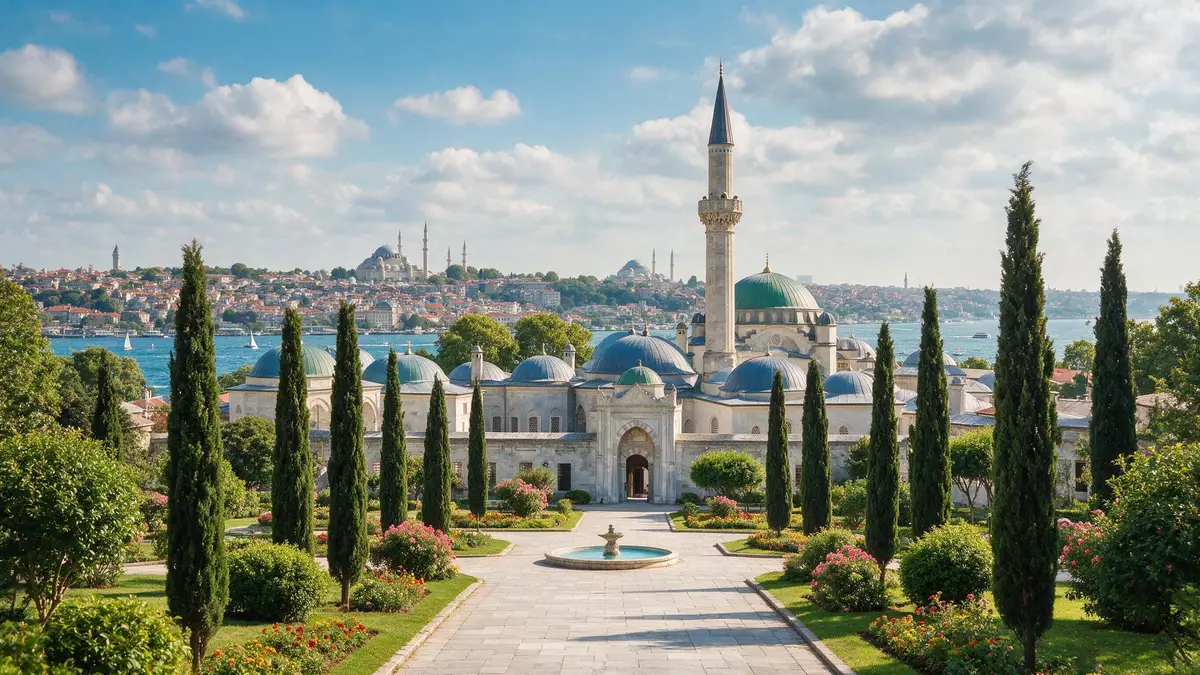
Topkapi Sarayi rises on Istanbul’s Seraglio Point as a palace without a single monumental block. Its courtyards, gardens, pavilions and richly decorated chambers form a layered complex overlooking the Bosphorus, the Golden Horn and the Sea of Marmara. Sultan Mehmed II ordered its construction in 1459, and the palace served the Ottoman court until 1856.
Topkapi Sarayi: a palace arranged as courtyards
The palace is organised through successive courtyards rather than one continuous residence. The layout established under Mehmed II remains legible, with gates marking movement from more public areas towards restricted spaces. The first courtyard contains Hagia Irene, a Byzantine church later used by the Ottoman court as an armoury.
The Gate of Salutation leads into the second courtyard, also known as Divan Square. This was the administrative centre of the palace, with the Imperial Council, kitchens and treasury buildings. The Tower of Justice rises beside the council chambers, while the palace kitchens contain displays of imperial porcelain.
From Mehmed II to the Ottoman court
Mehmed II, known as Mehmed the Conqueror, began the palace after taking Constantinople in 1453. The complex became the residence and administrative centre of the Ottoman court from about 1478 to 1856. Successive sultans added buildings and decoration, leaving a mixture of Ottoman, Islamic and European influences.
The third courtyard contains the Audience Chamber, the Palace School and the Privy Chamber. Beyond it, the fourth courtyard opens into gardens and pavilions on terraces above the waterways. The Baghdad Kiosk and Revan Kiosk carry glazed tilework, carved details and views across Istanbul.
The Imperial Harem occupies a separate section between the inner courtyards. Its rooms, courtyards and passages belonged to the sultan’s household, including the Valide Sultan, royal women, children and attendants. The Harem was part of the palace’s domestic and political life, not a separate building detached from court affairs.
Collections shaped by an empire
Topkapi Sarayi became a museum in 1924, after the establishment of the Republic of Turkey. The palace displays imperial collections of Ottoman objects, manuscripts, ceramics, textiles, weapons and ceremonial dress. Its library preserves books and manuscripts connected with the intellectual life of the court.
The treasury includes the Topkapi Dagger and the Spoonmaker’s Diamond. The kitchens display Chinese and Japanese porcelain, while Ottoman ceramics and Iznik tiles show the importance of colour, calligraphy and floral ornament in palace interiors. Sacred relics associated with Islamic history are kept in the Pavilion of the Holy Mantle.
The palace forms part of the Historic Areas of Istanbul, inscribed on the UNESCO World Heritage List in 1985. This designation includes a wider group of monuments that records the city’s Byzantine and Ottoman history. Topkapi Sarayi contributes the architecture and collections of the Ottoman imperial court.
Visiting Topkapi Sarayi: what travellers from Western Europe should know
- Topkapi Sarayi stands on Seraglio Point in Istanbul’s Fatih district. It lies beside Hagia Sophia and the former imperial centre, with tram connections serving the historic peninsula.
- The complex includes courtyards, gardens, terraces and historic interiors. A visit involves walking between separate buildings and crossing uneven historic surfaces.
- The Harem, treasury, sacred-relic rooms, kitchens and pavilions are distinct areas within the palace complex. The route combines open courtyards with enclosed chambers.
- The official language is Turkish and the currency is the Turkish lira.
- Entry requirements depend on your nationality; UK travellers can check the FCDO travel advice at gov.uk/foreign-travel-advice, Irish travellers the Department of Foreign Affairs at ireland.ie.
Searching for Topkapi Sarayi on social platforms
These links open searches for Topkapi Sarayi on each platform.
Frequently asked questions about Topkapi Sarayi
Where is Topkapi Sarayi?
Topkapi Sarayi is on Seraglio Point in Istanbul’s Fatih district. The palace overlooks the Bosphorus, the Golden Horn and the Sea of Marmara.
What can visitors see inside Topkapi Sarayi?
The complex contains courtyards, gardens, pavilions, the Harem, council chambers, kitchens, treasury rooms, manuscripts and sacred relics.
What makes Topkapi Sarayi distinctive?
Its identity comes from the combination of Ottoman court architecture, successive courtyards and imperial collections. The palace became a museum in 1924 after serving the Ottoman court for centuries.


