
Topkapi Sarayi: an Ottoman court spread across four courtyards
Published on 09/19/2026 at 10:30 | Editorial responsibility: Rafael Müller, Editor-in-Chief AD HOC NEWS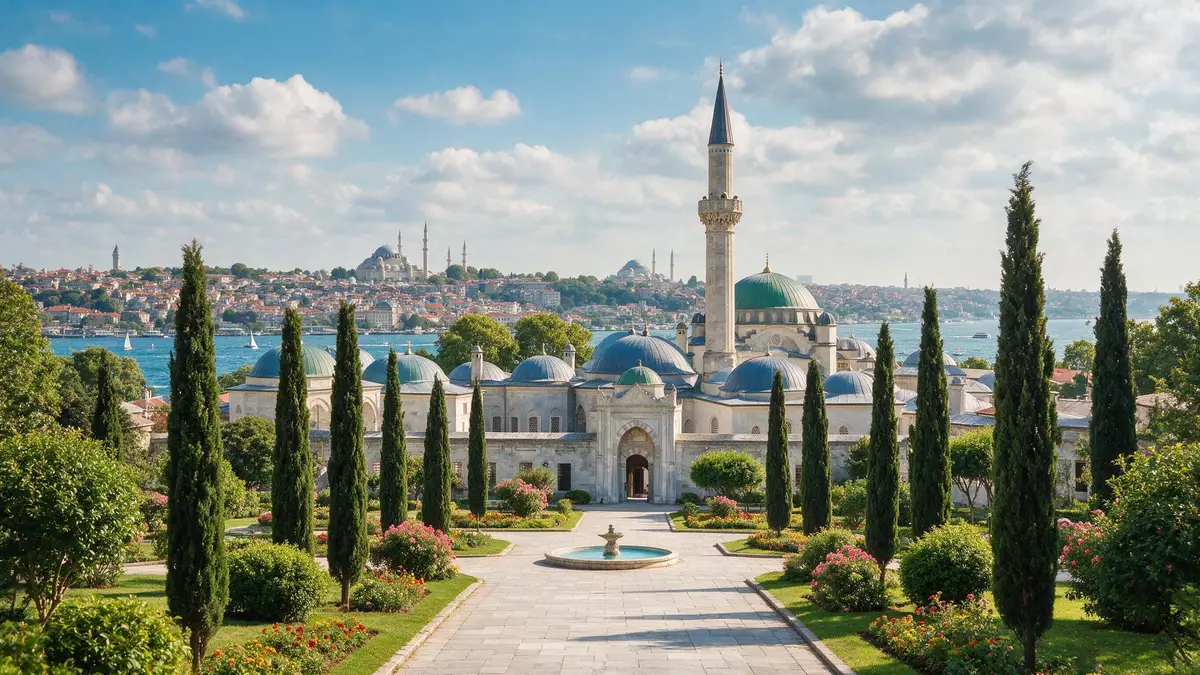
Topkapi Sarayi, known in English as Topkapi Palace, occupies the eastern tip of Istanbul’s historic peninsula with a sprawling complex of courtyards, halls and gardens that once formed the administrative and residential heart of the Ottoman Empire in the fifteenth century.Topkapi Palace Museum From the reign of Sultan Mehmed II onward, successive sultans extended and reshaped this seat of power, which was converted into a museum in 1924 after the foundation of the Republic of Turkey.converted into a museum in 1924
Court of empire on the Seraglio Point
Topkapi Sarayi stands on Seraglio Point between the Bosphorus and the Sea of Marmara, within the Fatih district that covers much of Istanbul’s old city.Seraglio Point between the Bosphorus and the Sea of Marmara Construction of the palace complex began under Sultan Mehmed II after his conquest of Constantinople in 1453, with major work dating from around 1459 and the main structures completed during the 1470s.construction began around 1459 and was largely completed around 1478
The result is not a single monumental block, but an ensemble of buildings and gardens enclosed within high walls and organised around four main courtyards that step away from the city towards the water.four main courtyards For nearly four centuries, from the late fifteenth century until the move to Dolmabahçe Palace in the nineteenth century, these courts housed the imperial household, the sultan’s council and a population of officials, guards, artisans and servants within an area covering hundreds of thousands of square metres.served as the administrative centre and residence of the imperial Ottoman court from about 1478 to 1856
Courtyards, council halls and the harem
Entry to Topkapi Sarayi is through a sequence of gates that lead successively deeper into the palace, each threshold marking a shift in status and privacy. The outer, or First Courtyard, is a broad expanse once used for processions and services, with structures such as the former palace bakery and the church of Hagia Irene set among trees and open ground.outer court and ancillary buildings Beyond it lies the Second Courtyard, framed by long ranges of kitchens on one side and administrative rooms on the other, where the Imperial Council met.
In this Second Courtyard, the Tower of Justice rises beside the council chambers, giving vertical emphasis to the low halls around it and signalling the importance of the decisions taken inside.Tower of Justice and Divan chambers Kitchens along the opposite flank once prepared food for large numbers of residents and guests, their chimneys punctuating the skyline over the courtyard.palace kitchens and service ranges Passing through another gate leads to the more intimate Third Courtyard, home to the Audience Chamber where sultans received envoys, and the Enderun School that trained members of the inner service.
Ottoman styles, treasured collections and waterfront views
Architecturally, Topkapi Sarayi reflects centuries of Ottoman court life, with buildings added, rebuilt and decorated in line with changing tastes from the fifteenth to the nineteenth century.adaptive, additive character of Ottoman court architecture Early structures express Classical Ottoman forms, while later additions incorporate Baroque and European influences in details such as tiled surfaces, painted ceilings and carved woodwork.Ottoman and Baroque elements Within these varied interiors, the palace treasury and relic chambers now present collections ranging from jewelled objects and arms to manuscripts and Islamic sacred relics.imperial collections and library
Topkapi Sarayi stands within the Historic Areas of Istanbul that form a UNESCO World Heritage Site, sharing the peninsula with structures such as the former Byzantine church of Hagia Sophia and the Blue Mosque.part of Istanbul’s historic areas inscribed by UNESCO Terraces and kiosks at the edge of the complex look out over the Bosphorus and the Golden Horn, connecting palace gardens to the waterways that linked the capital with provinces across Europe, Asia and North Africa.courts extending towards the Marmara Sea
Visiting Topkapi Sarayi: what travellers from Western Europe should know
- Topkapi Sarayi stands within the Sultanahmet area of Istanbul’s Fatih district, on the eastern tip of the historic peninsula bordered by the Bosphorus and the Sea of Marmara.
- The palace complex is approached on foot along paved paths and through several monumental gates, with movement inside involving walks between courtyards and climbs on stone staircases.
- The official language is Turkish and the currency is the Turkish lira.
- Entry requirements depend on your nationality; UK travellers can check the FCDO travel advice at gov.uk/foreign-travel-advice, Irish travellers the Department of Foreign Affairs at ireland.ie.
Searching for Topkapi Sarayi on social platforms
These links open searches for Topkapi Sarayi on each platform.Frequently asked questions about Topkapi Sarayi
Where is Topkapi Sarayi located within Istanbul?
Topkapi Sarayi stands in the Fatih district on Istanbul’s historic peninsula, close to Sultanahmet Square and bordered by the Bosphorus and the Sea of Marmara.
What can visitors expect when exploring Topkapi Sarayi?
Visitors move through a sequence of courtyards, council halls, pavilions and gardens, with interiors housing collections such as the treasury, manuscripts and sacred relics.
What makes Topkapi Sarayi distinctive among former royal residences?
Topkapi Sarayi is distinctive for its layered arrangement of four main courtyards, numerous discrete buildings and Ottoman architectural styles rather than a single palace block.


