
Topkapi Sarayi: an Ottoman court in layered stone
Published on 09/14/2026 at 15:29 | Editorial responsibility: Rafael Müller, Editor-in-Chief AD HOC NEWS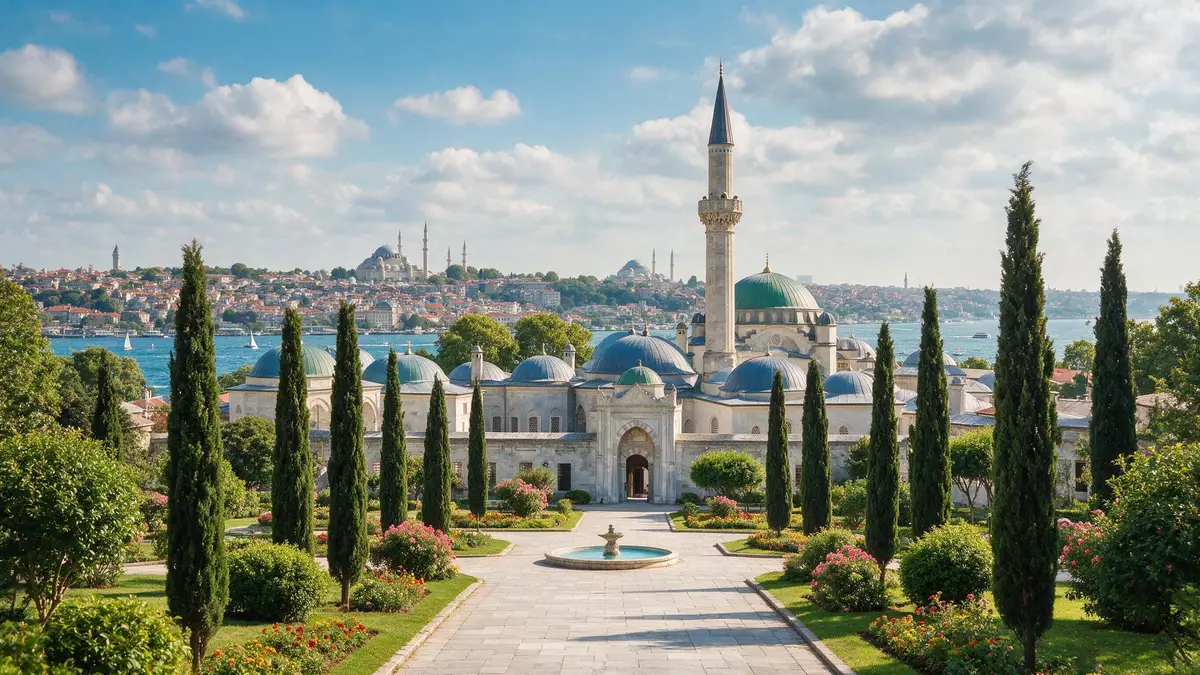
Topkapi Sarayi in Istanbul is the former imperial palace of the Ottoman sultans, laid out as a sequence of courtyards, halls and gardens on the city’s historic peninsula. Built under Sultan Mehmed II in the fifteenth century and converted into a museum in 1924, it presents court life in architecture rather than in words.
Court of empire above the Bosphorus
Topkapi Sarayi occupies the tip of the old acropolis between the Bosphorus, the Golden Horn and the Sea of Marmara, looking out over the waterways that once carried the wealth of the empire.The palace complex stands in the Fatih district, close to landmarks such as Hagia Sophia and the Hippodrome. Its position on the Seraglio Point set the Ottoman court slightly apart from the growing city while remaining within its walls.Seraglio Point
Construction began under Mehmed II in the late 1450s, after his conquest of Constantinople in 1453, and early work established the basic courtyards and service buildings.Building phases under Mehmed II The palace served as the administrative centre and principal residence of the Ottoman rulers for around four centuries, until the dynasty moved to Dolmabahçe Palace in the nineteenth century.Administrative centre and residence
Four courtyards instead of one great hall
Topkapi Sarayi is not a single monumental building but a complex of successive courtyards, each one more restricted than the last and framed by pavilions, kitchens and council chambers.Four sequential courtyards The outermost “first courtyard” functioned as a transitional zone where soldiers, officials and visitors approached the palace; Hagia Irene, a Byzantine church, stands here among trees and paths. Passing through the inner gate leads into the second courtyard, lined with the long roofs of the palace kitchens and the buildings associated with government.
The second courtyard held the Imperial Council chamber, known as the Divan-? Hümayun, where viziers discussed affairs of state under a low tiled dome, and where the sultan could observe discreetly from an elevated room.Imperial Council in the second courtyard Beyond the Gate of Felicity lies the third courtyard, a quieter enclosure devoted to the sultan’s private residence and the Enderun School, the elite palace school for future administrators.Third courtyard and inner court Further inward again, the fourth courtyard becomes more of a garden terrace, with small kiosks such as the Baghdad and Revan pavilions and views over the Bosphorus.
Harem, treasury and changing styles
Within this sequence of courts, the Harem forms a self-contained world of passages, chambers and tiled walls where the sultan’s family lived. Set mainly around the second courtyard and its rear, it grew over centuries into a dense network of rooms, baths and service areas.Expanding Harem apartments More than three hundred rooms, together with mosques, baths and other facilities, are recorded within the Harem, many faced with ?znik and Kütahya tiles bearing floral and geometric designs.
The architecture of Topkapi Sarayi reflects changes in Ottoman taste from the fifteenth to the nineteenth century. Early sections adopt a relatively modest, courtyard-centred style, while later additions bring Baroque and other European influences into façades and interiors.Layered Ottoman palace architecture Important structures such as the palace kitchens, the Audience Chamber and the treasury rooms show this layering in their decoration and alterations.
Visiting Topkapi Sarayi: what travellers from Western Europe should know
- Topkapi Sarayi stands on the historic peninsula of Istanbul in the Fatih district, east of Sultanahmet Square, and is reached on foot or by tram from the city’s old centre.
- The palace grounds rise gently above the surrounding streets, with cobbled approaches, uneven surfaces and a number of stone stairways between the courtyards and into tower interiors.
- The official language is Turkish and the currency is the Turkish lira.
- Entry requirements depend on your nationality; UK travellers can check the FCDO travel advice at gov.uk/foreign-travel-advice, Irish travellers the Department of Foreign Affairs at ireland.ie.
Searching for Topkapi Sarayi on social platforms
These links open searches for Topkapi Sarayi on each platform.
Frequently asked questions about Topkapi Sarayi
Where is Topkapi Sarayi located within Istanbul?
Topkapi Sarayi stands on the historic peninsula in the Fatih district of Istanbul, on the promontory between the Bosphorus, Golden Horn and Sea of Marmara.
What can visitors expect on a visit to Topkapi Sarayi?
A visit leads through successive courtyards, with kitchens, council chambers, gardens and selected rooms of the Harem and treasury open as museum spaces.
What makes Topkapi Sarayi distinctive among palaces?
Its layered courtyards, long use as the Ottoman imperial centre and the preserved Harem apartments together make Topkapi Sarayi a distinctive record of court life in architecture.


