
Topkapi Sarayi: an Ottoman court in four stone courtyards
Published on 09/18/2026 at 22:53 | Editorial responsibility: Rafael Müller, Editor-in-Chief AD HOC NEWS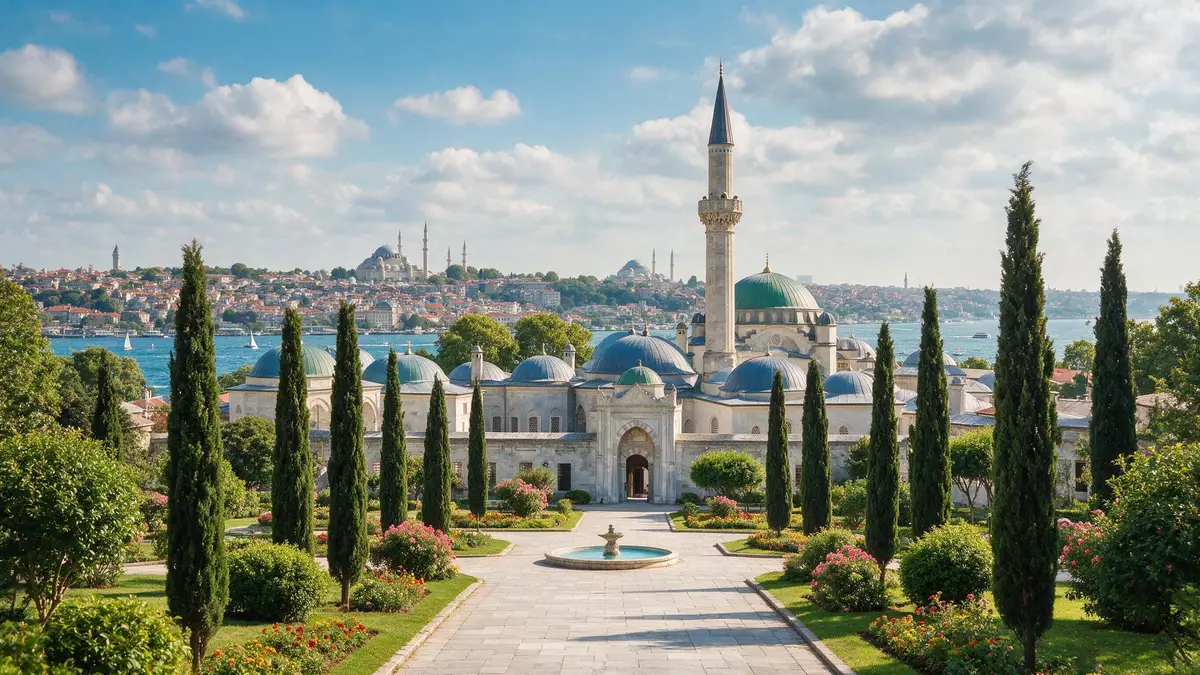
Topkapi Sarayi, better known in English as Topkapi Palace, is the former seat of the Ottoman sultans on the historic peninsula of Istanbul, looking out towards the Bosphorus and the Golden Horn. Built under Sultan Mehmed II in the late fifteenth century and turned into a museum in 1924, it remains a sprawling walled complex of courtyards, halls and gardens rather than a single palace block.
From Mehmed II’s fortress-palace to a museum of empire
Topkapi Sarayi grew out of the ambitions of Mehmed II, the conqueror of Constantinople in 1453, who ordered construction of a new imperial palace on the old Byzantine acropolis around 1459. The complex took shape over the following decades as the New Imperial Palace, before the name Topkapi, “cannon gate”, was adopted from a shore gate below the walls.Construction in the late 1450s
For around four centuries, from the late fifteenth century until the mid-nineteenth century, Topkapi Sarayi served as both the administrative centre and principal residence of the Ottoman court, with sultans, viziers, guards, servants and palace craftsmen all living and working within its walls.Administrative centre and residence After Sultan Abdülmecid I moved the court to Dolmabahçe Palace in 1853, Topkapi remained as a symbol of dynastic rule until a decree of 3 April 1924 opened it as a museum under the new Republic of Turkey.Transformed into a museum in 1924
Four courtyards and a mosaic of Ottoman architecture
The scale of Topkapi Sarayi is striking: instead of a single grand palace, visitors encounter a series of successive courts, pavilions and service buildings spread over a large area on Seraglio Point.A complex of courtyards and buildings The First Courtyard forms the outer approach, with gardens and the remains of earlier structures, setting the tone for a palace conceived as a self-contained city. Passing through the main gate leads into the Second Courtyard, where council chambers and extensive kitchens underline the palace’s role in government and ceremonial life.Organisation around four courtyards
Beyond lies the Third Courtyard, sometimes described as the Court of the Throne Room, with audience spaces and the inner school of pages close to the sultan’s private world. The Fourth Courtyard opens out into terraces and garden pavilions above the water, an unexpectedly relaxed sequence of kiosks, lawns and tree-shaded paths compared with the tighter ceremonial spaces nearer the entrance.Courtyards and Bosphorus views Architecturally, the ensemble blends early Ottoman forms with later Islamic and European influences: timber roofs over stone halls, tiled interiors, domed chambers and baroque-period additions sit side by side, reflecting centuries of expansion and rebuilding.
The Harem, treasury and collections inside the walls
Within this layout, some zones of Topkapi Sarayi stand out for their function and decoration. The Harem, begun in the later sixteenth century, is effectively a palace within the palace, a self-contained residential quarter for the sultan’s family linked by corridors, courtyards and small gardens.Harem as private quarters Its chambers are lined with dense fields of ?znik tiles, carved doors and painted ceilings, conveying the confined splendour in which royal women, princes and eunuchs lived.
The palace treasury houses imperial regalia, jewellery and ceremonial objects that once underpinned the political theatre of the Ottoman court, while other collections preserve arms, costumes, manuscripts and religious relics.Imperial collections and manuscripts Together with the council chamber, kitchens, mosque and hospital buildings scattered through the courts, these spaces make it clear that Topkapi Sarayi was designed as a complete imperial world, where administration, ritual, residence and devotion all took place within the same compound.
Visiting Topkapi Sarayi: what travellers from Western Europe should know
- Topkapi Sarayi stands on the Historic Peninsula of Istanbul in the district of Fatih, above the confluence of the Bosphorus and the Golden Horn. It is reached through the Sultanahmet area, where tram lines and roads converge on the old city and the approach to the main gate.
- The complex is spread over rising ground with long cobbled paths and large open courts, and moving between the gates, pavilions and gardens involves extended walking over uneven surfaces.
- Major interiors such as the Harem and treasury are housed in historic stone and brick structures with stairways and enclosed passages, and some areas have narrow corridors or low doorways characteristic of Ottoman palace architecture.
- The official language in Turkey is Turkish and the currency is the Turkish lira. Entry requirements depend on your nationality; UK travellers can check the FCDO travel advice at gov.uk/foreign-travel-advice, Irish travellers the Department of Foreign Affairs at ireland.ie.
Searching for Topkapi Sarayi on social platforms
These links open searches for Topkapi Sarayi on each platform.Frequently asked questions about Topkapi Sarayi
Where is Topkapi Sarayi located in Istanbul?
Topkapi Sarayi occupies the tip of the Historic Peninsula in the Fatih district of Istanbul, on elevated ground between the Bosphorus and the Golden Horn.
What can visitors expect inside Topkapi Sarayi?
Visitors encounter a sequence of four main courtyards with council halls, kitchens, treasury rooms, mosques, gardens and the tile-lined chambers of the Harem within a single walled complex.
What makes Topkapi Sarayi distinctive among palaces?
Rather than a single monumental building, Topkapi Sarayi is a layered imperial city of stone halls, pavilions and service quarters developed over centuries of Ottoman rule, facing the waterways of Istanbul.


