
Topkapi Sarayi: an Ottoman court above the Bosphorus
Published on 09/09/2026 at 08:03 | Editorial responsibility: Rafael Müller, Editor-in-Chief AD HOC NEWS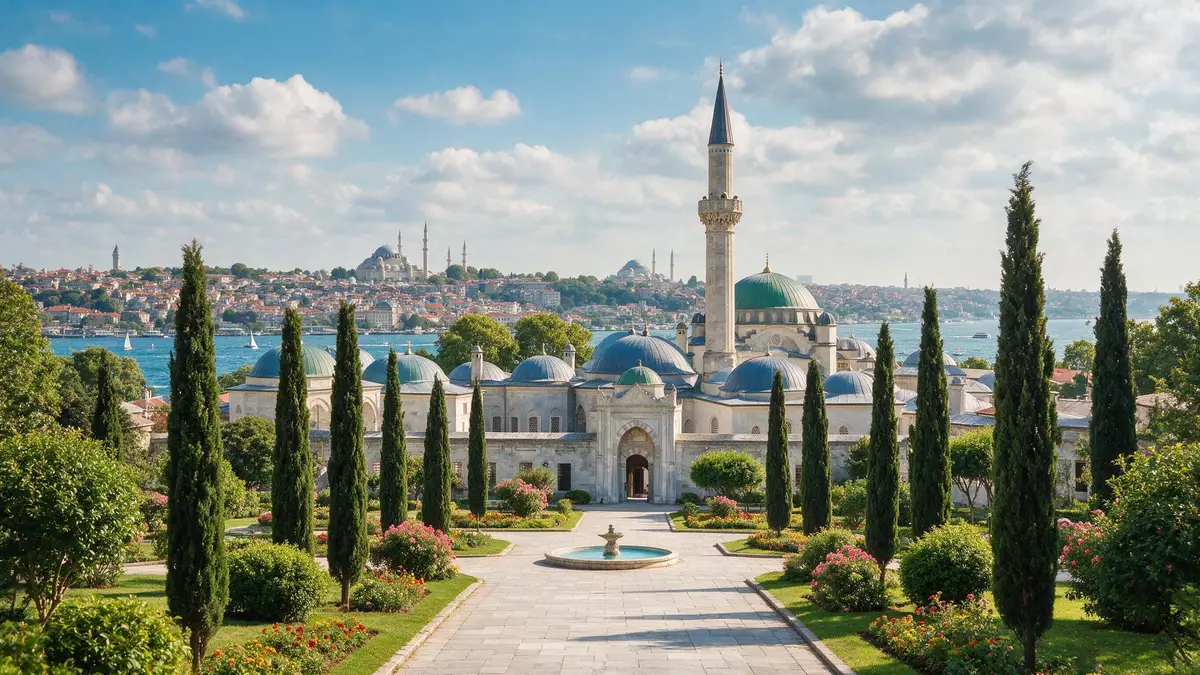
Topkapi Sarayi, known in English as Topkapi Palace, crowns the tip of Istanbul’s historic peninsula with a sequence of courtyards, pavilions and gardens that once housed the Ottoman court and today form a major museum complex. The palace began to take shape in the fifteenth century under Sultan Mehmed II after the conquest of Constantinople in 1453, and it later became the administrative centre and principal residence of the Ottoman sultans for several centuries.
From imperial residence to museum on the historic peninsula
Topkapi Sarayi stands on Sarayburnu, the promontory also called Seraglio Point, at the eastern end of Istanbul’s old walled peninsula where the Marmara Sea meets the Bosphorus and the Golden Horn. The site had been occupied by the ancient acropolis of Constantinople, and the palace complex rises above the shoreline on a series of terraces and gardens.Sarayburnu at the tip of the peninsula The palace’s location places it close to other major monuments of the city, including the former imperial church of Hagia Sophia and the Hippodrome of Constantinople.
Construction of the palace began under Mehmed II in the decades after 1453, and main parts of the complex were complete by the later fifteenth century.The administrative centre and residence From about 1478 Topkapi Sarayi served as the headquarters of imperial government and the principal residence of the Ottoman sultans. It remained the centre of court life until the nineteenth century, when Sultan Abdülmecid I shifted his residence to Dolmabahçe Sarayi on the Bosphorus. In 1924, following the end of the Ottoman monarchy, Topkapi Sarayi was formally converted into a museum within the new Republic of Turkey.Conversion into a museum in 1924
Courtyards, gates and the layered plan of Topkapi Sarayi
The plan of Topkapi Sarayi is organised around a sequence of courtyards stretching inland from the seaside, each entered through monumental gates and edged by ranges of buildings. The first courtyard includes service structures and the approach to the main gate, while the second courtyard holds kitchens, council chambers and other administrative buildings. Further in, the third courtyard centres on the sultan’s audience hall and private apartments, and later additions such as the Harem and library extend the complex towards the land walls.Courtyards, council chambers and Harem
Architecturally, the palace reflects Ottoman tastes over several centuries rather than a single fixed style. Residential pavilions frame gardens with arcades, timber elements and tiled interiors, while domed halls accommodate ceremonial and religious functions. Kitchens and service wings occupy large areas on the sea-facing side, recognisable by their clustered chimneys. Within the complex, visitors encounter distinct zones such as the Imperial Council chambers, treasury halls and the former Harem, each marked by different levels of ornament and enclosure.Imperial residence and royal family quarters
Collections, relics and views over the Bosphorus
As a museum, Topkapi Sarayi presents collections that reflect its role as an imperial residence and seat of government. The treasury halls display objects associated with the Ottoman court, including precious metalwork and jewelled ceremonial items. Other galleries hold manuscripts, calligraphy, weapons and textiles drawn from the palace’s historic inventories.Imperial collections and manuscripts One part of the complex is dedicated to sacred relics, housed in rooms adjoining the former audience halls.
The palace’s terraces and gardens frame wide views across the surrounding waters. From the sea-facing edges of the grounds the Bosphorus Strait and the Sea of Marmara are visible, with the Asian shore and the entrance to the Golden Horn beyond.Position above the Marmara Sea and Bosphorus Within the gardens, smaller kiosks and pavilions stand among planted areas, giving an idea of how outdoor spaces were integrated into courtly life. The combination of architecture, collections and landscape makes Topkapi Sarayi a place where the physical setting of Ottoman power can be read directly in stone, timber and tile.
Visiting Topkapi Sarayi: what travellers from Western Europe should know
- Topkapi Sarayi stands in the Sultanahmet quarter of the Fatih district on Istanbul’s historic peninsula, on the headland between the Bosphorus, the Marmara Sea and the Golden Horn. It lies within walking distance of Hagia Sophia and the former Hippodrome.
- The palace complex occupies a large, terraced site with multiple courtyards linked by gateways and passages; exploring it involves walking over stone paving and climbing various internal stairways.
- The official language is Turkish and the currency is the Turkish lira.
- Entry requirements depend on your nationality; UK travellers can check the FCDO travel advice at gov.uk/foreign-travel-advice, Irish travellers the Department of Foreign Affairs at ireland.ie.
Searching for Topkapi Sarayi on social platforms
These links open searches for Topkapi Sarayi on each platform.
Frequently asked questions about Topkapi Sarayi
Where is Topkapi Sarayi located within Istanbul?
Topkapi Sarayi is situated on Sarayburnu at the tip of Istanbul’s historic peninsula, in the Sultanahmet area of the Fatih district overlooking the Bosphorus and Marmara Sea.
What can visitors expect when exploring the palace complex?
Visitors encounter a sequence of courtyards, gateways, halls and gardens, together with museum collections such as treasury objects, manuscripts, weapons and textiles housed in former imperial buildings.
What makes Topkapi Sarayi distinctive among Istanbul’s historic sites?
Topkapi Sarayi combines its role as the former administrative and residential centre of the Ottoman Empire with extensive museum collections and wide views over the surrounding waters from its terraced gardens.


