
Tongariro National Park’s volcanic heart of the North Island
Published on 09/12/2026 at 16:30 | Editorial responsibility: Rafael Müller, Editor-in-Chief AD HOC NEWS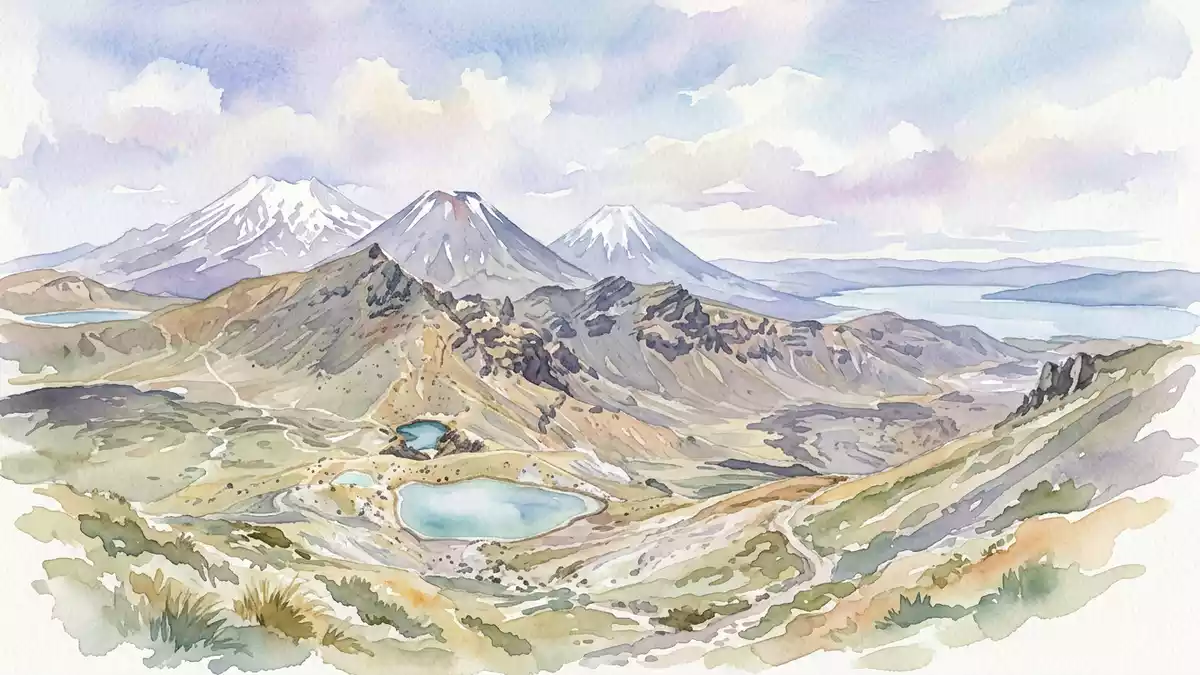
Tongariro National Park in New Zealand’s central North Island is built around a striking volcanic massif where three major mountains rise above a high plateau. It is New Zealand’s oldest national park, recognised for both its dramatic natural forms and its deep Maori cultural associations.
Volcanic peaks at the centre of the park
The defining feature of Tongariro National Park is the group of volcanoes that anchors its landscape: Tongariro, Ngauruhoe and Ruapehu. These mountains form the southern limits of the Taup? Volcanic Zone, part of the wider Pacific Ring of Fire that runs through the region.three andesitic volcanoes Their slopes and plateaus create a varied terrain of lava flows, ash fields and crater basins.
Mount Ruapehu is the highest of the three, rising to over 2,700 m (around 8,900 ft), with multiple peaks and active and inactive vents spread across a broad massif.Ruapehu, Tongariro and Ngauruhoe Ngauruhoe stands nearby as a steep composite cone built from interleaved lava and pyroclastic material, while Tongariro itself comprises several peaks arranged around a central high plateau.Tongariro is the lowest of the three central North Island volcanoes Together they give the park its recognisable profile, with snow-touched summits above tussock grasslands and alpine shrub.
Maori heritage and World Heritage recognition
Tongariro National Park has an international profile that rests as much on its cultural meaning as on its physical geography. It is one of New Zealand’s three sites recognised on the UNESCO World Heritage List, and it holds dual status for both natural and cultural values.dual World Heritage status The mountains at the heart of the park carry strong spiritual significance for local Maori communities, with traditional stories linking specific peaks and features to ancestors and events.
The park was nominated to the World Heritage List in 1990 for its natural values and then, in 1993, became the first property to be inscribed under revised criteria for cultural landscapes, recognising the association between people and place.World Heritage inscription for Tongariro National Park Tongariro is therefore part of a small group of sites worldwide where volcanic activity, alpine ecosystems and indigenous cultural traditions are considered together as a single heritage.
From early protection to modern national park
Tongariro National Park occupies a large swathe of upland terrain in the centre of the North Island, between Auckland and Wellington, and within reach of Taupo and the broader Ruapehu District.located in the central North Island It was established as a national park in 1894, making it the first such park in New Zealand and among the earliest national parks in the world.Tongariro National Park was established in 1894 Later expansions increased the protected area, taking in additional summits, ranges and lakes.
The park now covers hundreds of square kilometres of elevated terrain, with volcanic peaks, lakes, wetlands and native forests woven through its boundaries.the national park boundaries encompass an area of 795.9 sq km The mix of landforms and vegetation reflects its position on the Volcanic Plateau: lower slopes carry forest, higher ground is dominated by tussock and alpine herbs, and hardened lava and ash fields mark past eruptions.
Visiting Tongariro National Park: what travellers from Western Europe should know
- Tongariro National Park lies in New Zealand’s central North Island, south of Lake Taupo, reached by road routes that link Taupo with the Ruapehu area.
- The terrain includes steep volcanic slopes, high-altitude plateaus and long tracks across open ground, so extended sections of walking take place above 1,000 m (3,281 ft).
- In winter, snow frequently covers higher parts of Ruapehu, Ngauruhoe and Tongariro, and conditions on exposed ridges and plateaus can become demanding.
- The official language is English and the currency is the New Zealand dollar.
- Entry requirements depend on your nationality; UK travellers can check the FCDO travel advice at gov.uk/foreign-travel-advice, Irish travellers the Department of Foreign Affairs at ireland.ie.
Searching for Tongariro National Park on social platforms
These links open searches for Tongariro National Park on each platform.Frequently asked questions about Tongariro National Park
Where is Tongariro National Park?
Tongariro National Park is in the central part of New Zealand’s North Island, in the Ruapehu District and within reach of Taupo and other plateau towns.
What can visitors expect in the landscape?
The park combines high volcanic peaks, crater basins, alpine plateaus, native forest and lakes, with long tracks crossing lava flows, ash fields and open tussock country.
What makes Tongariro National Park distinctive?
The combination of three active volcanoes, early national park status from 1894 and dual UNESCO World Heritage recognition for natural and Maori cultural values gives Tongariro a distinctive character.


