
Tongariro National Park’s volcanic heart of Taupo
Published on 08/24/2026 at 20:41 | Editorial responsibility: Rafael Müller, Editor-in-Chief AD HOC NEWS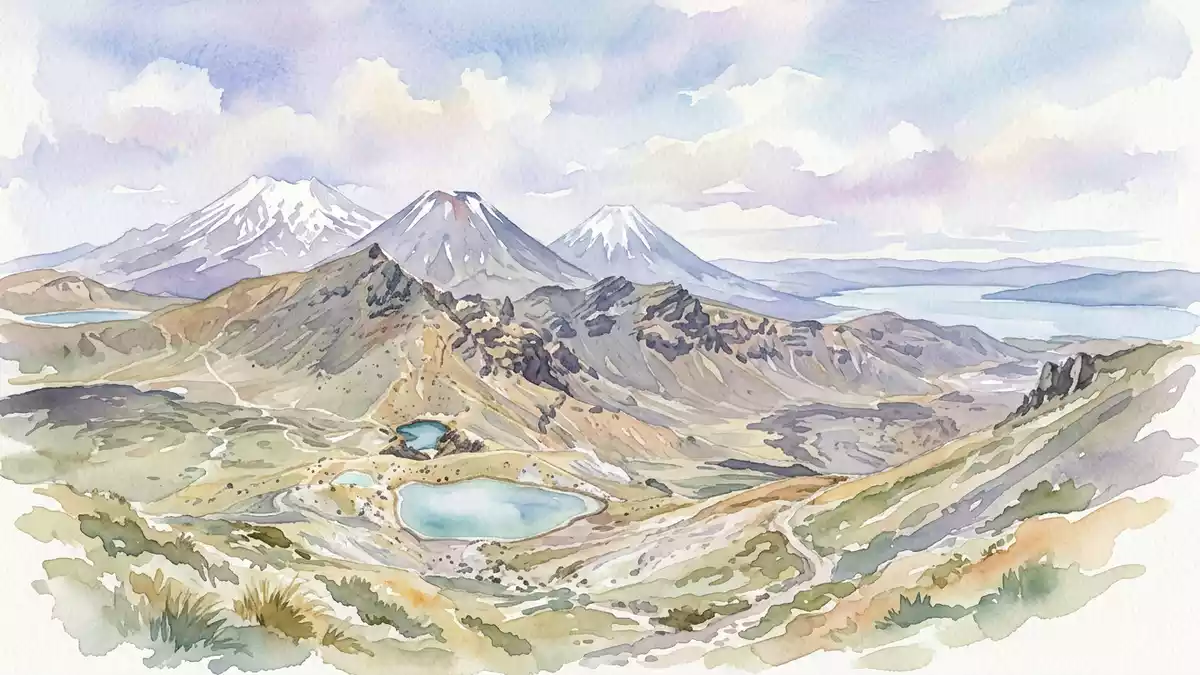
Tongariro National Park in the central North Island of New Zealand is a high volcanic plateau where three stratovolcanoes rise above lava fields, alpine tussock and beech forest. It was established as New Zealand’s first national park in 1887, anchoring a protected landscape that later gained dual UNESCO World Heritage recognition for both natural and cultural values in the late twentieth century.
Volcanoes, plateaux and a shaped landscape
The core of Tongariro National Park is a mountain massif dominated by Mount Ruapehu, Mount Ngauruhoe and Mount Tongariro, which stand within a broad volcanic plateau almost midway between Auckland and Wellington. The park boundary encircles these volcanoes and surrounding high country at elevations that begin around 800 m (2,625 ft), creating a compact block of high terrain in the middle of the North Island.encircles the Ruapehu, Ngauruhoe and Tongariro massif The protected area extends over roughly 79,600 ha, making it one of the largest contiguous highland reserves in the country and giving space for volcanic cones, glacial remnants and forest to sit within a single park.total area of the park is 79,596 ha
Ruapehu is the highest of the three major peaks, rising to 2,797 m (9,177 ft) above sea level, its upper slopes carrying permanent snow and ice in most years.Ruapehu is the tallest at 2,797 m Tongariro and Ngauruhoe form a cluster of vents, older lava domes and more recent cones that mark a long history of eruptions dating back well before the last ice age.Ruapehu and Tongariro date back before the last ice age Volcanic activity on this plateau began around two million years ago and continues at intervals, giving the park a landscape of craters, ash slopes and cooled lava where vegetation reclaims ground between flows.
M?ori gift and the making of a national park
The legal story of Tongariro National Park begins with a deed of gift signed on 23 September 1887, when Horonuku Te Heuheu Tukino, paramount chief of Ng?ti T?wharetoa, presented a core area of about 2,630 ha around the central volcanic peaks to the Crown. This act secured the summits of Tongariro, Ngauruhoe and Ruapehu as protected land within a framework that could evolve into a national park.presented 2,630 ha to the government The park was then established by statute in 1894, becoming New Zealand’s first national park and one of the earliest national parks in the world.
Over the following decades additional land was added to the original core, extending the park far beyond the initial peaks to include surrounding volcanic features and forest. The result is a protected area that combines a M?ori cultural landscape with a Western concept of national park management.more land was added and the park established by statute in 1894 In 1993 Tongariro National Park became the first property inscribed on the UNESCO World Heritage List under revised criteria for cultural landscapes, recognising both its outstanding volcanic features and the cultural, historical and spiritual significance of its peaks to M?ori communities.first property inscribed under cultural landscape criteria
Ecology, towns and the wider Taupo region
Tongariro National Park lies within the Ruapehu and Taupo region of the central North Island, close to Lake Taupo, which is the largest lake in New Zealand. Settlement patterns here differ from many other national parks, because several towns and villages sit inside or at the margins of the protected area, providing access points, accommodation and long-established communities alongside conservation land.Tongariro National Park is home to 7 different towns The park is reached by roads that cross the volcanic plateau, with rail and air routes across the central North Island giving views of Ruapehu’s snow-covered summit in clear weather.its snow-covered peaks are an arresting sight for people travelling through the central North Island by road, rail or air
The ecological mosaic reflects altitude and exposure. Lower slopes and valleys carry podocarp–broadleaf forest, including beech stands, while higher ground grades into scrubland and alpine herbfield where plants colonise ash and scoria. Birdlife includes blue duck, North Island brown kiwi, bellbird, t?? and a range of warblers and silvereyes, alongside introduced mammals such as red deer and possums, which form part of the modern fauna of the park.different forest habitats and birds can be found in Tongariro National Park Human use has added elements such as heritage huts, old coach roads and long-established ski facilities on Ruapehu’s slopes, creating layers of recreational history within the volcanic landscape.
Visiting Tongariro National Park: what travellers from Western Europe should know
- Tongariro National Park lies in the central North Island of New Zealand, south of Lake Taupo, and is reached by roads crossing the volcanic plateau from regional centres.
- The terrain includes high-altitude plateaux, steep volcanic slopes and sections of rough lava and ash, so some walking routes cross uneven ground and exposed ridges.
- Weather on the plateau can change quickly, and the higher slopes of Ruapehu, Tongariro and Ngauruhoe rise well above 2,000 m (6,562 ft), where conditions are markedly alpine.
- English is the official language and the currency is the New Zealand dollar.
- Entry requirements depend on your nationality; UK travellers can check the FCDO travel advice at gov.uk/foreign-travel-advice, Irish travellers the Department of Foreign Affairs at ireland.ie.
Searching for Tongariro National Park on social platforms
These links open searches for Tongariro National Park on each platform.
Frequently asked questions about Tongariro National Park
Where is Tongariro National Park and what does it protect?
Tongariro National Park is in the central North Island of New Zealand near Taupo, and it protects a volcanic plateau centred on Ruapehu, Tongariro and Ngauruhoe.
What can visitors expect to encounter on a visit?
Visitors encounter high-altitude terrain with volcanic cones, craters, lava fields, alpine vegetation and forest, alongside towns and long-established recreational infrastructure.
What makes Tongariro National Park distinctive among New Zealand parks?
The park is distinctive as New Zealand’s first national park, a dual UNESCO World Heritage cultural landscape and a protected area where active volcanoes and M?ori cultural heritage share the same ground.


