
Tokyo Tower, a lattice giant above Shiba in Tokio
Published on 09/03/2026 at 18:38 | Editorial responsibility: Rafael Müller, Editor-in-Chief AD HOC NEWS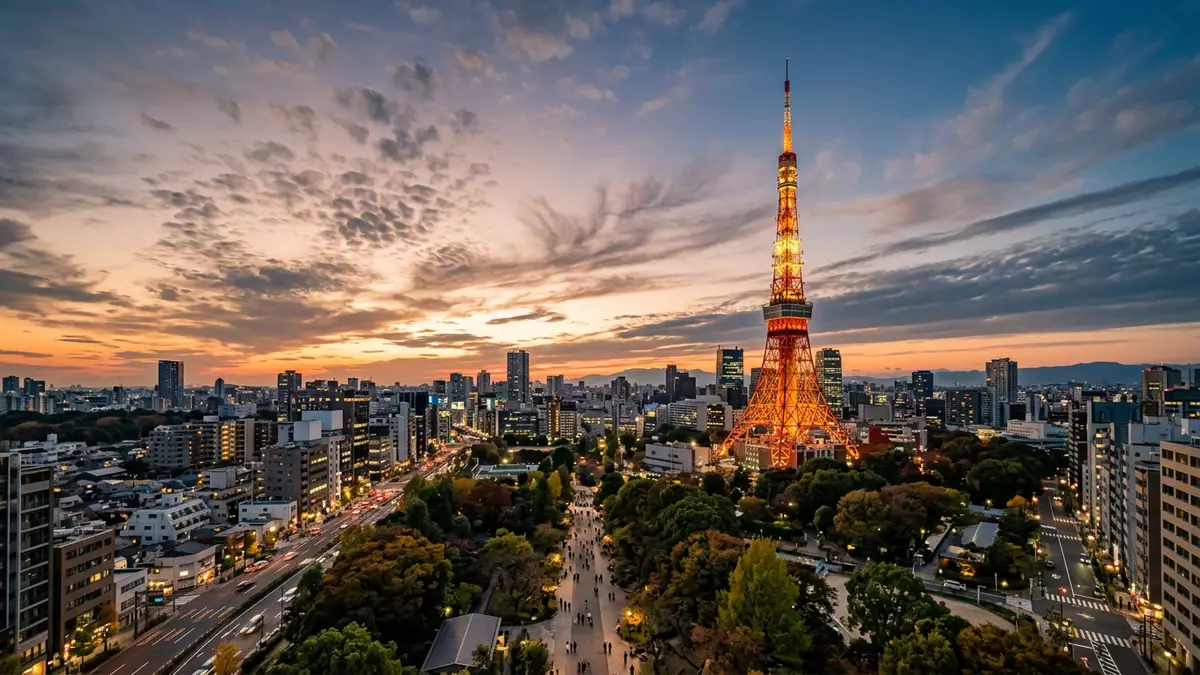
Tokyo Tower rises above the Shiba district of Minato in Tokio as a bold lattice steel landmark from the late 1950s, combining broadcasting infrastructure with elevated viewing decks over the city. Completed in 1958 and reaching 333 m (1,093 ft), it became a symbol of post-war reconstruction and modern engineering in Japan, designed by structural engineer Tach? Nait? as a freestanding communications and observation tower.
A steel lattice tower shaped by post-war ambitions
Tokyo Tower is a freestanding steel lattice structure standing 333 m (1,093 ft) high, with its legs planted in Shiba-koen in Minato, south of central Tokio. The tower’s overall form, with four raking legs tapering to a slender upper section, was inspired by European steel towers and adapted to Japanese seismic conditions by Tach? Nait?, a specialist in tall building design.freestanding communications and observation tower The structure uses a lattice of painted steel members, creating a geometric pattern that reads differently at street level and from a distance.
Construction of Tokyo Tower began in June 1957 and the tower opened to the public on 23 December 1958, following an 18?month building period that involved extensive manual calculation of loads and joints.Tokyo Tower was opened to the public on December 23, 1958 Nait?’s approach balanced structural efficiency with visual impact, giving the tower a height that surpasses the Eiffel Tower’s original 324 m figure and establishing it as one of the dominant vertical elements in Tokio’s skyline.333 meters (1,093 feet) compared to the Eiffel Tower's 324 meters
Observation decks and the city views they frame
Two principal observation decks sit partway up Tokyo Tower, offering enclosed spaces for viewing the city through broad windows and internal walkways. One deck lies roughly mid?height and another higher up, stacked along the tower’s shaft within a band of structural framing that supports the enclosed floors and their circulation routes.???????????????? Inside, lifts carry visitors through the steel skeleton, and interior stairs connect levels, contrasting the robust external lattice with more refined finishes in the viewing halls.
From these decks, the views reach across Minato’s mix of offices, temples and residential blocks towards other landmarks of Tokio, with the tower’s position in Shiba-koen giving sightlines over neighbouring parks and districts. The decks sit within the truss structure, so structural members frame parts of the panorama, reminding visitors that the vistas are being taken from an engineered object rather than a bare platform. At lower levels, the base complex houses functions such as shops and exhibition spaces, wrapping the tower legs with enclosed floors that anchor the tall structure to the surrounding streetscape.Tokyo Tower, rising to a height of 333 meters, was built in 1958
Tokyo Tower in its urban and cultural setting
Tokyo Tower stands at 4?2?8 Shibakoen in Minato City, integrated into an urban park landscape within one of Tokio’s central wards.4-2-8 Shibakoen, Minato-ku, Tokyo Its role as a broadcasting tower for radio and television, combined with visitor access to observation decks, has given it a dual identity: infrastructure serving communications networks and an accessible lookout point over the metropolis.Tokyo Tower is the second tallest structure in Japan The tower was designated a national registered tangible cultural property in 2013, recognising its significance in Japan’s architectural and technological history.designated as a national registered tangible cultural property in 2013
Within the wider constellation of Japanese tall structures, Tokyo Tower held the record for height among the country’s towers until Tokyo Skytree’s completion in 2012, and it remains a recognised symbol of the capital and of post?war modernisation.Tokyo Skytree completed in 2012 The lattice silhouette is familiar in films, television and tourism imagery, where it often appears as shorthand for Tokio itself, much as older photographs from the late twentieth century used it to signal economic growth and technological confidence. Its continued presence in Minato’s skyline ties contemporary high?rise districts to an earlier era of steel construction, giving the city a vertical reference point that predates many of its glass towers.
Visiting Tokyo Tower: what travellers from Western Europe should know
- Tokyo Tower stands in Shibakoen, Minato City, south of central Tokio, and is reached from nearby stations such as Akabanebashi on the Toei ?edo Line and other local rail stops.
- Approaching the tower involves walking across urban parkland and paved plazas, with internal lifts and stairways inside the legs and core; some routes use long flights of steps.
- Tokyo Tower is in Japan, where the official language is Japanese and the currency is the yen.
- Entry requirements depend on your nationality; UK travellers can check the FCDO travel advice at gov.uk/foreign-travel-advice, Irish travellers the Department of Foreign Affairs at ireland.ie.
Searching for Tokyo Tower on social platforms
These links open searches for Tokyo Tower on each platform.
Frequently asked questions about Tokyo Tower
Where is Tokyo Tower located within Tokio?
Tokyo Tower stands at 4?2?8 Shibakoen in Minato City, integrated into parkland south of central districts and close to stations such as Akabanebashi.
What should visitors expect on a visit to Tokyo Tower?
Visitors encounter a steel lattice broadcasting tower with enclosed base floors, lifts and stairs leading to observation decks that frame wide views across Minato and the wider city.
What makes Tokyo Tower distinctive among tall structures in Japan?
Its 333 m height from 1958, lattice steel construction and dual role as communications infrastructure and public viewpoint, together with its cultural property status, give it a distinctive place in Japan’s skyline.


