
Tokyo Skytree, a steel lattice giant above Tokio
Published on 08/28/2026 at 09:09 | Editorial responsibility: Rafael Müller, Editor-in-Chief AD HOC NEWS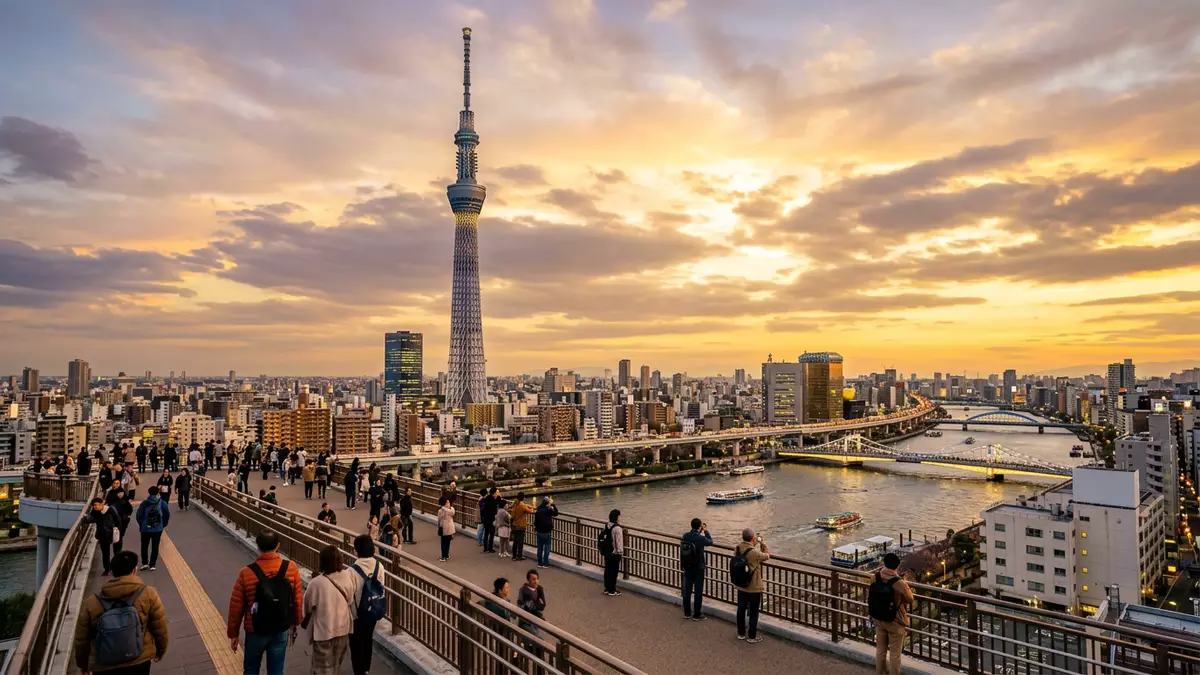
Tokyo Skytree lifts a steel lattice silhouette above the Sumida district in Tokio, a broadcasting tower completed in 2012 that has become a landmark of far-reaching views and engineering ambition.
A 634 m broadcasting tower in Sumida
Tokyo Skytree stands in Sumida City on the eastern side of Tokio, a steel truss tower rising to 634 m (2,080 ft) from a reinforced-concrete central core.steel truss tower rising to 634 m The structure functions as a freestanding transmission tower for digital television signals covering the capital and its surrounding region.freestanding transmission tower for digital television
The project was commissioned by broadcasting interests and railway companies and realised with Obayashi Corporation as the main contractor, under architectural and engineering design by Nikken Sekkei.Obayashi Corporation as the main contractor Construction work began in 2008 and structural completion followed in February 2012, with the tower opening to visitors in May of that year.construction work began in 2008 and structural completion followed in February 2012
Steel, concrete and a tapered lattice form
The basic structure of Tokyo Skytree combines a reinforced-concrete inner shaft with an external steel lattice that narrows as it rises, creating a tapered tower profile above a broader base.reinforced-concrete inner shaft with an external steel lattice The exterior frame uses high-strength steel tubes assembled into a truss system, distributing loads across intersecting members that give the tower its open, mesh-like appearance.high-strength steel tubes assembled into a truss system
At the lower levels, some of the largest tubular members reach diameters of around 2.3 m, with wall thicknesses up to 10 cm, a scale that underlines the forces carried near the base.diameters of around 2.3 m with wall thicknesses up to 10 cm Beneath the tower, podium structures integrate commercial facilities with access routes to the elevators, tying the broadcasting role to wider urban functions.
Observation decks above the city
Tokyo Skytree incorporates two main observation spaces within its upper structure, the Tembo Deck around 350 m (1,148 ft) above ground and the Tembo Galleria near 450 m (1,476 ft).Tembo Deck around 350 m above ground and the Tembo Galleria near 450 m These enclosed viewing levels sit below the upper antenna zone, where metalwork carries the gain tower used for the transmission equipment above about 500 m (1,640 ft).gain tower used for the transmission equipment above about 500 m
Elevators connect the base facilities with the observation levels, travelling through the tower’s core and lattice framework to reach the glass-lined spaces where visitors look out across the Sumida River, the Tokyo lowlands and distant mountain ranges on clear days. At night the structure is lit by programmed illuminations that trace the steel frame and emphasise the tower’s vertical reach against the surrounding city.
Visiting Tokyo Skytree: what travellers from Western Europe should know
- Tokyo Skytree stands in Sumida City to the east of central Tokio, close to the Sumida River and Oshiage Station on the city’s rail and metro network.
- The tower rises from an urban podium with paved plazas, indoor concourses and escalators, and access to the observation decks involves lifts and internal stairways rather than long outdoor approaches.
- Tokio lies in Japan, where the official language is Japanese and the currency is the yen.
- Entry requirements depend on your nationality; UK travellers can check the FCDO travel advice at gov.uk/foreign-travel-advice, Irish travellers the Department of Foreign Affairs at ireland.ie.
Searching for Tokyo Skytree on social platforms
These links open searches for Tokyo Skytree on each platform.
Frequently asked questions about Tokyo Skytree
Where is Tokyo Skytree located in Tokio?
Tokyo Skytree is located in Sumida City on the eastern side of Tokio, near the Sumida River and transport hubs such as Oshiage Station.
What can visitors expect when going up Tokyo Skytree?
Visitors travel by lift from podium-level facilities to enclosed observation decks at around 350 m and 450 m, with expansive views over the city and surrounding landscape.
What makes Tokyo Skytree distinctive among towers?
Tokyo Skytree combines a height of 634 m with twin observation decks, a steel lattice wrapped around a concrete core and a role as the main digital broadcasting tower for the Japanese capital.


