

Todai-ji’s Great Buddha Hall in Nara
Published on 08/19/2026 at 21:57 | Editorial responsibility: Rafael Müller, Editor-in-Chief AD HOC NEWS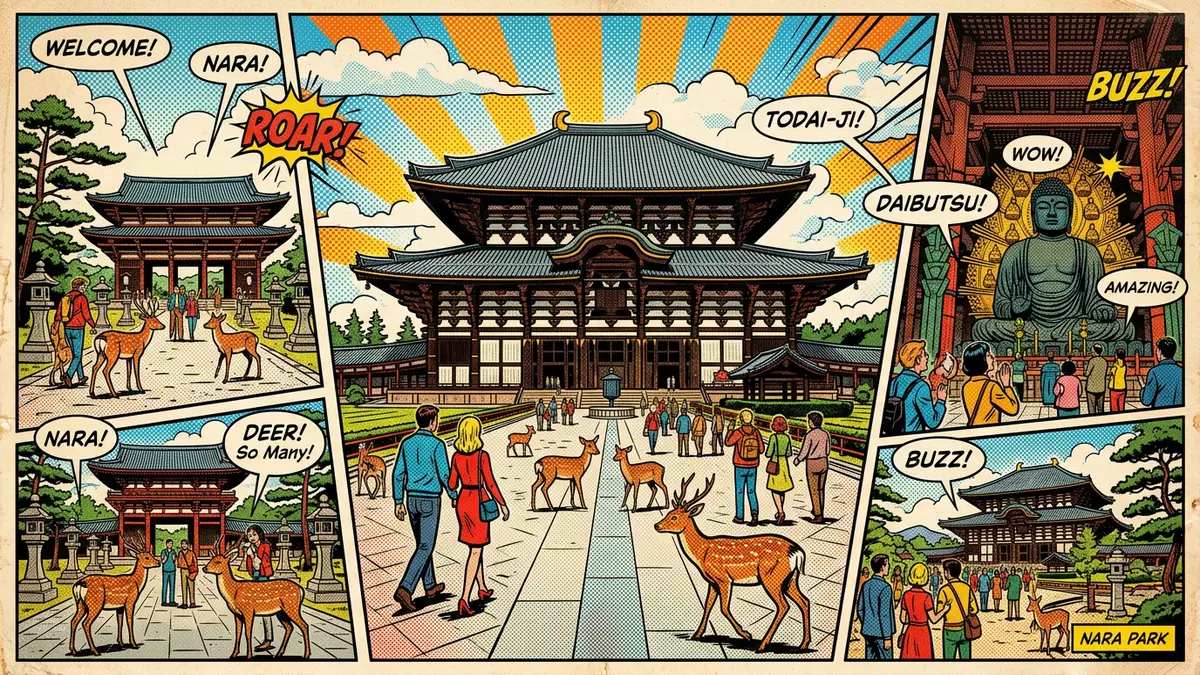
Todai-ji in Nara is a temple complex shaped by scale: the Great Buddha Hall dominates the precincts, and the bronze Vairocana Buddha remains its strongest visual centre. The temple is tied to Emperor Sh?mu and the Nara period, with origins in the eighth century and a place in the Kegon tradition.
Todai-ji and the Nara court
The temple’s beginnings lie with Kinsh?-ji, founded in 728 for the repose of Crown Prince Motoi, the son of Emperor Sh?mu. In 741, Sh?mu ordered a national system of provincial monasteries, and Todai-ji rose into that network as the leading temple in Yamato. The Great Buddha was proclaimed in 743, and construction in Heij?, the Nara capital, brought the temple into the centre of court religion.
The Nara temple was not a single hall but an organised compound of halls, gates, towers and quarters. Its early role joined worship, Buddhist learning and state ritual, giving the site a clear historical profile that still shapes how it is read today.
The Great Buddha Hall as a wooden monument
The Great Buddha Hall, or Daibutsuden, is the main hall of Todai-ji and a National Treasure. The present hall dates to the Edo period and was completed in 1709 under the direction of the monk K?kei, after earlier buildings were lost to fire.
The hall is a vast timber structure, and its reduced seven-bay width still leaves it one of the most imposing wooden interiors in Japan. The temple gives its measurements as 57.012 m (187 ft) wide, 50.480 m (165 ft) long and 48.742 m (160 ft) high. The hall also houses the Great Buddha, a bronze image of Vairocana, and the surrounding space is organised around that single, dominant figure.
Details from the hall make the building feel architectural rather than abstract. Massive timber members, a long roofline and the hall’s broad frontage create a clear sense of weight, while the scale of the Buddha inside keeps the room visually anchored to one point. The building’s form is inseparable from the image it shelters, and the hall remains the most recognisable element of the temple complex.
Reconstruction, damage and continuity
Todai-ji has been rebuilt more than once after fire, and that history is visible in its present fabric. The hall was destroyed in 1180 and again in 1567, then restored in stages that kept the temple functioning as a major Buddhist centre.
The present Great Buddha Hall was rebuilt under K?kei, with later work in the modern era strengthening the structure. The temple’s history also includes the name of Minamoto Yoritomo, whose 1181 reconstruction project belongs to the long sequence of rebuilding at the site. That continuity matters: Todai-ji is not a frozen relic, but a temple complex whose fabric records repeated repair, loss and renewal.
The broader precincts still carry that layered history. The Great South Gate, the Sh?s?in and other surviving structures place the temple within a larger sacred landscape, while the Great Buddha Hall keeps the strongest architectural focus. For many visitors, the experience of Todai-ji begins with timber mass and ends with the calm authority of the Buddha image inside.
Visiting Todai-ji: what travellers from Western Europe should know
- The temple stands in Nara, within walking distance of the city’s historic centre. Rail access is via Nara’s stations, followed by a walk into the temple district.
- The precincts include large halls, gates and open approaches. The Great Buddha Hall is a timber building with substantial interior volume and a pronounced horizontal profile.
- The temple is a World Heritage site within the Historic Monuments of Ancient Nara, and it is part of the city’s Buddhist landscape. Its setting combines major architecture with a long religious and civic history.
- English is not an official language in Japan and the currency is the Japanese yen.
- Entry requirements depend on your nationality; UK travellers can check the FCDO travel advice at gov.uk/foreign-travel-advice, Irish travellers the Department of Foreign Affairs at ireland.ie.
Searching for Todai-ji on social platforms
These links open searches for Todai-ji on each platform.
Frequently asked questions about Todai-ji
Where is Todai-ji?
Todai-ji is in Nara, Japan, in the city’s historic temple area. It belongs to the Historic Monuments of Ancient Nara.
What does a visit to Todai-ji focus on?
The Great Buddha Hall is the main draw, with its huge timber structure and the bronze Vairocana Buddha inside. The wider precincts include gates and other surviving temple buildings.
What makes Todai-ji distinctive?
Its combination of Nara-period origins, repeated reconstruction and an immense wooden hall gives the temple a strong identity. Emperor Sh?mu, K?kei and Minamoto Yoritomo all belong to its historical story.


