
Todai-ji in Nara and the scale of Japan’s Great Buddha
Published on 09/14/2026 at 19:39 | Editorial responsibility: Rafael Müller, Editor-in-Chief AD HOC NEWS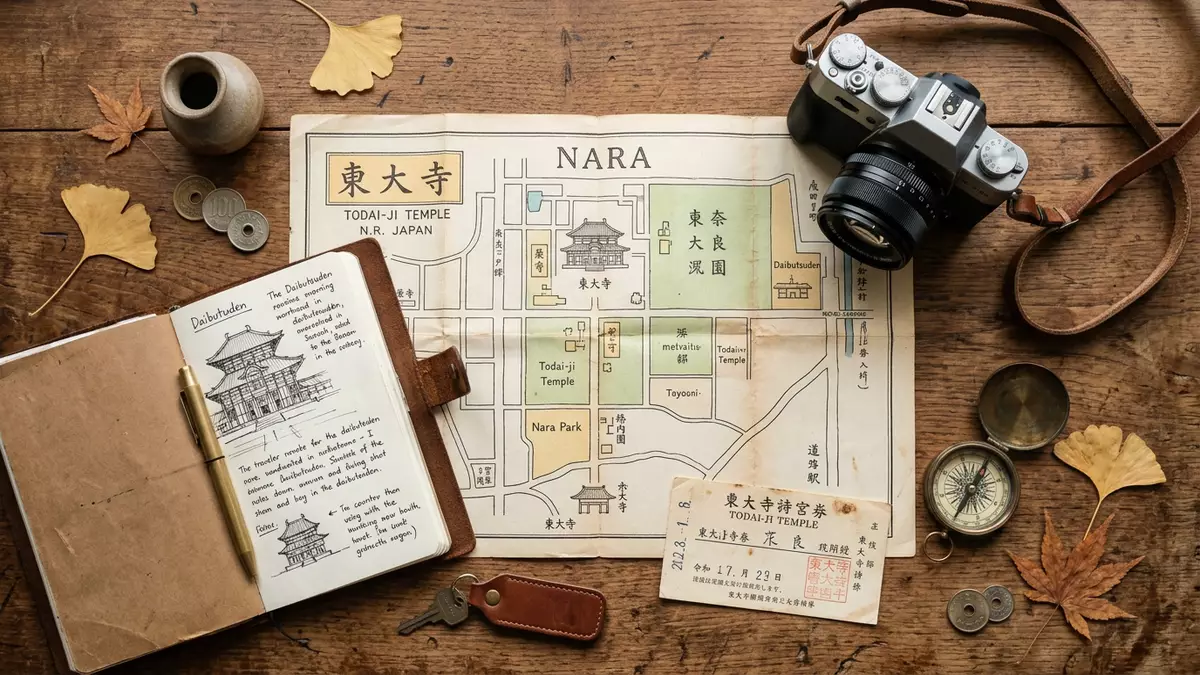
Todai-ji in Nara is a Buddhist temple complex defined by scale: a vast wooden Great Buddha Hall enclosing an enormous bronze statue within the greenery of Nara Park. Founded in the eighth century as the head temple of the Kegon school of Buddhism under Emperor Sh?mu, it anchors the group of “Historic Monuments of Ancient Nara” recognised as a UNESCO World Heritage site.Historic Monuments of Ancient Nara
The Great Buddha Hall: wood on an extraordinary scale
The centrepiece of Todai-ji is the Great Buddha Hall, or Daibutsu-den, the main hall of the complex and one of the largest wooden buildings in the world.Great Buddha Hall dimensions The hall’s timber structure rises to around 48.7 m (159.7 ft), with a width of about 57 m (187 ft) and a length of roughly 50 m (164 ft), forming a vast enclosed volume above a stone platform.wooden structure measurements Inside, massive wooden columns support the roof, creating tall bays leading the eye towards the seated Buddha.
The hall visible today dates from the Edo period, rebuilt after earlier structures were destroyed by fire in 1180 and 1567.fires in 1180 and 1567 Its form expresses an interpretation of classical temple architecture on a monumental scale, with tiled roofs stepping down over deep eaves and a symmetrical façade punctuated by large doors. Within the temple grounds, smaller halls and gates echo this use of timber and tile, but Daibutsu-den remains the dominant volume in the landscape.
The Great Buddha and the eighth-century foundation
Todai-ji’s scale continues inside Daibutsu-den with the Great Buddha of Nara, a bronze seated statue of Vairocana Buddha standing close to 15 m (around 49 ft) high.Nara Great Buddha height Cast in the eighth century, the figure sits on a large lotus pedestal, framed by an ornate halo and flanked by guardian figures and smaller sculptures. The statue’s presence turns the hall into a single vast sanctuary oriented towards the Buddha.
The temple complex itself was constructed in the Nara period, with major buildings of Todai-ji completed between 745 and 752 under Emperor Sh?mu.construction between 745 and 752 As the head temple of the Kegon school, Todai-ji became a national religious centre, housing halls such as the Nigatsu-d? and Hokked? alongside Daibutsu-den.head temple of the Kegon school The complex’s long history is visible in the mixture of Nara-period foundations and later reconstructions in the architectural ensemble.
Todai-ji within Nara Park and the wider temple grounds
Todai-ji stands in the northern part of Nara Park, an expanse of lawns, ponds and woodland dotted with shrines and other historic structures.location in Nara Park Approaching the temple from the park brings visitors through the Nandaimon, a large wooden south gate guarded by statues of the Nio, before paths lead on towards Daibutsu-den and the other halls.Nandaimon gate and Nio guardians The arrangement sets a sequence of open parkland, monumental gate and central hall.
Beyond the Great Buddha Hall, the Todai-ji grounds include subsidiary halls such as Nigatsu-d? and Sangatsu-d?, as well as the Todai-ji Museum displaying temple treasures.Todai-ji Museum and halls Together with other historic sites in Nara, the temple forms part of the UNESCO listing that recognises the city’s role as an ancient capital.UNESCO World Heritage site The combination of large-scale wooden architecture, significant sculptures and landscaped surroundings makes the complex distinctive within Japan’s temple heritage.
Visiting Todai-ji: what travellers from Western Europe should know
- Todai-ji lies in the northern part of Nara Park, north-east of Nara’s city centre, and can be reached on foot from both JR Nara Station and Kintetsu Nara Station.
- Within the grounds, access to the Great Buddha Hall involves walking along park paths and through large temple gates, with several sets of stone steps on the approaches and around the hall.
- The temple complex stands inside Nara Park, where paths between halls and through woodland cover a moderate distance on foot and involve gentle gradients rather than steep climbs.
- The official language is Japanese and the currency is the yen.
- Entry requirements depend on your nationality; UK travellers can check the FCDO travel advice at gov.uk/foreign-travel-advice, Irish travellers the Department of Foreign Affairs at ireland.ie.
Searching for Todai-ji on social platforms
These links open searches for Todai-ji on each platform.Frequently asked questions about Todai-ji
Where is Todai-ji and what kind of place is it?
Todai-ji is a Buddhist temple complex in Nara in central Japan, forming part of the historic monuments of the former capital and set within Nara Park.
What should visitors expect on a visit to Todai-ji?
Visitors encounter large wooden temple buildings, notably the Great Buddha Hall with its enormous bronze statue, along with gates, subsidiary halls and museum spaces linked by park paths.
What makes Todai-ji distinctive among Japanese temples?
Todai-ji combines an eighth-century foundation as head temple of the Kegon school with one of the world’s largest wooden halls and a towering bronze Buddha, all within an open park landscape.


