

Todai-ji and the great hall that defines Nara
Published on 08/21/2026 at 13:18 | Editorial responsibility: Rafael Müller, Editor-in-Chief AD HOC NEWS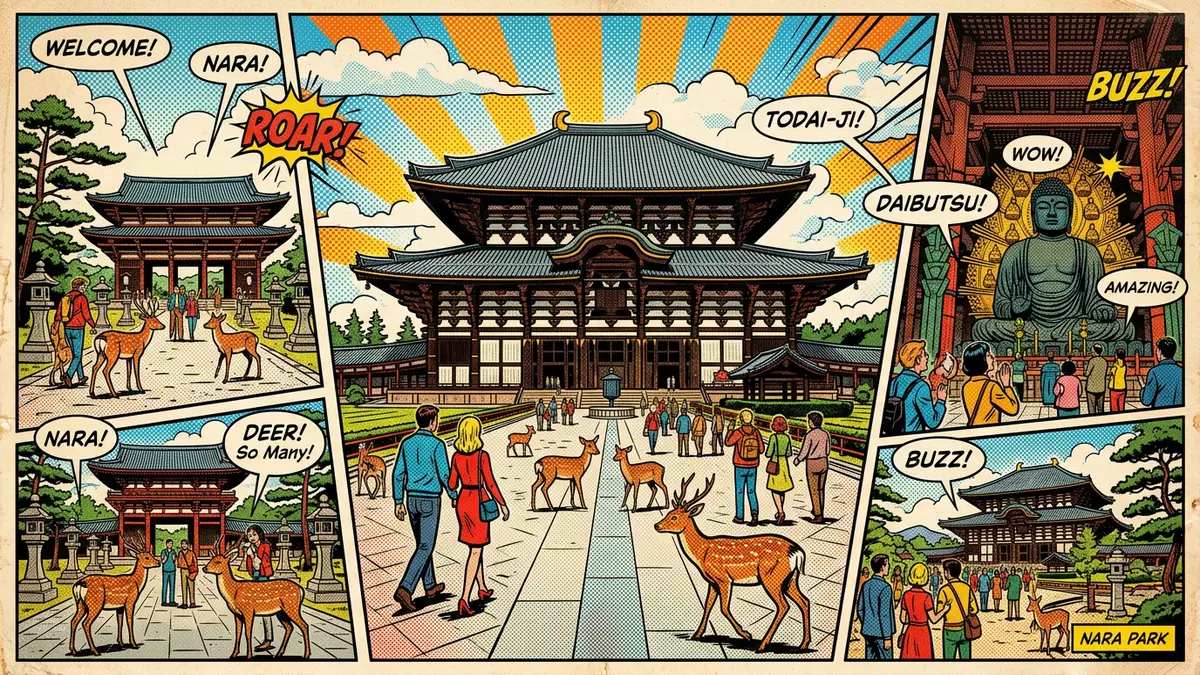
Todai-ji in Nara is a temple complex defined by scale and rebuilding. Its Great Buddha Hall belongs to the Nara period, and the present hall dates from the Edo period under K?kei.
Todai-ji and the shape of the Great Buddha Hall
The Great Buddha Hall, or Daibutsuden, is Todai-ji’s main hall and houses the Vairocana Buddha. The present structure was completed in 1709, after earlier halls were lost to fire in 1180 and 1567present structure.
It is a timber building of seven bays, with a width of 57.012 m (187 ft), a length of 50.480 m (165 ft) and a height of 48.742 m (160 ft)timber building. The hall is also presented as the largest wooden structure in the world, a claim that sits comfortably beside its measured bulk rather than replacing it.
Emperor Sh?mu, R?ben and the temple’s early centuries
The temple’s origins go back to Kinsh?-ji, founded in 728 for Crown Prince Motoi, the son of Emperor Sh?mu. In 741, Sh?mu’s edict created a national system of monasteries, and Todai-ji rose within that frameworkEmperor Sh?mu.
Sh?mu ordered the Great Buddha in 743, and the image was completed in 749. The statue was dedicated in 752, and the temple also developed as a centre for scholar monks and Buddhist ritualdedicated in 752.
World Heritage status and the wider temple precinct
Todai-ji forms part of the UNESCO World Heritage property Historic Monuments of Ancient Nara. The property includes T?dai-ji among its Buddhist temples in the modern city of NaraHistoric Monuments of Ancient Nara.
The precinct preserves several named buildings beyond the Great Buddha Hall, including the Great South Gate, Nigatsu-d? and Hokke-d?. Together they give the site a layered appearance, with halls, gates and ritual spaces from different periods standing within one temple complexnamed buildings.
Visiting Todai-ji: what travellers from Western Europe should know
- Todai-ji stands in Nara, Japan, within the city that gives the temple its modern setting. Rail travellers usually reach Nara and continue towards the temple precinct on foot or by city bus.
- The Great Buddha Hall is a large timber building, and the approach through the precinct includes broad open spaces and gate structures. The hall itself is far larger than a neighbourhood shrine pavilion.
- English is not an official language, and the currency is the Japanese yen.
- The temple belongs to the Historic Monuments of Ancient Nara, a UNESCO World Heritage property that also includes other Buddhist temples, a shrine, a palace site and a forest landscape.
Searching for Todai-ji on social platforms
These links open searches for Todai-ji on each platform.
Frequently asked questions about Todai-ji
Where is Todai-ji?
Todai-ji is in Nara, Japan, inside the historic temple landscape that includes several major Buddhist and Shinto sites. It sits within the modern city rather than on an isolated hilltop.
What does a visit centre on?
The Great Buddha Hall is the main focus, with its huge timber frame and the seated Vairocana Buddha inside. The precinct also includes gates and subsidiary halls that add depth to the visit.
What makes Todai-ji distinctive?
The temple combines an early imperial foundation, a UNESCO-listed setting and a hall rebuilt in the Edo period. The result is a place where the Nara period, the medieval fires and the later restoration remain visible in one complex.


