
Todai-ji and the Great Buddha Hall of Nara
Published on 09/19/2026 at 23:00 | Editorial responsibility: Rafael Müller, Editor-in-Chief AD HOC NEWS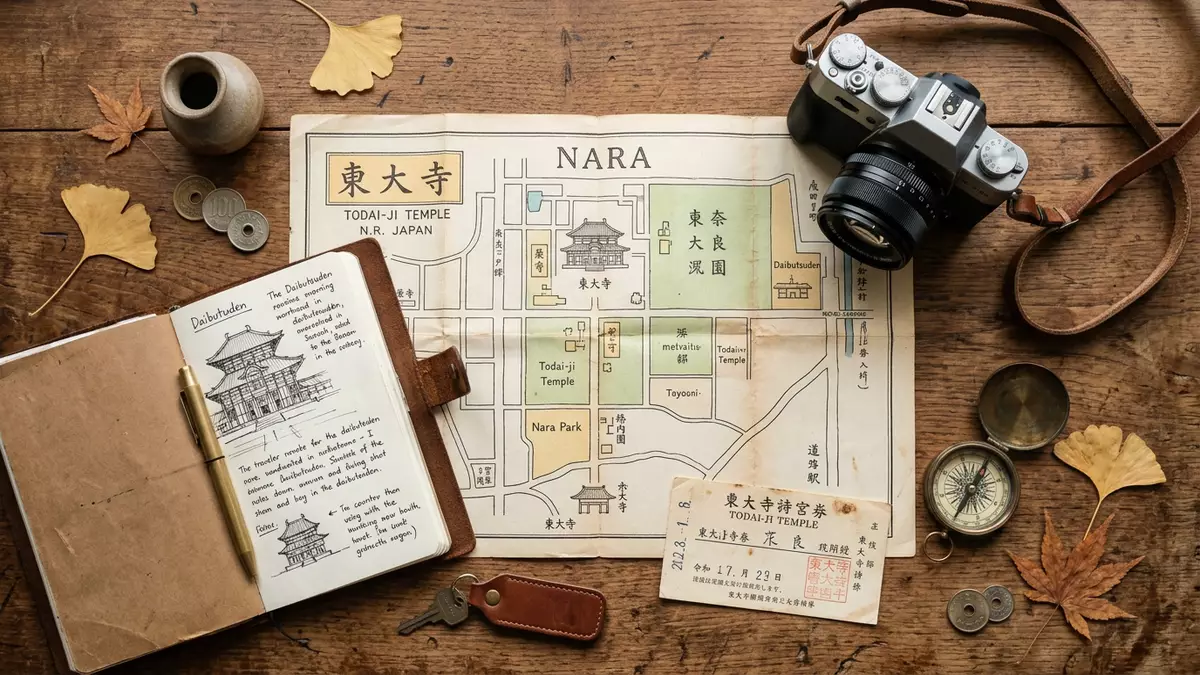
Todai-ji in Nara is a Buddhist temple complex centred on a vast wooden hall that shelters a monumental bronze Buddha statue, an arrangement that defines the site at first glance. Built under Emperor Sh?mu in the eighth century, it stands within Nara Park as the head temple of the Kegon school of Buddhism and forms part of the Historic Monuments of Ancient Nara World Heritage listing.
The Great Buddha Hall and its statue
The focus of Todai-ji is the Great Buddha Hall, known as Daibutsuden, a main worship hall whose timber structure rises with multiple roof tiers over a broad platform in the northern area of Nara Park.The Great Buddha Hall is the Main Hall of T?dai-ji Inside sits a seated bronze image of Vairocana Buddha, called Daibutsu in Japan, surrounded by attendant figures and subsidiary altars that reinforce its role as a central icon.Todaiji is one of Japan's most significant temples
The present hall dates to the Edo period, after earlier buildings were lost to fire, and its timber construction has long been described as among the largest of any wooden building, with a width of over 57 m (187 ft) and a height approaching 49 m (161 ft).The present structure dates to the Edo period The hall’s deep interior, lined with massive columns and side aisles, frames the Great Buddha so that the statue’s head rises well above visitors at floor level, emphasising the scale of both image and building.
A temple of the Kegon school in an ancient capital
Todai-ji was established in the eighth century when Nara served as the imperial capital, and its creation under Emperor Sh?mu is closely tied to the adoption of Buddhism as a state religion in Japan.Emperor Sh?mu vowed to found T?dai-ji in the 8th century The complex became the headquarters of the Kegon school, a tradition rooted in the Avatamsaka Sutra and concerned with the interpenetration of all phenomena, a doctrinal background that gives context to the temple’s grand scale.
The temple grounds form part of the group of sites registered as the Historic Monuments of Ancient Nara, recognising the surviving architecture and archaeological remains from the period when Nara was the centre of government and religion.T?dai-ji is included in Historic Monuments of Ancient Nara Within the complex, halls such as Nigatsu-d? and Sangatsu-d? stand on adjacent terraces and slopes, connected by paths and stairways that climb through groves of trees and open clearings frequented by the free-roaming deer of Nara Park.
Layout, materials and approaches
Todai-ji extends over a broad area inside Nara Park, with the Great Buddha Hall aligned roughly south of the main gate, Nandaimon, a large timber gatehouse approached along a wide path flanked by lawns and trees.Todai-ji lies near Nara Park Beyond the gate, stone paving and steps lead gradually up to the hall’s raised base, where visitors step from the open forecourt into the interior.
The buildings of the complex are primarily constructed in timber with tiled roofs, combining heavy structural members, bracketed eaves and plastered walls in characteristic Nara-period and later styles.Todai Temple is a monumental Japanese temple Smaller halls and the museum display sculpted images, ritual implements and historical documents, while the surrounding parkland, ponds and subsidiary shrines create a sequence of outdoor and indoor spaces that show how the temple sits within the wider landscape of Nara.
Visiting Todai-ji: what travellers from Western Europe should know
- Todai-ji stands in the northern part of Nara Park, reached on foot or by local bus from JR Nara Station or Kintetsu Nara Station, with stops signed for the Great Buddha Hall.
- The approaches from Nandaimon and through the park include stone paths and flights of steps, and the ascent to Nigatsu-d? involves a longer stairway up a hillside terrace.
- The official language is Japanese and the currency is the Japanese yen.
- Entry requirements depend on your nationality; UK travellers can check the FCDO travel advice at gov.uk/foreign-travel-advice, Irish travellers the Department of Foreign Affairs at ireland.ie.
Searching for Todai-ji on social platforms
These links open searches for Todai-ji on each platform.
Frequently asked questions about Todai-ji
Where is Todai-ji located?
Todai-ji is in Nara, in the northern part of Nara Park in Nara Prefecture in Japan, reached from JR Nara Station or Kintetsu Nara Station by bus or on foot.
What can visitors expect when they enter Todai-ji?
Visitors pass through the large Nandaimon gate and follow stone paths and steps to the Great Buddha Hall, where the vast bronze Daibutsu sits inside a high timber interior with subsidiary altars.
What makes Todai-ji distinctive among Japanese temples?
Todai-ji combines its role as head temple of the Kegon school with the scale of the Great Buddha Hall, the size of the bronze Buddha image and its World Heritage status within the Historic Monuments of Ancient Nara.


