Tiwanaku’s stone monuments on the Altiplano
Published on 09/04/2026 at 14:47 | Editorial responsibility: Rafael Müller, Editor-in-Chief AD HOC NEWS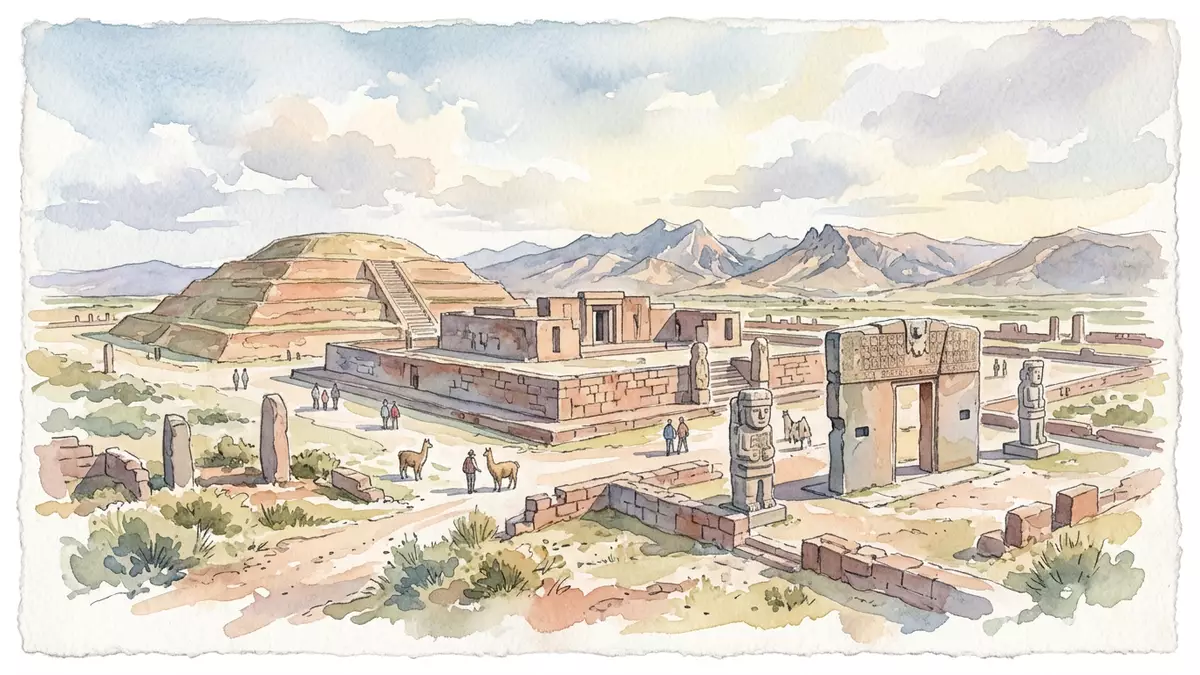
Tiwanaku in Bolivia is an archaeological site of stone monuments on the Altiplano, near Lake Titicaca. Its remains preserve the outline of a pre-Hispanic centre linked to a powerful Andean civilisation and a UNESCO World Heritage designation.
Stone ceremonial architecture on the Altiplano
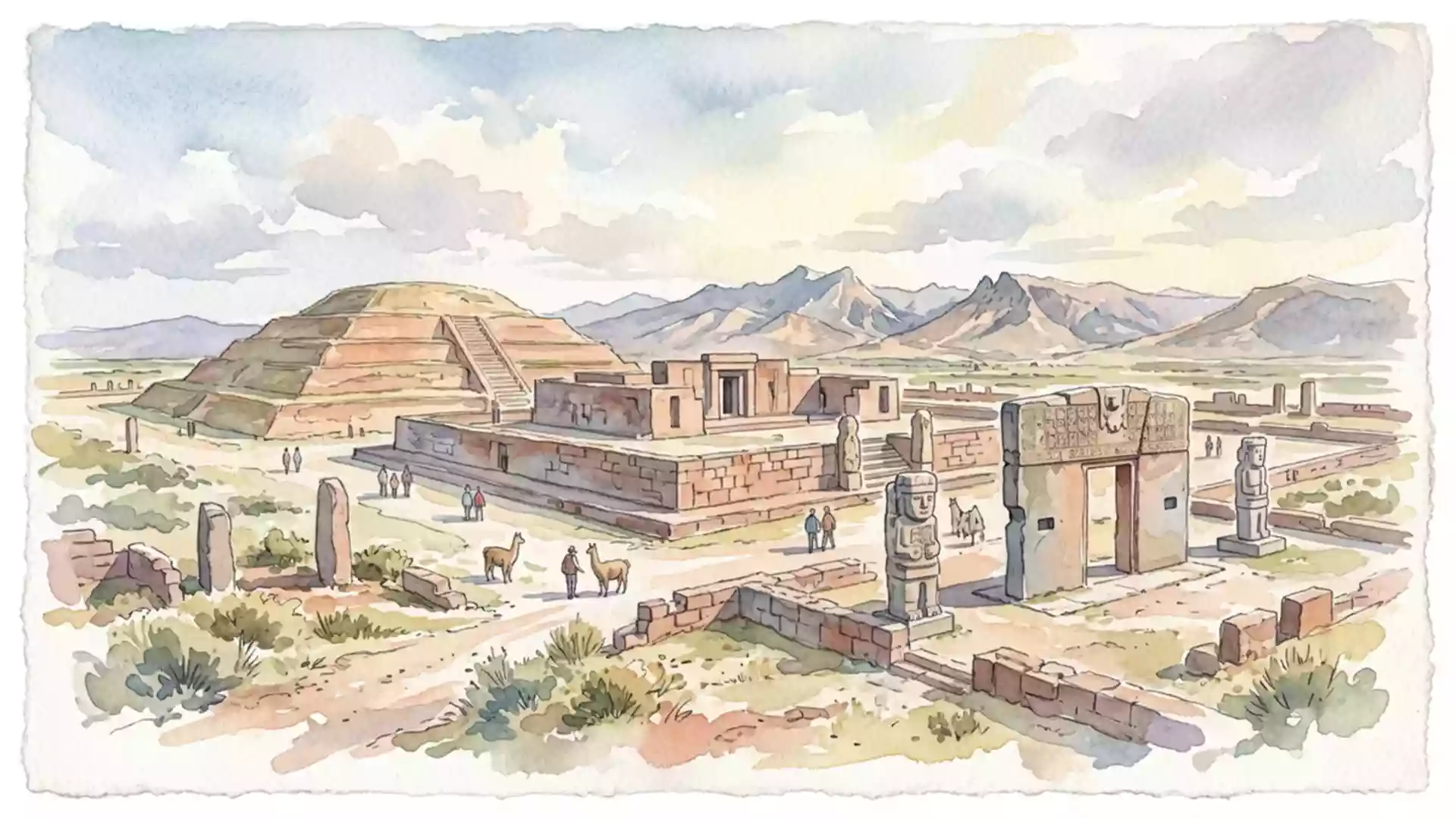
The site is known for its monumental buildings in andesite and sandstone, including the Akapana, the Kalasasaya and the semi-subterranean temple. The best-known single object is the Gate of the Sun, a carved stone gateway within the ceremonial core.
UNESCO places the city’s apogee between 500 and 900 AD, and describes it as the capital of a powerful pre-Hispanic empire. Britannica identifies the main site as a major pre-Columbian civilisation near the southern shore of Lake Titicaca, and notes UNESCO inscription in 2000.pre-Columbian civilisation
The city’s political and ritual centre
The archaeological complex combines raised platforms, enclosed courts and free-standing monoliths. The layout includes the Akapana mound, the Kalasasaya enclosure and the semi-subterranean temple, all part of a civic and ceremonial landscape.
The city is associated with the Tiwanaku culture, a name that gives the place its own historical identity as well as its modern recognition. UNESCO describes the remains as testimony to the cultural and political significance of that civilisation, and the site sits in the Province of Ingavi, Department of La Paz.Province of Ingavi
Tiwanaku and Andean history
Tiwanaku belongs to the long sequence of Andean urban cultures that shaped the highlands before the Inca expansion. Britannica places its major building phases in the Early Intermediate and Middle Horizon periods, with influence extending across parts of the southern Andes.Middle Horizon periods
The site’s stonework, monoliths and carved gateway make the complex readable as architecture rather than ruin alone. The surviving remains present a planned ceremonial centre, not a scattered collection of stones, and that coherence is one reason the place matters to travellers and historians alike.
Visiting Tiwanaku: what travellers from Western Europe should know
- Tiwanaku lies near the southern shore of Lake Titicaca, west of La Paz in Bolivia. Road access links the site with the city and the Altiplano route toward the lake.
- The site stands at high altitude on open ground. The stone monuments are spread across an exposed archaeological area with long sightlines and little shelter.
- The ceremonial core includes an earth mound, enclosing walls and carved monoliths. The main experience is an outdoor walk among substantial stone remains.
- English is not the official language, and the currency is the Bolivian boliviano.
- Entry requirements depend on your nationality; UK travellers can check the FCDO travel advice at gov.uk/foreign-travel-advice, Irish travellers the Department of Foreign Affairs at ireland.ie.
Searching for Tiwanaku on social platforms
These links open searches for Tiwanaku on each platform.
Frequently asked questions about Tiwanaku
Where is Tiwanaku?
Tiwanaku lies in Bolivia, near Lake Titicaca, on the high Altiplano west of La Paz. UNESCO places it in the Province of Ingavi, Department of La Paz.
What does a visit involve?
The site is an outdoor archaeological complex with stone platforms, courts and carved monuments. The main impression comes from walking among the Akapana, Kalasasaya and the semi-subterranean temple.
What makes Tiwanaku distinctive?
Its stone ceremonial architecture and its role in Andean history define the place. The Gate of the Sun and the planned civic core give the site its strongest visual identity.