

Tiwanaku and the stone geometry of the Bolivian Altiplano
Published on 08/21/2026 at 06:46 | Editorial responsibility: Rafael Müller, Editor-in-Chief AD HOC NEWS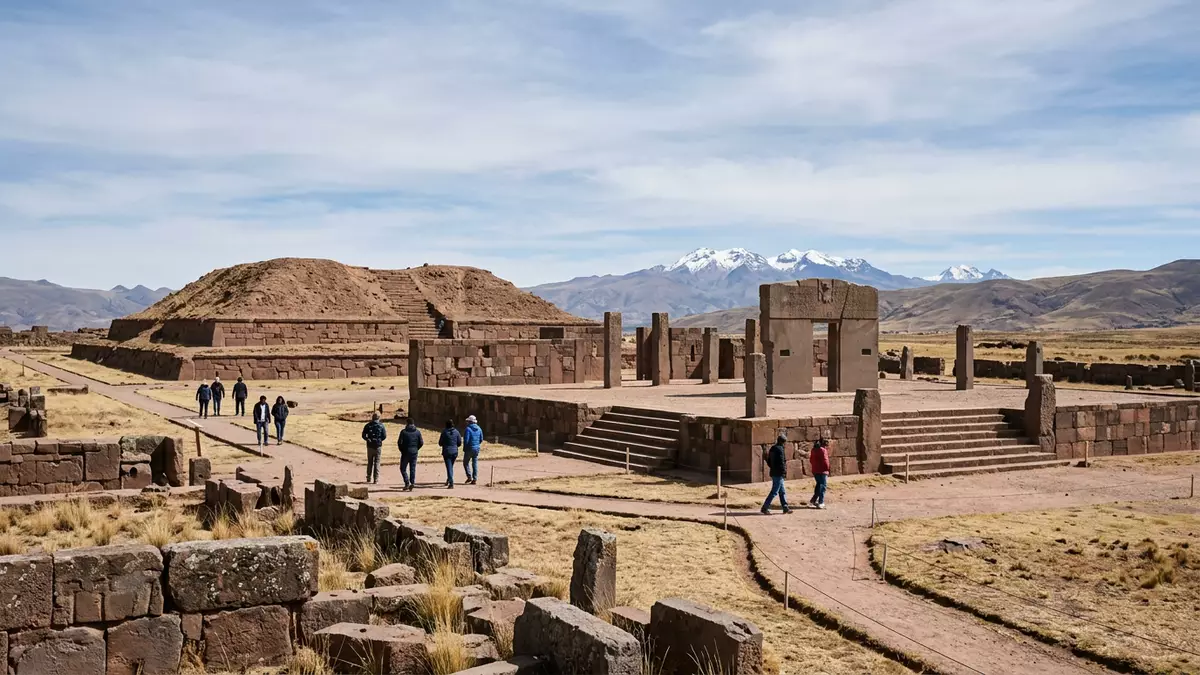
High on the Bolivian Altiplano, Tiwanaku stretches across a windswept plateau of earth and carved stone, a pre-Columbian city framed by mountains and by Lake Titicaca. The ruins preserve ceremonial platforms, sunken courts and monoliths that belonged to a civilisation which reached its height between the fifth and ninth centuries CE, long before the rise of the Inca.Tiwanaku: Spiritual and Political Centre of the Tiwanaku Culture
Capital of a highland civilisation
Tiwanaku lies in the La Paz Department of western Bolivia, close to the southern shore of Lake Titicaca and more than 3,800 m (around 12,500 ft) above sea level.near the southern shores of Lake Titicaca The site forms the centre of Tiwanaku Municipality in the Province of Ingavi, in a landscape of open fields and distant Andean peaks.
The city flourished as the political and ceremonial heart of a state whose influence extended across parts of present-day Bolivia, Peru, Chile and Argentina between about 400 and 900 CE.Tiwanaku as capital of a vast empire The main ruins cover several hectares and include monumental platforms, sunken ritual spaces, palaces and stone sculptures arranged on a grid-like plan.
Monumental platforms and ritual spaces
At the centre of Tiwanaku rises Akapana, a stepped platform built from large stone blocks and earth fill.Akapana, a stepped pyramid Its terraces form a geometric mass that dominates the surrounding plain and gives a sense of how the city organised its sacred architecture around elevated platforms.
Nearby, the Kalasasaya enclosure stretches as a large raised rectangle edged with tall stone pillars and lined walls.the Kalasasaya, an open temple built on a platform Within this space stands the Gateway of the Sun, a single carved stone block decorated with relief figures, and monolithic statues such as the Ponce Monolith, whose stylised faces and hands still read clearly against the highland light.
World Heritage status and living symbolism
The main archaeological core of Tiwanaku is inscribed on the UNESCO World Heritage List under the title “Tiwanaku: Spiritual and Political Centre of the Tiwanaku Culture”, with inscription dating from 2000.Date of inscription: 2000 The designation recognises the site as an outstanding example of an Andean civilisation distinct from other pre-Hispanic empires of the Americas.capital of a powerful pre-Hispanic empire
Tiwanaku also carries meaning beyond its stone architecture. Aymara communities in Bolivia regard the ruins as a sacred landscape linked to ancestral origins, and archaeological research continues to refine the chronology of the city from its early occupation in the first centuries CE through its monumental phase between about 300 and 900 CE.chronology for Tiwanaku
Visiting Tiwanaku: what travellers from Western Europe should know
- Tiwanaku lies in western Bolivia, in the La Paz Department on the Altiplano, west of the city of La Paz and inland from the southern shore of Lake Titicaca.
- The ruins stand at an elevation of around 3,850 m (about 12,630 ft), so movement across the site takes place at high altitude on exposed ground.
- Monumental areas such as Akapana, Kalasasaya and the semi-subterranean temple are linked by open paths across the archaeological zone, with steps and uneven stone surfaces in several sections.
- The official language is Spanish and the currency is the Bolivian boliviano.
- Entry requirements depend on your nationality; UK travellers can check the FCDO travel advice at gov.uk/foreign-travel-advice, Irish travellers the Department of Foreign Affairs at ireland.ie.
Searching for Tiwanaku on social platforms
These links open searches for Tiwanaku on each platform.Frequently asked questions about Tiwanaku
Where is Tiwanaku?
Tiwanaku is an archaeological site in the La Paz Department of western Bolivia, on the Altiplano plateau near the southern shore of Lake Titicaca.
What can visitors expect to see at Tiwanaku?
Visitors encounter stepped platforms such as Akapana, the rectangular Kalasasaya enclosure, a semi-subterranean temple and carved stone monoliths standing across the ceremonial core.
What makes Tiwanaku distinctive among Andean sites?
Tiwanaku served as the spiritual and political centre of a highland empire between about 400 and 900 CE and preserves monumental stone architecture recognised as a UNESCO World Heritage Site.


