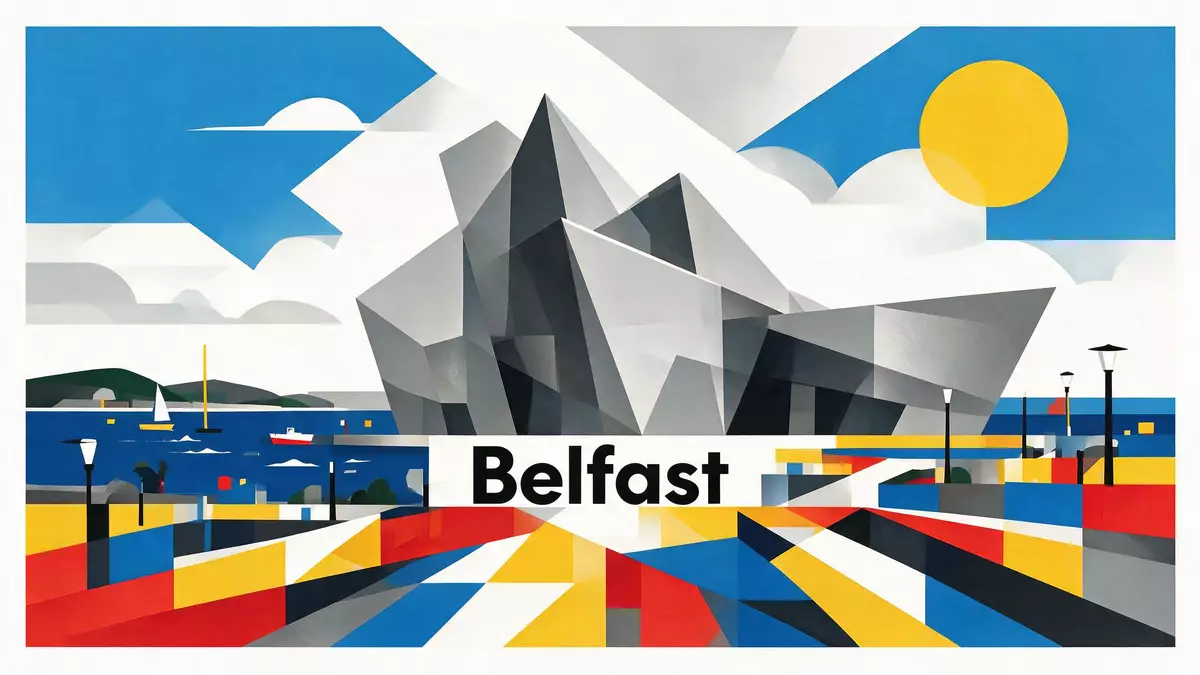
Titanic Belfast: a sculpted memory of the shipyards
Published on 08/06/2026 at 22:28 | Editorial responsibility: Rafael Müller, Editor-in-Chief AD HOC NEWS
Titanic Belfast is a striking museum and visitor centre on the redeveloped docks of Belfast, shaped as a multifaceted monument to the shipbuilding era that produced RMS Titanic in 1912. Its angular aluminium-clad facades rise above the former Harland & Wolff shipyards, where the White Star Line’s Olympic?class liners were constructed in the early twentieth century. Opened in 2012 to coincide with the centenary of Titanic’s maiden voyage, the building gives physical form to a story that is rooted in Belfast’s industrial heritage and in the global memory of the ship itself.
A building that echoes a ship’s hull and the shipyard skyline
The most immediate impression of Titanic Belfast is its sculptural architecture, designed by Eric Kuhne and Todd Architects as a cluster of sharp, leaning forms radiating around a central atrium. Each corner is clad in textured aluminium panels that catch the light and recall the intersecting lines of a ship’s hull and bow. From a distance the ensemble resembles several vessels converging, while up close the façades turn into a repeating pattern of folded metal and glass that feels both industrial and abstract.
The museum stands on land associated with the Harland & Wolff shipyards, whose cranes and dock structures dominated Belfast’s waterfront through the late nineteenth and early twentieth centuries. That industrial setting informs the materials and scale: the building’s base is anchored by concrete and glass, and its outer skin uses aluminium to reflect the shipbuilding trade and the engineering labour that once filled the nearby slipways. The central atrium acts as a hub from which exhibition levels spread outward, echoing the way ship sections once rose from keel to deck in the yards.
Following Titanic’s story through immersive galleries
Inside Titanic Belfast, the story of RMS Titanic unfolds through a series of themed galleries arranged across several floors, beginning with Belfast’s growth as a linen and shipbuilding city and moving through the commissioning and construction of the Olympic?class liners. The early galleries explore the industrial landscape of late Victorian and Edwardian Belfast, using large-scale visuals, models and reconstructions to show how Harland & Wolff developed the capacity to build ever larger steel ships for the White Star Line.
Further into the museum, visitors encounter spaces that focus on the design and fitting?out of Titanic herself, including exhibits on her grand staircases, first?class cabins and engineering spaces. Multimedia installations and projected imagery trace the ship’s launch, sea trials and departure on the transatlantic route from Southampton in April 1912. Later galleries address the collision with the iceberg, the sinking and its aftermath, presenting archival material, passenger stories and details of the inquiries held in Britain and the United States. The final sections look at the discovery of Titanic’s wreck on the Atlantic seabed in 1985 and the wider legacy of the disaster in maritime safety and cultural memory.
The wider Titanic Quarter and the preserved dockscape
Titanic Belfast sits at the heart of the Titanic Quarter, a dockside regeneration project that repurposes parts of Belfast’s former shipyards into a mixed area of cultural attractions, offices and residential developments. Around the museum, the layout retains sightlines towards the large Harland & Wolff cranes, which remain some of the most recognisable landmarks on the city’s skyline. The ground level connects to open plazas and walkways that follow the lines of the historic slipways where Titanic and her sister ships were constructed and launched.
Close to the visitor centre, a short walk brings travellers to the preserved dry dock and pump?house that once formed part of Harland & Wolff’s heavy engineering infrastructure. These structures, built in the early twentieth century, illustrate the scale of the facilities required to maintain large ships and form a tangible backdrop to the museum’s narrative galleries. Together, the museum and its surroundings create a layered experience in which contemporary architecture, historic industrial remnants and interpretive exhibits combine to show how a shipyard city responded to the most famous vessel in its history.
Visiting Titanic Belfast: what travellers from Western Europe should know
- Titanic Belfast stands in the Titanic Quarter on Belfast’s waterfront and is reached from Belfast city centre by road and by local public transport.
- Admission arrangements and opening hours are set by the site’s operator and change with the season; the official website is the only binding source.
- The experience is largely indoors, so it lends itself to visits in any season, with brighter days giving added character to the aluminium and glass façades.
- The museum is spread across multiple levels connected by lifts and stairs, and the surrounding dockside involves a moderate amount of walking on level surfaces.
- On site, staff use English, card payments are widely accepted, and visitors will find the usual customs of the United Kingdom regarding queuing and public behaviour.
- Entry requirements depend on your nationality. UK travellers should check the FCDO travel advice at gov.uk/foreign-travel-advice; Irish travellers the Department of Foreign Affairs at ireland.ie; EU and EEA citizens their own national foreign ministry.
Searching for Titanic Belfast on social platforms
These links open searches for Titanic Belfast on each platform.
Frequently asked questions about Titanic Belfast
Where is Titanic Belfast located?
Titanic Belfast stands in the Titanic Quarter on the former docklands of Belfast, in the north?east of the island of Ireland.
What can visitors expect inside Titanic Belfast?
Visitors move through themed galleries combining models, reconstructions, multimedia and archival material that trace the story of RMS Titanic from design to legacy.
What makes Titanic Belfast distinctive among maritime museums?
Its faceted aluminium and glass architecture stands beside preserved shipyard structures, directly linking the narrative of Titanic to the landscape where the ship was built.