
Times Square at the crossroads of New York City
Published on 09/12/2026 at 16:56 | Editorial responsibility: Rafael Müller, Editor-in-Chief AD HOC NEWS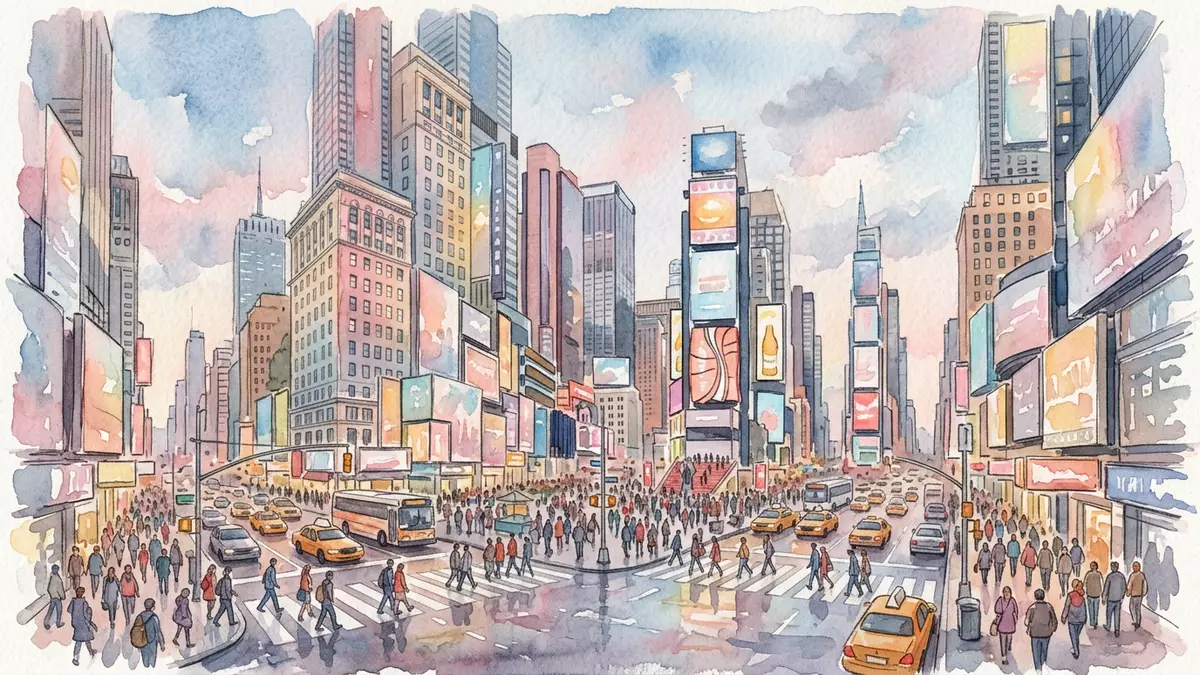
Times Square in New York City is a compact urban crossroads where Broadway and Seventh Avenue intersect in Midtown Manhattan, framed by dense streets and towers and filled with theatres and illuminated advertising. It took its present name in 1904, when The New York Times moved its headquarters to the then new Times Building at the junction of Broadway and 42nd Street, tying the square’s identity directly to the newspaper’s presence.Times Square was renamed in 1904
A junction that became a district
Strictly speaking, Times Square is the stretch of Midtown Manhattan around the intersection where Broadway and Seventh Avenue cross between 42nd and 47th Streets, but the name has come to describe a wider entertainment district centred on that meeting of streets.Broadway, Seventh Avenue and 42nd Street meet here The square grew out of what had been Longacre Square, a name borrowed from London’s carriage district, and for much of the nineteenth century the area combined commercial premises with housing before its theatre era began.
The turn of the twentieth century brought a cluster of theatres to West 42nd Street and the surrounding blocks, and within a couple of decades the Times Square and Broadway area had become a major American entertainment district dominated by playhouses, music halls and hotels.The Times Square and Broadway area developed into an entertainment district Its location above a large subway interchange helped fix it as one of New York City’s principal gathering places, reinforcing the sense that this junction was more than just a traffic crossing.
From Longacre Square to the “Crossroads of the World”
Before its association with the newspaper, the area was known as Longacre Square and was linked to carriage manufacturing, stables and related trades, reflecting the role of horse-drawn transport in nineteenth-century Manhattan.Longacre Square was named for London’s carriage district The renaming to Times Square followed Adolph Ochs’s decision to move The New York Times into a new skyscraper on 42nd Street, and the building that housed the paper became known later as One Times Square.
The twentieth century layered reputations onto the square. It became a centre for big electric signage, especially after the arrival of neon in the 1920s, and earned the nickname “Crossroads of the World” as its theatres and illuminated adverts drew attention from across the United States.Early electric signage helped define Times Square The same density that made it a celebrated entertainment hub also contributed to phases in which adult entertainment, crime and a generally sleazy atmosphere dominated parts of the district during the mid and late twentieth century, before later programmes of renewal shifted its character again.
Light, signage and celebration
One of the most striking features of Times Square is the concentration of illuminated advertising and screens attached to the facades along Broadway, Seventh Avenue and the connecting streets, creating a canyon of light around the road junctions. Early in the twentieth century it became a showcase for large electric signs, and by the interwar years the displays along the buildings were an established presence in the square’s image.Electric signs and displays line the buildings
Times Square is also known as the place where New Yorkers gather to mark the New Year, with celebrations centred on the tower bearing the New York Times name and the ball lowered from a flagpole on New Year’s Eve. The ball drop tradition dates from 1907, when a wood-and-iron globe fitted with lamps was first used to mark midnight, and the annual descent above the square has become part of its identity.The New Year’s Eve ball drop dates from 1907
Visiting Times Square: what travellers from Western Europe should know
- Times Square lies in Midtown Manhattan where Broadway and Seventh Avenue intersect between 42nd and 47th Streets, reached easily by New York City Subway services that stop at the Times Square–42nd Street station complex.
- The streets around the square are busy urban thoroughfares with kerbs, crossings and sections of pedestrian plaza, so moving between viewpoints involves walking on paved surfaces and crossing streets with traffic.
- The area is surrounded by theatres and commercial buildings, and the concentration of large illuminated signs means that the facades facing the square carry extensive lighting installations and advertising panels.
- The official language is English and the currency is the US dollar.
- Entry requirements depend on your nationality; UK travellers can check the FCDO travel advice at gov.uk/foreign-travel-advice, Irish travellers the Department of Foreign Affairs at ireland.ie.
Searching for Times Square on social platforms
These links open searches for Times Square on each platform.
Frequently asked questions about Times Square
Where is Times Square in New York City?
Times Square is in Midtown Manhattan around the intersection of Broadway and Seventh Avenue, centred near 42nd Street.
What should visitors expect on a visit to Times Square?
Visitors encounter dense streets lined with theatres, commercial buildings and large illuminated advertising displays, with pedestrian areas and heavy traffic flows.
What makes Times Square distinctive among New York City squares?
The combination of its theatre district, its concentration of electric signage and its association with The New York Times and the New Year’s Eve ball drop gives Times Square a particular character.


