
Timbuktu, city of sand, scholarship and earthen mosques
Published on 08/26/2026 at 15:43 | Editorial responsibility: Rafael Müller, Editor-in-Chief AD HOC NEWS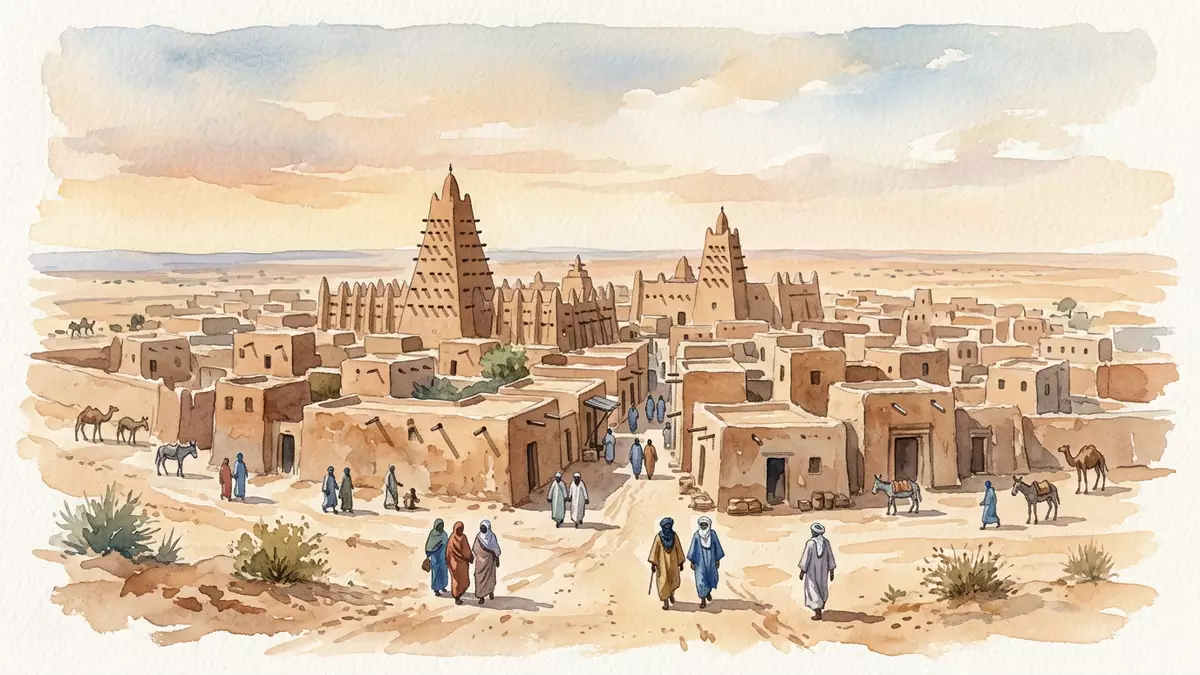
Timbuktu in Mali sits on the southern edge of the Sahara Desert, close to a great bend of the Niger River, and rose from a nomads’ encampment into a celebrated centre of Islamic scholarship in the late medieval period. Its landscape of sand streets, flat-roofed houses and monumental earthen mosques reflects centuries of trade and learning that linked West Africa with North Africa and the wider Islamic world.
A Saharan trading city shaped by sand and the Niger
Timbuktu lies in central Mali, near the northernmost point of the Niger River’s course, on the boundary between riverine Sahel and true desert. The town is located about 12 miles north of the Niger on the southern edge of the Sahara, where the river’s broad bend turns south-east after flowing through the inland delta region of Massina.The town is located 12 miles north of the Niger River The surrounding terrain is sandy and windswept, with low dunes and sparse vegetation, so the presence of a navigable river nearby has long given the city strategic importance.
The settlement began as a seasonal encampment used by Tuareg nomads, then became permanent in the early twelfth century as trade intensified along trans-Saharan caravan routes.Timbuktu began as a seasonal settlement and became permanent Incorporated into the Mali Empire from the late thirteenth century, Timbuktu developed into a key trading post for salt carried from the desert, gold from regions to the south and other goods moving between West Africa and Mediterranean cities.After incorporation into the Mali Empire it became an important post on trans-Saharan caravan routes Its location meant that camel caravans traversing the desert could connect with river transport on the Niger, linking desert and savannah economies.
Earthen mosques and the architecture of a learning capital
Timbuktu’s skyline is defined by three historic mosques constructed from sun-dried mud bricks and timber: Djinguereber, Sankore and Sidi Yahia. These mosques, dating from the fourteenth and early fifteenth centuries, are among the oldest in western Africa and symbolise the city’s era as an intellectual and spiritual capital.Three of western Africa’s oldest mosques—Djinguereber, Sankore and Sidi Yahia—were built there during the 14th and early 15th centuries Their thick earthen walls, projecting wooden beams and tapered minarets embody Sahelian mud architecture adapted to a harsh, dry climate.
The Djinguereber Mosque was built in 1327 during the reign of Mansa Musa, the celebrated ruler of the Mali Empire, following his pilgrimage to Mecca.The Djinguereber Mosque was built in 1327 during the reign of Mansa Musa Sankore Mosque developed into the core of a scholarly complex often described collectively as the University of Timbuktu, where students studied Quranic exegesis, law, mathematics and other disciplines under prominent scholars.The term “University of Timbuktu” refers to a scholastic community associated with the mosques of Sankore, Djinguereber and Sidi Yahia Sidi Yahia Mosque, completed in the fifteenth century, was named after Sidi Yahya al?Tadelsi, who served as imam and gave the complex an enduring scholarly reputation.The Sidi Yahia Mosque, completed in the 15th century, was named after Sidi Yahya al?Tadelsi
These mosques and a series of mausoleums and holy places form the core of Timbuktu’s inscription on the UNESCO World Heritage List. The property “Timbuktu” was inscribed in 1988 for its three great mosques and sixteen mausoleums, which together represent a major centre of Islamic learning in Africa.Home of the prestigious Sankore University and other madrasas, Timbuktu was inscribed as a UNESCO World Heritage Site in 1988 The city’s houses and alleys, built largely in earthen materials, echo the same construction techniques, with flat roofs supported by timber and walls renewed with mud plaster.
Manuscript culture and an African centre of scholarship
Between roughly the fifteenth and sixteenth centuries Timbuktu functioned as an intellectual and spiritual capital for West Africa, attracting scholars and students from across the Sahara. Manuscripts written in Arabic script, covering religious law, astronomy, medicine, mathematics, history and poetry, accumulated in family libraries and mosque complexes over generations.It became a centre of Islamic culture approximately 1400–1600 Estimates for the number of manuscripts preserved in Timbuktu’s public and private collections run into several hundred thousand, ranging from around 300,000 to 700,000 documents.Estimates place the number of surviving manuscripts at between 300,000 and 700,000
The term “Timbuktu manuscripts” covers handwritten works from the thirteenth to twentieth centuries, produced both locally and elsewhere, that found their way into the city through trade and scholarship.Approximately 400,000 documents dating from the 13th to the 20th century are said to be held in Timbuktu collections Today many of these manuscripts are housed in institutional libraries, including the Ahmed Baba Institute of Higher Learning and Islamic Research, named after the sixteenth?century scholar Ahmed Baba al?Massufi al?Timbukti, who authored numerous works and maintained an extensive personal library.The majority of surviving manuscripts are housed at the Ahmed Baba Institute For visitors, the manuscript heritage is an essential context for understanding why a remote desert town became synonymous with knowledge and long-distance learning.
Visiting Timbuktu: what travellers from Western Europe should know
- Timbuktu is reached in Mali’s central region near the Niger River; travel commonly combines overland routes across the Sahel with access from riverine towns.
- The town stands on sandy terrain where streets and paths cross low dunes; walking involves uneven ground and exposure to desert sun.
- Historic mosques such as Djinguereber, Sankore and Sidi Yahia sit within residential quarters, so moving between them means navigating narrow alleys and compact neighbourhoods.
- The official language is French and the currency is the West African CFA franc.
- Entry requirements depend on your nationality; UK travellers can check the FCDO travel advice at gov.uk/foreign-travel-advice, Irish travellers the Department of Foreign Affairs at ireland.ie.
Searching for Timbuktu on social platforms
These links open searches for Timbuktu on each platform.
Frequently asked questions about Timbuktu
Where is Timbuktu and what kind of place is it?
Timbuktu is a town in central Mali on the southern edge of the Sahara Desert, situated north of the Niger River and shaped by desert and Sahel landscapes.
What can visitors expect when exploring Timbuktu?
Visitors encounter earthen mosques, compact residential quarters and sandy streets that reflect the city’s history as a caravan trading centre and a hub of Islamic learning.
What makes Timbuktu distinctive among African cities?
Timbuktu combines Saharan caravan heritage, monumental mud?brick mosques from the fourteenth and fifteenth centuries and vast collections of Arabic manuscripts that document centuries of scholarship.


