
Tiantan in Peking: the Temple of Heaven’s vast ceremonial geometry
Published on 09/16/2026 at 07:30 | Editorial responsibility: Rafael Müller, Editor-in-Chief AD HOC NEWS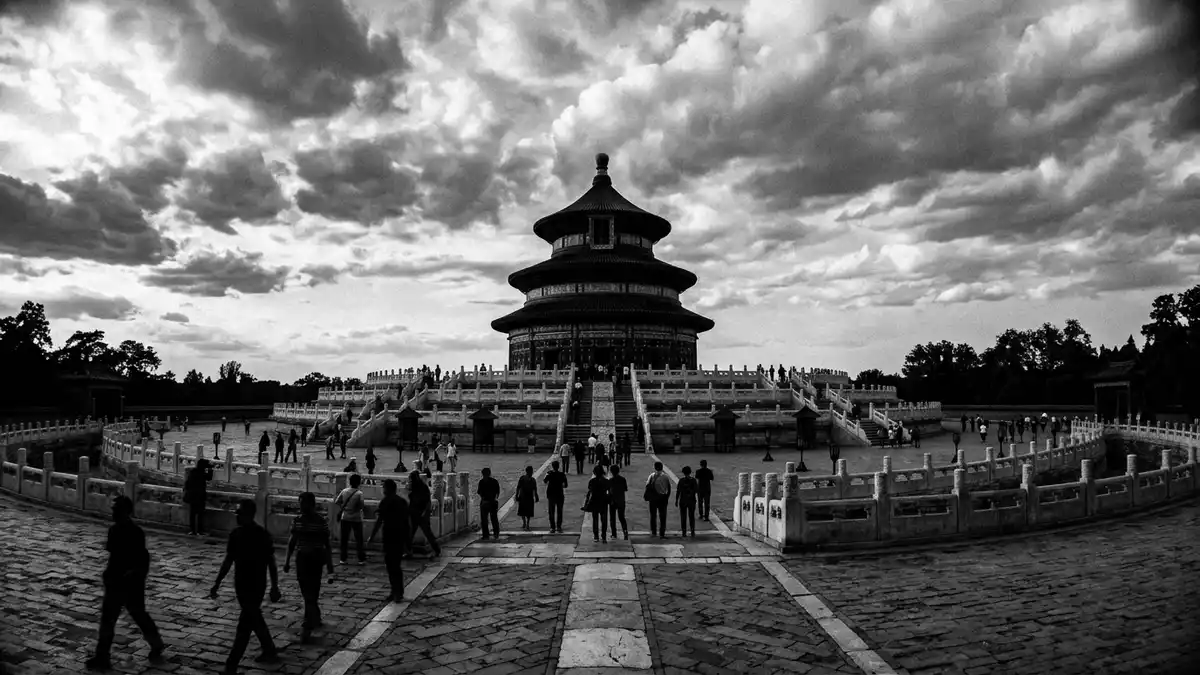
Tiantan in Peking, known internationally as the Temple of Heaven, is a vast park where imperial ritual architecture unfolds across lawns, groves and ceremonial axes. Completed in 1420 during the reign of the Ming emperor Yongle, it embodies a carefully choreographed relationship between heaven and earth in built form.
From imperial altar to urban park
The Temple of Heaven lies in the southern part of Beijing’s old city, within Dongcheng District, on the historic axis that once led towards the imperial core.Dongcheng District in Beijing The complex was completed in 1420 under Emperor Yongle of the Ming dynasty, the same ruler who oversaw the construction of the Forbidden City.completed in 1420 during Yongle’s reign It served for centuries as the primary sacrificial site where Ming and Qing emperors offered rites to Heaven and prayed for abundant harvests on behalf of the empire.
The grounds now function as a public park wrapped around the historic altars and halls, but the ritual layout remains legible at every turn.its total area covers 2,730,000 square metres Paths, cypress avenues and enclosing walls frame the main ceremonial route, while open lawns are used by local residents for exercise, music and socialising around the historic structures.
Circles, squares and the cosmology of Tiantan
Tiantan’s lead idea is architectural: the complex uses circles and squares at monumental scale to express the relationship between the heavens above and the earth below. The sacrificial precinct is arranged with the Circular Mound Altar in the south and the Imperial Vault of Heaven and Hall of Prayer for Good Harvests further north along the same axis.axial arrangement of major altars The temple domain itself is described as round in the north and square in the south, echoing the traditional Chinese phrase “heaven round, earth square”.symbolising heaven round and earth square
The Hall of Prayer for Good Harvests rises on a marble terrace and is recognisable by its triple tier of blue-glazed roof tiles, each level slightly smaller than the one below. Blue tiles link the hall visually to the sky, while the circular form and concentric terraces emphasise its role as the primary focus of the emperors’ supplications for grain yields.Hall of Prayer and marble terraces To the south, the Circular Mound Altar presents stacked white stone platforms enclosed by walls whose outer faces are square and inner faces circular, reinforcing the contrast between earthly and celestial realms in stone geometry.
UNESCO site on Beijing’s southern axis
The Temple of Heaven covers an area of around 2.73 million square metres, giving Tiantan a park scale that dwarfs many palace precincts in Beijing.around 2.73 million square metres The complex occupies land south of Zhengyangmen, the former main gate on Beijing’s central north–south axis.located to the southeast of Zhengyangmen Groves of ancient cypress trees frame long processional routes, and the enclosing wall separates the ritual interior from the city streets beyond.
In 1998 Tiantan was inscribed on the UNESCO World Heritage List as an “Imperial Sacrificial Altar in Beijing”, recognising both its architectural refinement and its role in state ritual.inscribed on the UNESCO World Heritage List in 1998 The listing highlights the ensemble of altars, halls and surrounding parkland as the most complete surviving imperial sacrificial complex in China, where the built forms and spatial organisation still convey the cosmology that shaped imperial ceremonies.
Visiting Tiantan: what travellers from Western Europe should know
- Tiantan lies in Dongcheng District, south of Beijing’s historic centre; it is reached by the city’s metro network, including stations named for the Temple of Heaven on Line 5.
- Exploring the main structures involves walking long, gently sloping avenues and climbing stone steps to reach the terraces of the Hall of Prayer for Good Harvests and the Circular Mound Altar.
- The park area includes extensive lawns and cypress groves, and distances between the principal altars can involve substantial time on foot for visitors crossing the entire complex.
- The official language is Chinese and the currency is the renminbi (RMB); English-language information panels appear at major structures in the park.
- Entry requirements depend on your nationality; UK travellers can check the FCDO travel advice at gov.uk/foreign-travel-advice, Irish travellers the Department of Foreign Affairs at ireland.ie.
Searching for Tiantan on social platforms
These links open searches for Tiantan on each platform.
Frequently asked questions about Tiantan
Where is Tiantan located in Peking?
Tiantan, the Temple of Heaven, stands in Dongcheng District in the southern part of Beijing, south of Zhengyangmen on the city’s historic axis.
What should visitors expect on a visit to Tiantan?
Visitors encounter a large urban park containing imperial altars, halls and cypress groves, with long ceremonial avenues and stone terraces linked along a north–south alignment.
What makes Tiantan distinctive among Beijing’s historic sites?
Tiantan is distinctive for its vast park scale, its circles and squares expressing Chinese cosmology, and its recognition as a UNESCO World Heritage Site for imperial sacrificial architecture.


