
Tiantan in Peking: the celestial geometry of the Temple of Heaven
Published on 09/14/2026 at 18:09 | Editorial responsibility: Rafael Müller, Editor-in-Chief AD HOC NEWS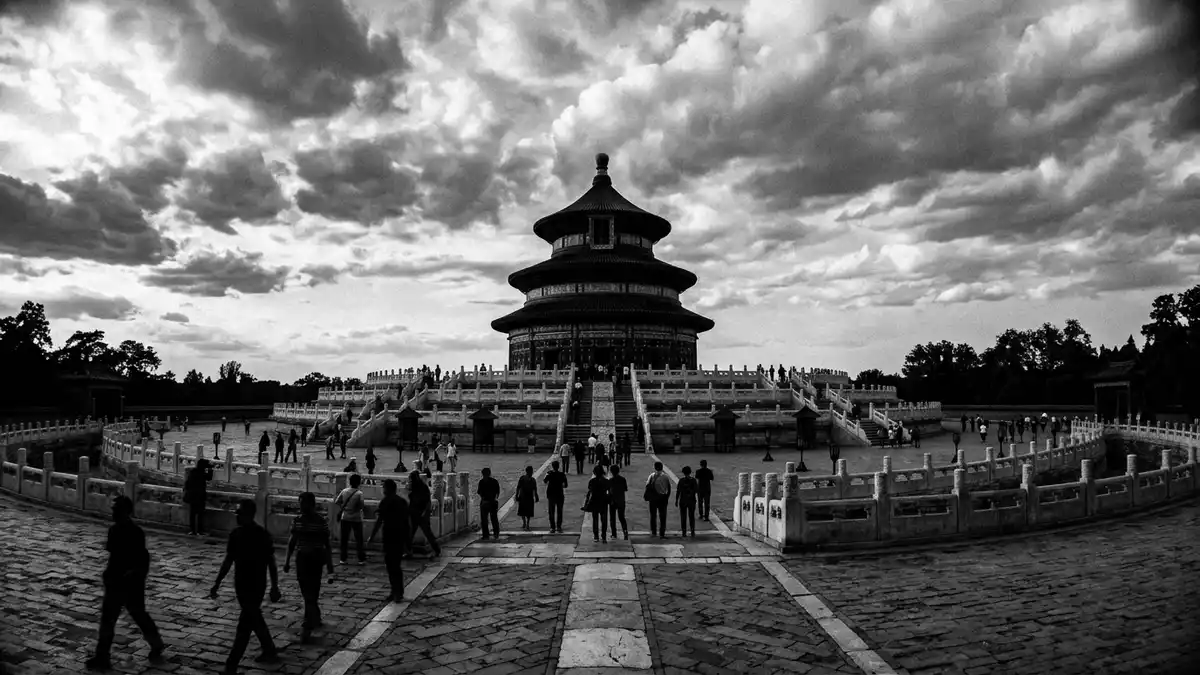
Tiantan in Peking, better known internationally as the Temple of Heaven, is an expansive imperial ritual complex whose geometry and symbolism define a whole ceremonial landscape. Built for the Ming court in the early fifteenth century and later used by Qing emperors, it turns abstract ideas about heaven, earth and imperial power into stone, timber and carefully planned space.
A ritual park conceived on an imperial scale
The Temple of Heaven occupies a broad parkland in the southern part of what is now central Beijing, laid out as a walled compound with inner and outer precincts and long ceremonial approaches. Emperors of the Ming and Qing dynasties travelled here from the Forbidden City to perform state rituals, especially sacrifices to heaven and ceremonies linked to harvests.Ming and Qing dynasties Within the park, formal altars, halls and smaller service buildings are set among groves of pine and cypress, giving the complex the character of both religious site and planned landscape.set in gardens and historic pine woods
The site was established in the first half of the fifteenth century, during the reign of the Yongle Emperor of the Ming dynasty, the same ruler who oversaw the construction of much of Beijing’s imperial core.constructed in 1420 Over the following centuries it was rebuilt and refurbished, notably in the eighteenth and late nineteenth centuries under Qing emperors, but its basic layout as an axial composition of major ritual elements has remained recognisable. In 1998 the Temple of Heaven was inscribed as a UNESCO World Heritage Site as “an Imperial Sacrificial Altar in Beijing”, underlining its status as one of China’s major ceremonial ensembles.UNESCO inscription in 1998
Circles, squares and the Hall of Prayer for Good Harvests
Many visitors first encounter Tiantan through the Hall of Prayer for Good Harvests, the complex’s most recognisable structure. This timber hall rises on a three-tiered marble terrace and is roofed in stacked, conical forms clad with deep blue tiles, a colour long associated with heaven in Chinese imperial architecture.Hall of Prayer for Good Harvests Seen from the surrounding terrace the hall appears as a circular volume above a sequence of balustraded platforms, with stairways aligned to cardinal axes emphasising its role as the northern focal point of the main ritual route.
The hall’s circular plan reflects a fundamental theme of the entire complex: the contrast between circle and square as images of heaven and earth. The surrounding terraces and much of the precinct adopt rectilinear forms, while key ritual buildings and altars take circular layouts or ring-like platforms. This interplay continues in other elements of Tiantan, including the Imperial Vault of Heaven to the south and the Circular Mound Altar beyond it, where balustrades, paving patterns and the stepped platforms all repeat the theme of concentric circles set within a larger orthogonal scheme.Circular Mound Altar and Imperial Vault of Heaven
The ritual axis: from Circular Mound Altar to Inner Temple
One of Tiantan’s most striking features is the straight ceremonial route that links its principal ritual structures along a north–south axis. At the southern end stands the Circular Mound Altar, a series of ringed marble platforms open to the sky, where imperial sacrifices to heaven were performed on exposed stone rather than inside a hall.axial arrangement of Circular Mound Altar North of this altar lies the Imperial Vault of Heaven, a compact circular hall enclosed by walls, which forms an intermediate point on the axis.
The raised route that connects the Circular Mound Altar, the Imperial Vault of Heaven and the Hall of Prayer for Good Harvests is sometimes described as a sacred way, its paving slightly elevated above the surrounding ground to mark it out within the park.linked by a raised sacred way Around this axial composition, secondary courtyards, service buildings and walls define the inner and outer temple zones, while beyond them the larger park with its trees and open lawns provides a frame that makes the central structures read as a distinct ceremonial core within the wider landscape.Inner Temple and Outer Temple
Visiting Tiantan: what travellers from Western Europe should know
- Tiantan lies in the Dongcheng District of Beijing, south of the old central axis of the city, with entrances aligned to major streets in the surrounding urban area.
- The park is a broad, level expanse with long paved routes and terraces; exploring the main halls and altars involves walking significant distances on stone surfaces and climbing flights of steps to reach the upper platforms.
- Tiantan Park is served by the Beijing Metro, with Tiantandongmen Station on Line 5 providing access near the eastern gate and further stations on other lines within walking distance of the compound.
- The official language is Chinese and the currency is the renminbi (yuan).
- Entry requirements depend on your nationality; UK travellers can check the FCDO travel advice at gov.uk/foreign-travel-advice, Irish travellers the Department of Foreign Affairs at ireland.ie.
Searching for Tiantan on social platforms
These links open searches for Tiantan on each platform.
Frequently asked questions about Tiantan
Where is Tiantan and what kind of place is it?
Tiantan is the Temple of Heaven, a historic imperial ritual complex set within a large park in the Dongcheng District of Beijing.
What can visitors expect when walking through the site?
Visitors encounter broad paved avenues, groves of trees, high terraces and a sequence of major structures including the Hall of Prayer for Good Harvests, the Imperial Vault of Heaven and the Circular Mound Altar.
What makes Tiantan distinctive among Beijing’s historic sites?
Tiantan stands out for its combination of circular and square forms, its strict axial layout linking open altar platforms with enclosed halls, and its role as a former centre of state ritual for the Ming and Qing courts.


