Tian Tan Da Fo: Hongkong’s great bronze Buddha above Lantau
Published on 09/08/2026 at 12:09 | Editorial responsibility: Rafael Müller, Editor-in-Chief AD HOC NEWS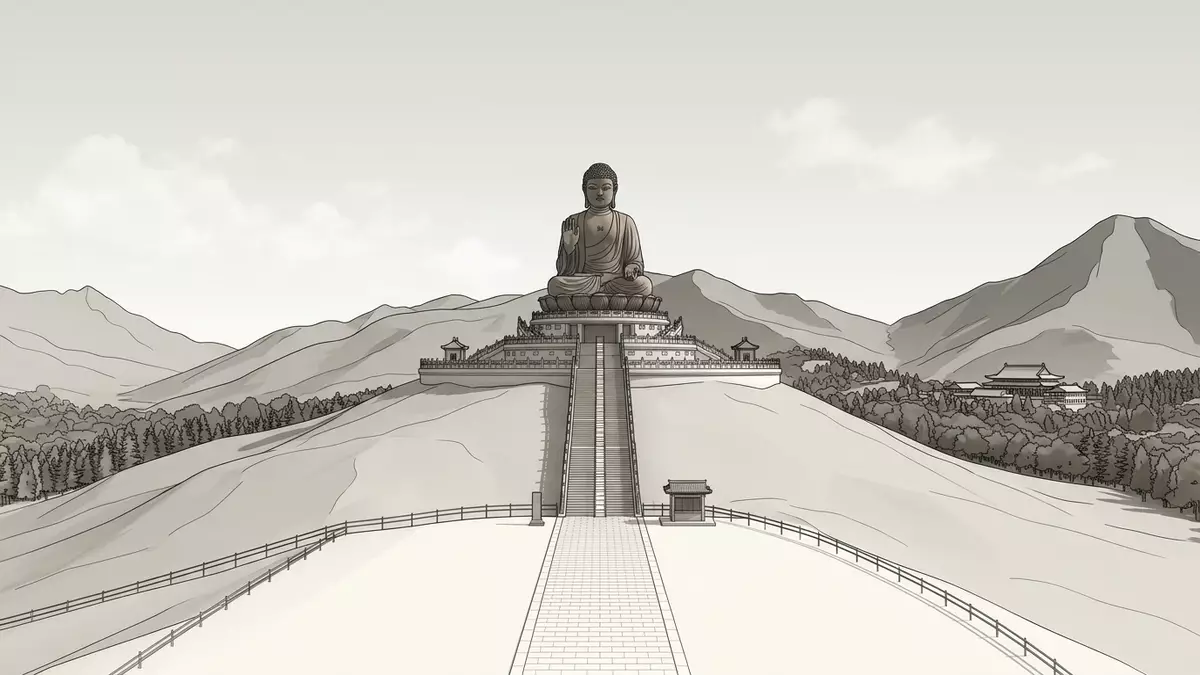
Tian Tan Da Fo in Hongkong is a vast bronze statue of Sakyamuni Buddha seated above Ngong Ping on Lantau Island, looking north towards mainland China. Completed in 1993 and closely linked with the neighbouring Po Lin Monastery, it has become a landmark of Lantau’s uplands and a focal point for Buddhist worship and quiet contemplation.
A seated Buddha in bronze above Ngong Ping
The figure known internationally as Tian Tan Buddha is a large bronze sculpture depicting a seated Buddha on a lotus throne, raised on a multi-level base above the Ngong Ping plateau on Lantau Island. The statue itself rises to more than 20 m (66 ft), with the lotus and base bringing the total height to about 34 m (112 ft), giving the figure a presence that dominates the surrounding hilltop.The Buddha statue itself stands 26.4 metres tall Crafted from bronze pieces that together weigh hundreds of tonnes, Tian Tan Da Fo has acquired a reputation as one of the largest outdoor seated Buddha statues in the world.a large bronze statue of Buddha Sakyamuni
The statue is reached by a broad flight of steps climbing from the main approach at Ngong Ping, giving arriving visitors a gradual ascent from the plateau to the base of the Buddha. From the upper platform, the outlook takes in the uplands around Ngong Ping and the valleys dropping towards Tung Chung and the coast, placing the bronze figure in a wide landscape of wooded hills and distant water. At the foot of the statue, a series of halls within the base accommodate devotional spaces and exhibitions related to Buddhist practice and to the story of the monument.
Tian Tan Da Fo and Po Lin Monastery
Tian Tan Da Fo stands immediately above Po Lin Monastery, a Buddhist temple complex founded in the early twentieth century that grew into an important centre of practice on Lantau Island. The name “Tian Tan” refers to the form of the statue’s base, which echoes the arrangement of the temple of heaven in Beijing and ties the Lantau monument to an architectural pattern from northern China.Tian Tan refers to the circular platform it sits on The combination of monastery buildings, courtyards and the elevated Buddha creates a continuous sacred precinct at Ngong Ping.
The statue was completed in 1993, decades after the first temple buildings were established on the site, and it extends the religious focus of Po Lin Monastery upwards onto the hill above.completed in 1993 Within the base and the monastery, visitors encounter traditional halls with incense coils, altars and images of Buddhist figures, alongside spaces that explain the symbolism of the seated Buddha and its lotus throne. The layout links the everyday life of the monastery with the elevated, monumental image of Sakyamuni, giving Tian Tan Da Fo both a devotional and a cultural role.
Lantau Island setting and approaches
Tian Tan Da Fo occupies a high point above Ngong Ping on Lantau Island, which lies to the west of Hongkong’s main urban areas across the water of the harbour. The location places the statue relatively close to Hong Kong International Airport at Chek Lap Kok, separated only by the low ridge lines and valleys of northern Lantau. Paths and roads from Ngong Ping connect the Buddha complex with other viewpoints and with the Wisdom Path, a nearby installation of wooden columns inscribed with verses.
Approach routes from the coast lead up to Ngong Ping via road and cable car, with the Ngong Ping 360 cable car linking Tung Chung near the airport to the upland plateau.The Big Buddha, also known as Tian Tan Buddha, is famed as the most iconic attraction of Lantau From the arrival point at Ngong Ping Village, the route to Tian Tan Da Fo is on foot, passing through the village streets and temple forecourt before climbing the stairway to the statue’s base.To reach the statue, visitors have to climb 268 steps The upland position, with surrounding peaks and open sky, frames the bronze figure against changing light and weather, making its outline a constant presence above the plateau.
Visiting Tian Tan Da Fo: what travellers from Western Europe should know
- Tian Tan Da Fo stands at Ngong Ping on Lantau Island in Hongkong, above Po Lin Monastery and Ngong Ping Village. It is reached from Tung Chung by road or the Ngong Ping 360 cable car, followed by an uphill walk through the village and temple grounds.
- The approach to the statue involves climbing a long exterior staircase of several hundred steps from the plateau up to the base platform, with handrails and landings at intervals.
- Ngong Ping lies in the uplands of Lantau Island, where weather can bring cloud and mist around the hills; the statue and its platforms are exposed to wind and sun.
- The official languages of Hongkong are Chinese and English, and the currency is the Hong Kong dollar.
- Entry requirements depend on your nationality; UK travellers can check the FCDO travel advice at gov.uk/foreign-travel-advice, Irish travellers the Department of Foreign Affairs at ireland.ie.
Searching for Tian Tan Da Fo on social platforms
These links open searches for Tian Tan Da Fo on each platform.
Frequently asked questions about Tian Tan Da Fo
Where is Tian Tan Da Fo located?
Tian Tan Da Fo stands above Ngong Ping on Lantau Island in Hongkong, near Po Lin Monastery and within reach of Tung Chung and Hong Kong International Airport.
What should visitors expect on a visit?
Visitors encounter a large seated bronze Buddha reached by a long staircase, temple buildings at Po Lin Monastery and wide views across Lantau’s uplands from the platforms around the statue.
What makes Tian Tan Da Fo distinctive?
The combination of its height, bronze construction and hilltop position above Ngong Ping, together with its close association with Po Lin Monastery, makes Tian Tan Da Fo a distinctive monument of Buddhist Hongkong.