
Tian Tan Da Fo and the geometry of bronze above Lantau
Published on 09/23/2026 at 04:12 | Editorial responsibility: Rafael Müller, Editor-in-Chief AD HOC NEWS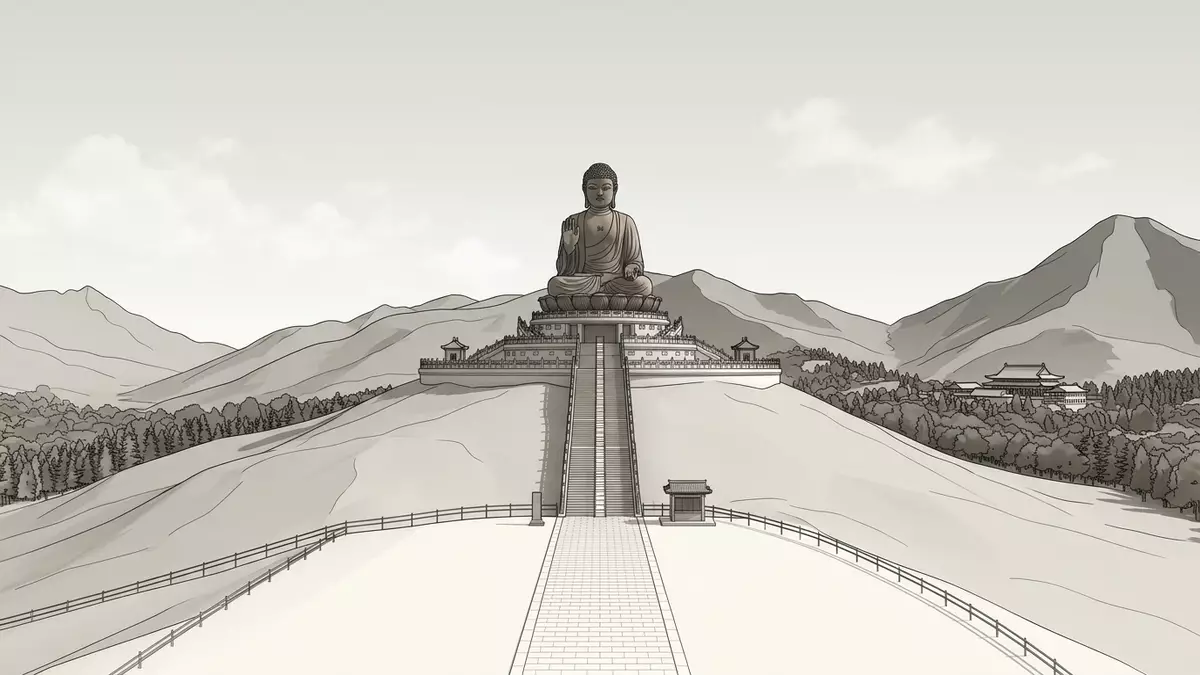
Tian Tan Da Fo rises above Ngong Ping on Lantau Island, Hongkong, as a seated bronze Buddha above a three-level granite base. Completed in 1993, the statue reaches 34 m (112 ft) from its lotus throne and base, creating a carefully defined silhouette on Mount Muk Yue.
Thirty-four metres of bronze above Ngong Ping
The statue’s body measures 26.4 m, while the lotus throne and granite base bring the complete structure to 34 m. Its mass comes from approximately 250 tonnes of bronze, assembled as a large sculptural figure rather than a solid block.
The seated form shows Siddhartha Gautama in meditation, with the right hand raised and the left hand resting on the lap. The gestures are known as mudras. They give the figure a visual language connected with compassion, fearlessness and blessing. the statue’s dimensions and symbolism are closely linked with its Buddhist setting.
Mount Muk Yue, the lotus throne and Tian Tan
Tian Tan Da Fo stands in front of Po Lin Monastery at Ngong Ping, on the uplands of Lantau Island. The surrounding complex includes the monastery, Ngong Ping Piazza and the Wisdom Path, placing the statue within a larger religious and cultural landscape.
The base consists of three granite levels and imitates the pedestal associated with Tian Tan, the Temple of Heaven in Beijing. This architectural reference gives the statue its name and places the bronze figure above a stone platform with a distinct ceremonial profile. the granite pedestal and Mount Muk Yue connect the statue to both Hongkong and mainland Chinese architectural tradition.
From bronze sections to a Buddhist landmark
Construction began in 1986, and the statue was completed on 29 December 1993. The Nanjing Chenguang Machinery Plant of the China Astronautics Science and Technology Consultant Corporation constructed the image.
The bronze surface was assembled from 202 separate pieces. This method gives the statue a visible relationship between sculpture and engineering, with the broad robes, folded legs and calm face forming one continuous seated figure. the 1993 completion date marks the point at which the mountain statue entered Hongkong’s public landscape.
Po Lin Monastery remains the statue’s immediate religious companion. Together, the bronze Buddha, lotus throne, granite platform and monastery form a composition that can be read from several levels: as a religious image, a large-scale work of bronze sculpture and a landmark of Lantau.
Visiting Tian Tan Da Fo: what travellers from Western Europe should know
- Tian Tan Da Fo stands at Ngong Ping on Lantau Island, in front of Po Lin Monastery. The Ngong Ping 360 cable car and New Lantao Bus routes connect the area with Tung Chung, Mui Wo and Tai O.
- The statue is reached from Ngong Ping Village on foot. The approach ends at a broad flight of 268 steps leading towards the base and lotus throne.
- The surrounding site includes Po Lin Monastery, Ngong Ping Piazza and the Wisdom Path. Lantau’s upland setting includes exposed rock, planted slopes and mountain views.
- The official language is Chinese and English, and the currency is the Hong Kong dollar.
Searching for Tian Tan Da Fo on social platforms
These links open searches for Tian Tan Da Fo on each platform.
Frequently asked questions about Tian Tan Da Fo
Where is Tian Tan Da Fo?
Tian Tan Da Fo is at Ngong Ping on Lantau Island, Hongkong. The statue stands beside Po Lin Monastery on Mount Muk Yue.
What can visitors see there?
The site includes the bronze seated Buddha, its lotus throne, the granite base and the surrounding Buddhist complex. The approach from Ngong Ping Village includes a flight of steps.
What makes the statue distinctive?
Its distinctive features are its 34 m height, bronze construction, seated Buddhist form and three-level granite base. The structure was completed in 1993 and assembled from 202 bronze pieces.


