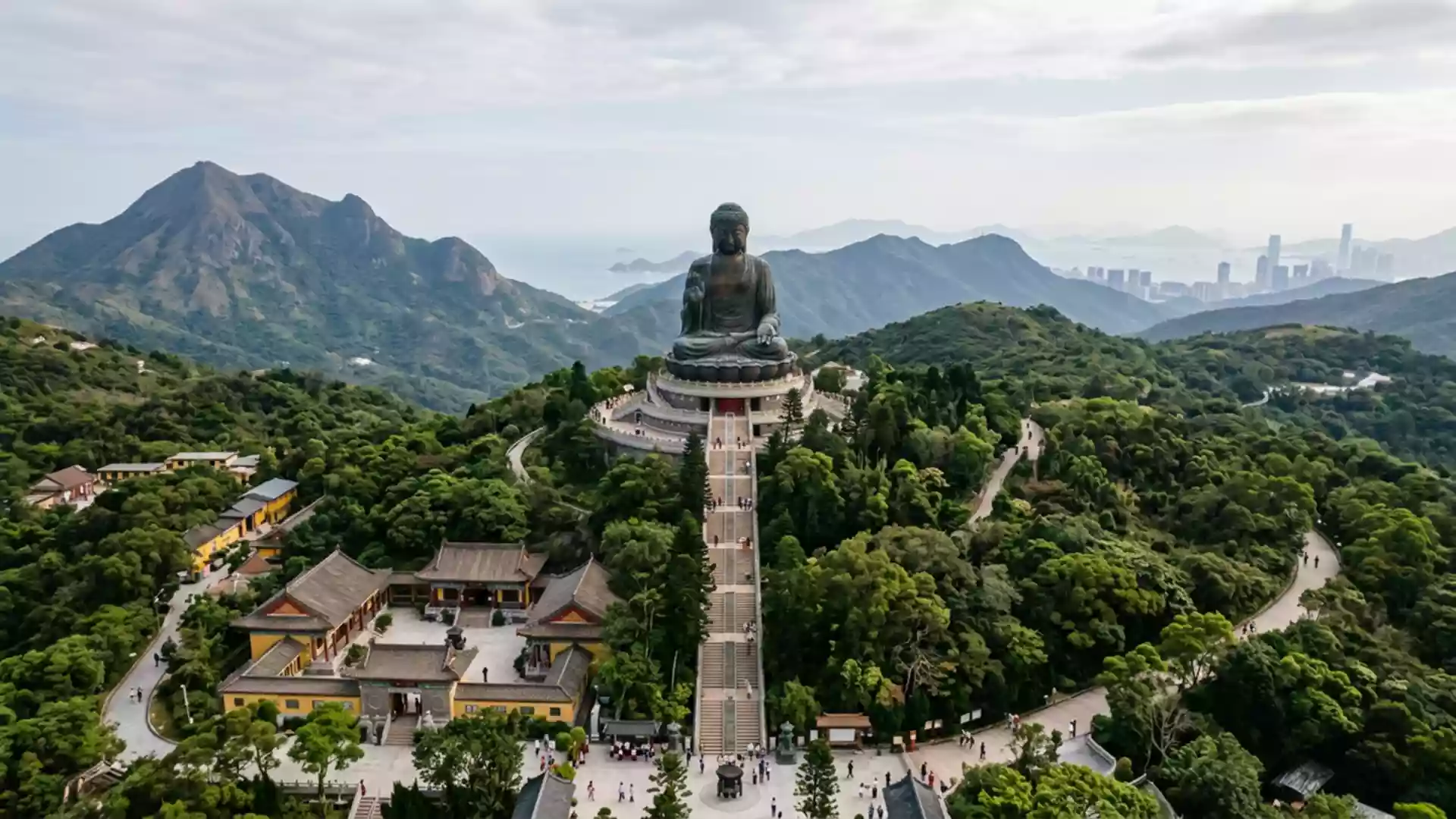
Tian Tan Da Fo, a bronze Buddha above Lantau’s green hills
Published on 08/27/2026 at 19:15 | Editorial responsibility: Rafael Müller, Editor-in-Chief AD HOC NEWS
Tian Tan Da Fo, known in English as the Tian Tan Buddha or Big Buddha, is a monumental bronze statue of Shakyamuni Buddha above Ngong Ping on Lantau Island in Hongkong. Completed in 1993, it stands beside Po Lin Monastery on the peak of Mount Muk Yue, bringing a single seated figure into a wide landscape of forested slopes and distant sea.
A seated Buddha in bronze and stone
The core of Tian Tan Da Fo is a bronze image of Shakyamuni Buddha seated in meditation on a lotus pedestal, facing north over the hills of Lantau Island.The Big Buddha sits solemnly atop Mount Muk Yue The statue’s body rises to about 26.4 m (86.6 ft), while the total height from the lowest point of the granite base to the highest point of the Buddha reaches about 34 m (111.5 ft).The statue height and total height figures Cast with roughly 250 tonnes of bronze, the figure presents the Buddha with one hand raised and the other resting on his knee, above layers of lotus petals.
Beneath the statue, the base follows the form of the Tian Tan, the Temple of Heaven in Beijing, translated into a three-level granite pedestal with circular terraces and balustrades.The base imitates the Tian Tan pedestal in Beijing Within this base lies a multi-storey exhibition hall that houses Buddhist relics and devotional objects, enclosed by stone walls and ornamented with traditional Chinese decorative elements.A three-storey exhibition hall inside the pedestal The combination of heavy bronze above and carved stone below gives the site a layered architectural presence, with the Buddha poised on a stepped platform that rises out of the landscape.
Ngong Ping, Po Lin Monastery and the surrounding landscape
Tian Tan Da Fo stands on Muk Yue Peak at Ngong Ping, a plateau in the western highlands of Lantau Island, more than 500 m (1,640 ft) above sea level.Muk Yue Peak, Ngong Ping, Lantau Island location Around the statue, the terrain falls away in steep, wooded valleys, opening views towards the South China Sea and across the island’s ridges. On clear days, the elevated site provides long sightlines not only over Lantau’s hills but also towards the wider Hongkong region, with islands dotted across the water.
Directly in front of the Buddha, Po Lin Monastery forms an ensemble of halls, courtyards and incense burners that frame the approach to the statue.Po Lin Monastery beside the Tian Tan Buddha The monastery originated in the early twentieth century and became closely associated with the statue during the late twentieth century, when the bronze Buddha was commissioned and constructed. Together, the monastery buildings and Tian Tan Da Fo form a Buddhist complex in a rural part of Hongkong, contrasting strongly with the dense urban districts on Hong Kong Island and Kowloon.
Construction, symbolism and access
Planning for Tian Tan Da Fo began in the late twentieth century and the statue was formally inaugurated in December 1993, after a construction period stretching over more than a decade.The statue’s inauguration in 1993 Engineering work on the bronze image and its support structure involved Nanjing Chenguang Machinery Plant of the China Astronautics Science and Technology Consultant Corporation, which produced the bronze elements for assembly on site.Cast with 250 tonnes of bronze by Nanjing Chenguang The final statue, assembled from more than 200 bronze pieces, became a landmark of modern Buddhist sculpture in East Asia.Constructed from hundreds of bronze pieces
The base of Tian Tan Da Fo is reached by a long, straight staircase of 268 steps that climbs from the level of Ngong Ping’s main paved area up to the terrace surrounding the statue.Climbing 268 steps to the pedestal The side of the terrace opens towards the surrounding hills, so the ascent brings visitors from the built environment of Ngong Ping Village and Po Lin Monastery through a sequence of stone landings to an outlook over forest and sea. The statue itself has been described as one of the world’s largest outdoor bronze seated Buddha statues of its type, a designation reflected in government and tourism material.Largest outdoor bronze seated Buddha statue
Visiting Tian Tan Da Fo: what travellers from Western Europe should know
- Tian Tan Da Fo stands at Ngong Ping on Lantau Island, south-west of central Hongkong, beside Po Lin Monastery on the peak of Mount Muk Yue.
- The approach from Ngong Ping to the statue involves climbing a staircase of 268 steps, which rises steadily to the terrace around the Buddha.
- Ngong Ping is linked to Tung Chung by the Ngong Ping 360 cable car and by New Lantao Bus routes; services also connect with other parts of Lantau Island.
- The paths and terraces around the Buddha and Po Lin Monastery are paved, with a mixture of open squares and narrower walkways on an elevated plateau.
- The official languages of Hongkong are Chinese and English, and the currency is the Hong Kong dollar.
Searching for Tian Tan Da Fo on social platforms
These links open searches for Tian Tan Da Fo on each platform.
Frequently asked questions about Tian Tan Da Fo
Where is Tian Tan Da Fo located in Hongkong?
Tian Tan Da Fo stands on Muk Yue Peak at Ngong Ping on Lantau Island, beside Po Lin Monastery in the outlying islands region of Hongkong.
What can visitors expect when climbing to the statue?
Visitors ascend a staircase of 268 steps from the plateau at Ngong Ping to a high terrace around the bronze Buddha, with paved landings and broad views over hills and sea.
What makes Tian Tan Da Fo distinctive among Buddha statues?
The statue combines a large bronze seated Buddha cast from about 250 tonnes of metal with a three-level granite base modelled on Beijing’s Temple of Heaven, standing over 30 m (98.4 ft) high on a mountain plateau.