
Three Sisters above the sandstone rim of Jamison Valley
Published on 08/30/2026 at 10:05 | Editorial responsibility: Rafael Müller, Editor-in-Chief AD HOC NEWS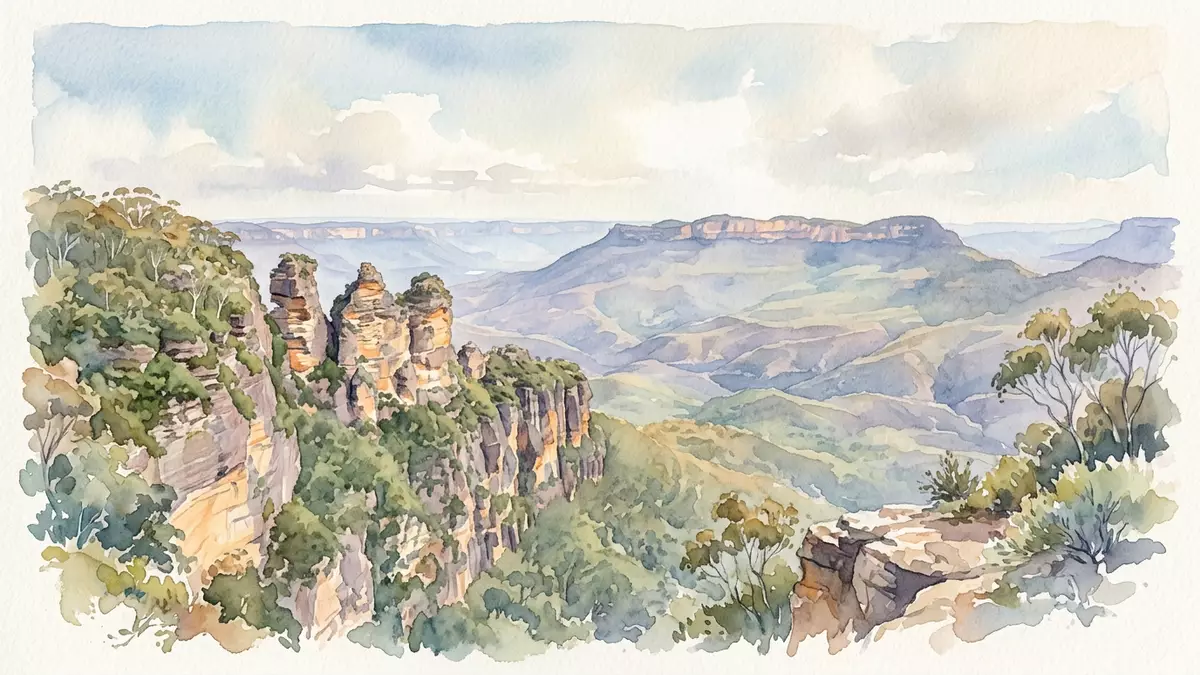
On the edge of the Jamison Valley in New South Wales, Three Sisters stands as a trio of sandstone towers rising from the Blue Mountains escarpment near Katoomba, where rock and story share the same cliff line. The formation belongs to the greater Blue Mountains region in eastern Australia and is rooted in Triassic sandstone laid down hundreds of millions of years ago.
Sandstone pillars on the Blue Mountains rim
Three Sisters forms part of the northern rim of the Jamison Valley, a wide, forested basin within the Blue Mountains of New South Wales. The three pillars stand close to Katoomba, a town on the plateau that serves as a gateway to this section of Blue Mountains National Park.rock formation in the Blue Mountains From viewpoints on the escarpment, the sandstone drops steeply to the valley floor, with the towers projecting from the cliff line above.
Each pillar carries its own name: Meehni, Wimlah and Gunnedoo. They rise to elevations a little above 900 m (about 3,000 ft) above sea level, standing in a row along the valley edge rather than isolated in the basin.Meehni Wimlah and Gunnedoo The rock itself is part of the Hawkesbury Sandstone, a sedimentary formation built from compacted sand and silt that once formed a broad plateau across this part of eastern Australia.Hawkesbury Sandstone plateau
Geological time carved into three towers
Geologically, Three Sisters records processes that began in the Triassic period, around 200 million years ago, when layers of sand and silt accumulated on ancient river plains and later hardened into sandstone.formed over 200 million years ago Subsequent uplift raised the plateau, and erosion cut into it, opening the Jamison Valley and defining the cliff lines that frame the present landscape.sandstone plateau eroded by wind and water
Water seeping into vertical joints in the sandstone, together with rain, rivers and weathering, widened fractures in the plateau edge. Over long spans of time, parts of the cliff detached along these joints, leaving three separated pillars where once there was a continuous rim.erosion along sandstone joints The same processes continue to reshape the escarpment, though at a pace that stretches beyond any human lifetime.
Aboriginal stories and cultural recognition
For the Aboriginal peoples of this part of New South Wales, Three Sisters is more than a geological feature. The Gundungurra and Darug are among the traditional owners of the land, and Dreamtime stories link the stone pillars with three young women whose transformation into rock preserves memories of conflict and protection.Dreamtime legend of Meehni Wimlah and Gunnedoo One widely circulated version tells of Meehni, Wimlah and Gunnedoo of the Katoomba people and three brothers from a neighbouring tribe, whose forbidden love and ensuing battle ended with a sorcerer turning the sisters into stone.
The cultural importance of Three Sisters to Aboriginal communities has been recognised formally. In New South Wales, the rock formation is declared an Aboriginal Place, a designation that marks sites of special spiritual, social or historic significance to Aboriginal people.declared an Aboriginal Place Alongside the stories, visitors encounter interpretive material and perspectives that emphasise the continuing connection between the cliffs, the valley and the communities whose traditions are rooted in this landscape.
Visiting Three Sisters: what travellers from Western Europe should know
- Three Sisters stands on the escarpment above the Jamison Valley near Katoomba in New South Wales, within the Blue Mountains National Park in eastern Australia. The formation is reached from Katoomba by road, with viewing areas on the plateau overlooking the sandstone towers.
- The terrain around the main viewpoints includes cliff-side paths and constructed lookouts set close to steep drops towards the valley. Approaches involve walking on paved surfaces with railings along sections near the escarpment edge.
- The surrounding landscape forms part of the Greater Blue Mountains, with forested slopes falling from the plateau into deep valleys. Weather on the exposed rim can change, affecting visibility of the distant sandstone walls and towers.
- The official language is English and the currency is the Australian dollar.
- Entry requirements depend on your nationality; UK travellers can check the FCDO travel advice at gov.uk/foreign-travel-advice, Irish travellers the Department of Foreign Affairs at ireland.ie.
Searching for Three Sisters on social platforms
These links open searches for Three Sisters on each platform.
Frequently asked questions about Three Sisters
Where is Three Sisters located?
Three Sisters is a sandstone rock formation on the escarpment above the Jamison Valley near Katoomba, within the Blue Mountains of New South Wales in eastern Australia.
What can visitors expect when viewing Three Sisters?
Visitors see three named sandstone pillars projecting from a steep cliff above a broad forested valley, with constructed lookouts on the plateau providing views of the towers and the surrounding Blue Mountains landscape.
What makes Three Sisters distinctive among Australian landmarks?
The combination of three closely spaced sandstone pillars, their Triassic geological origin and their recognised Aboriginal cultural significance together give Three Sisters a character tied both to deep geological time and to continuing stories on the Blue Mountains rim.


