
Theatro Epidavrou and the stone curves of ancient Epidaurus
Published on 09/04/2026 at 22:18 | Editorial responsibility: Rafael Müller, Editor-in-Chief AD HOC NEWS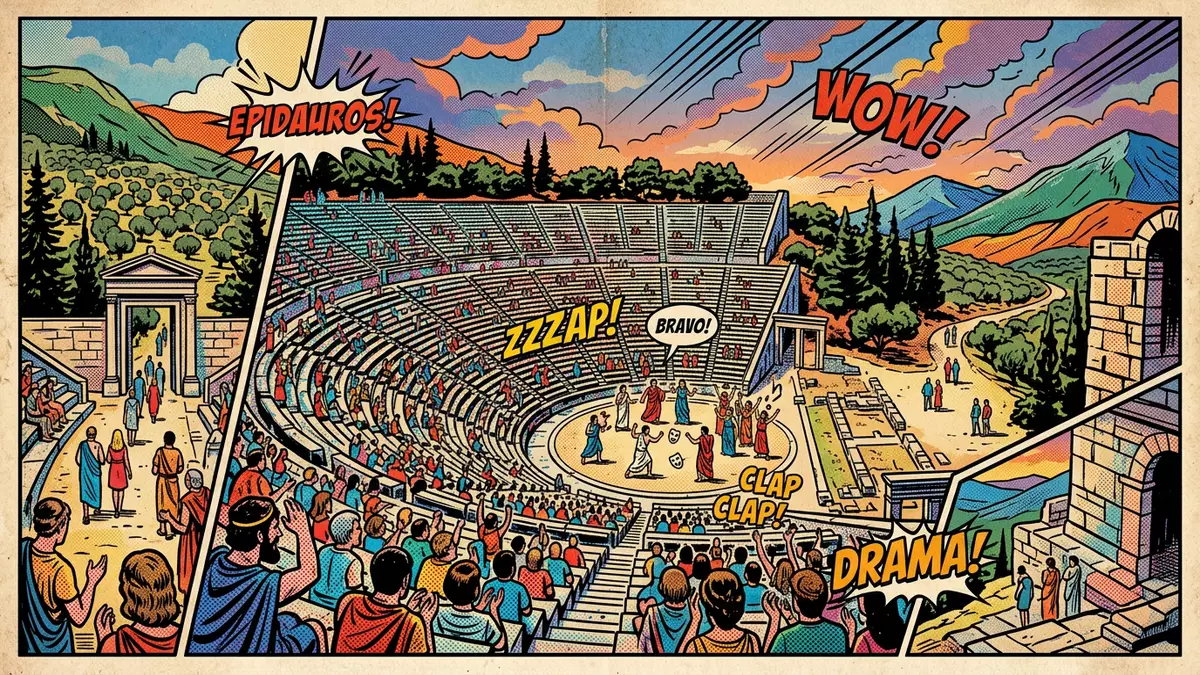
Theatro Epidavrou is the ancient theatre at the Sanctuary of Asklepios near Epidauros in Greece, a late classical structure laid out on the slope of Mount Kynortion in the fourth century BC.theatre at the Asklepieion of Epidaurus Built into the hillside in the era of the healer-god Asklepios, it is widely attributed to the architect Polykleitos the Younger, whose name ties the theatre directly to the high traditions of Greek art.Polykleitos the Younger
Stone tiers on a healing hillside
Theatro Epidavrou occupies the south-eastern edge of the ancient sanctuary, where pilgrims once came to seek cures from Asklepios and his cult of healing.southernmost edge of the Sanctuary of Asklepios The theatre’s cavea, the sweeping bank of spectator seating, is carved into the natural slope of Mount Kynortion and built largely of local stone, which binds the architecture tightly to the surrounding Argolis landscape.local stone on a natural slope of Mt Kynortion From the upper rows the view opens towards the hills of the Peloponnese, so the auditorium reads as much as a landscape structure as a performance space.
In architectural terms Theatro Epidavrou presents the characteristic tripartite layout of a Hellenistic theatre: the cavea for the audience, the almost circular orchestra for the chorus and action, and the stage building that closes the backdrop.tripartite layout of Hellenistic theaters The whole complex is aligned with the sanctuary, tying theatrical performance to ritual and to the broader programme of healing that made Epidaurus one of the major cult centres of the Greek world.Sanctuary of Asklepios at Epidaurus
Curves, proportions and capacity
The stone tiers of Theatro Epidavrou climb the hillside in an ordered pattern of benches, forming a broad arc around the orchestra that demonstrates the late classical Greek interest in proportion and geometry.large, in a slope built theatre As preserved, the cavea is arranged in dozens of rows divided by stairways and walkways, and ancient and modern estimates place its capacity in the range of roughly 13,000 to 14,000 spectators, making it one of the largest surviving theatres of antiquity.capacity of approximately 13,000-14,000 spectators The width of the cavea reaches more than 100 m (328 ft), so the structure dominates its hollow in the hillside.
The earliest phase of construction is placed by archaeological and literary evidence in the late fourth century BC, in the years around 340–330 BC, with later additions in the Hellenistic and Roman periods extending the seating and refining the stonework.built at the end of the classical era, in 340-330 BC The attribution to Polykleitos the Younger, known from the second-century AD traveller Pausanias, fits with this dating and with the high quality of both plan and execution in the surviving fabric.
From sanctuary monument to world heritage stage
The ancient theatre at Epidaurus forms part of a wider archaeological site where temples, stoas, baths and healing buildings once supported a complex ritual life around Asklepios.healing centre of the ancient Greek and Roman world The relationship between Theatro Epidavrou and the sanctuary means that even a short walk around the site traces a path from medical practice and religious devotion to large-scale communal performance, all set within the Argolis countryside of the Peloponnese.archaeological site of the Sanctuary of Asklepios in the Argolis prefecture
Since 1988 Theatro Epidavrou, together with the Asklepios sanctuary, has been recognised as a UNESCO World Heritage Site, a formal acknowledgement of its outstanding preservation and the clarity with which it illustrates ancient Greek theatre design.UNESCO World Heritage Sites Performances of ancient drama are still staged here under festival programmes, so the theatre continues to function as a working stone auditorium as well as an archaeological monument of the late classical period.ancient theatre is still in use for performances
Visiting Theatro Epidavrou: what travellers from Western Europe should know
- Theatro Epidavrou stands within the archaeological site of the Sanctuary of Asklepios in the regional unit of Argolis, on the Peloponnese peninsula in Greece, reached by road via Epidaurus and Lygourio from the direction of Corinth or Nafplio.
- The theatre occupies a hillside setting, and reaching the upper seating involves climbing stone steps that rise steeply along the curve of the cavea.
- The surrounding area includes further remains of the ancient sanctuary, such as temples, stoas and bath structures, so a visit to the theatre usually involves walking across uneven archaeological ground.
- Greek is the official language and the currency is the euro.
Searching for Theatro Epidavrou on social platforms
These links open searches for Theatro Epidavrou on each platform.
Frequently asked questions about Theatro Epidavrou
Where is Theatro Epidavrou located?
Theatro Epidavrou is located within the Sanctuary of Asklepios near Epidauros in the Argolis region of the Peloponnese, Greece, on the slope of Mount Kynortion.
What should visitors expect at the site?
Visitors encounter a large stone theatre cut into a hillside, with extensive tiers of seating, an orchestra and stage area, and nearby ruins of the wider healing sanctuary.
What makes Theatro Epidavrou distinctive among ancient theatres?
Its combination of late classical design, large capacity, hillside setting above the sanctuary and formal recognition as part of a UNESCO World Heritage Site makes Theatro Epidavrou distinctive.


