
Theatro Epidavrou and the stone arc of Epidauros
Published on 08/28/2026 at 17:37 | Editorial responsibility: Rafael Müller, Editor-in-Chief AD HOC NEWS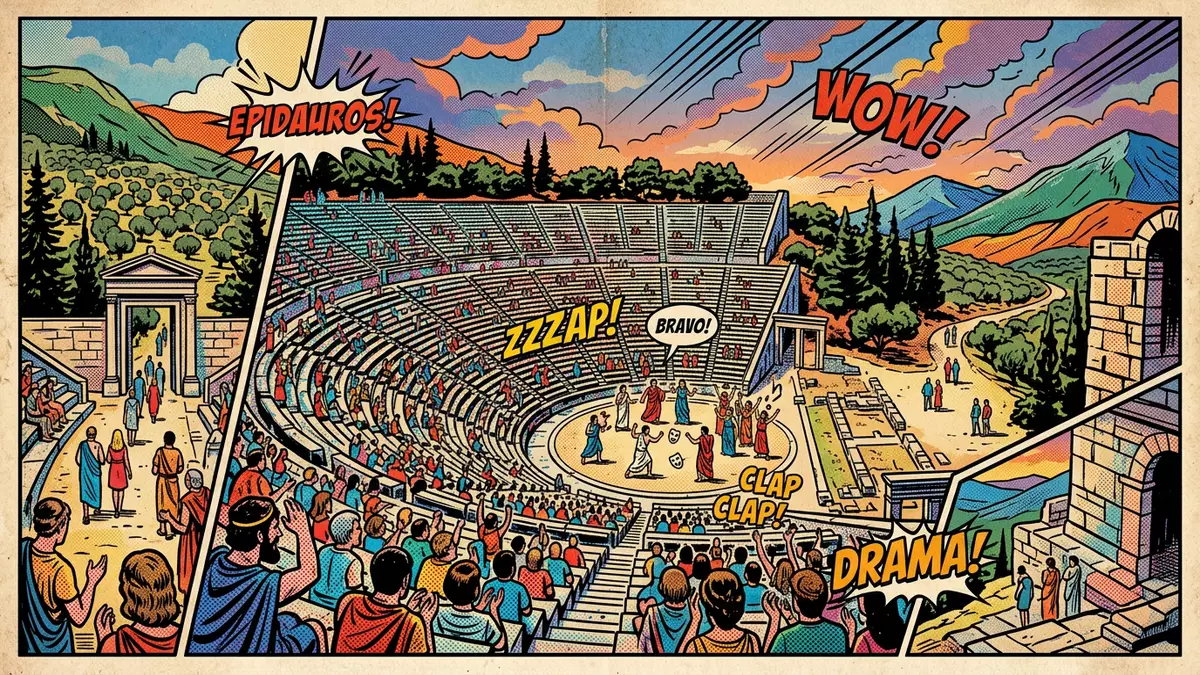
Theatro Epidavrou, known in English as the ancient theatre of Epidaurus, curves around a stone orchestra on the slopes of Mount Kynortion in Epidauros in Greece. Built in the late fourth century BC as part of the Sanctuary of Asklepios, it is attributed to the architect Polykleitos the Younger and has become a model of classical theatre design.
A theatre carved into a healing sanctuary
Theatro Epidavrou forms part of the Sanctuary of Asklepios at Epidaurus, the principal healing centre of the ancient Greek world.Sanctuary of Asklepios at Epidaurus The sanctuary lies in Argolis in the Peloponnese, framed by low hills and reached through the modern municipality of Epidaurus.theater of Epidaurus stands on a slope of Mount Kynortion
The theatre occupies the south-eastern edge of the sanctuary, a position that places its stone seating above the sacred buildings associated with Asklepios, the god of medicine.Ancient Theatre of Epidaurus The site as a whole, including Theatro Epidavrou and the Asklepieion, is recognised as part of a UNESCO World Heritage ensemble, underlining its importance in Greek architectural and religious history.UNESCO World Heritage Sites
Stone geometry: cavea, orchestra and skene
Theatro Epidavrou is laid out with the tripartite structure characteristic of Hellenistic theatres: the cavea for the audience, the orchestra for performance and ritual, and the skene forming the architectural backdrop.tripartite structure characteristic of Hellenistic period theatres The cavea spreads out in more than a semi-circle, set into the hillside and bounded by curved retaining walls built in local limestone quarried nearby.local limestone quarried nearby
The seating is arranged in two tiers divided by a walkway, with thirty-four rows in the lower section and twenty-one rows in the upper, together forming fifty-five rows that could accommodate an ancient crowd.lower section has 34 rows of benches and the upper tier has 21 Narrow flights of steps cut the tiers into wedge-shaped segments, giving the cavea a regular pattern of stone sectors oriented towards the orchestra. The orchestra itself is a full circle with a diameter of around 20 m (about 65 ft), floored in compacted earth and bordered by a ring of stones that define its edge.a full circle, ~20 m in diameter
Architecture, materials and enduring acoustics
Theatro Epidavrou is attributed to Polykleitos the Younger, whose design combined geometric regularity with the practical demands of performance.It was designed by Polykleitos the Younger The cavea is constructed from a hard reddish-grey limestone, which gives the seating its characteristic colour and texture, while the stage building used a softer yellow limestone for its walls and Ionic colonnade.cavea was built from a local hard, reddish-grey limestone
The skene, set behind the orchestra, combined a raised proscenium with a two-storey stage building whose upper façade incorporated Ionic columns and wide openings for painted wooden panels.design, acoustics and quality sound A stone-lined drainage channel runs between cavea and orchestra, and an altar stone, the thymele, once occupied the centre of the circular performance space.paved depression between the orchestra and the cavea Modern analyses of Theatro Epidavrou’s geometry and materials have shown that its form supports clear audibility of speech across the cavea, reinforcing its reputation for acoustics without altering the visible stone arrangement.
Visiting Theatro Epidavrou: what travellers from Western Europe should know
- Theatro Epidavrou lies in the Epidaurus Municipality of Argolis in the Peloponnese, reached by road from Nafplio and other towns on the Saronic Gulf.
- The cavea rises up a natural hillside, and reaching the upper tiers involves climbing long flights of stone steps without shade.
- The theatre forms part of the wider Sanctuary of Asklepios, so paths lead past other archaeological structures before and after entering the cavea area.
- Greek is the official language and the currency is the euro.
Searching for Theatro Epidavrou on social platforms
These links open searches for Theatro Epidavrou on each platform.
Frequently asked questions about Theatro Epidavrou
Where is Theatro Epidavrou located?
Theatro Epidavrou is located in the Sanctuary of Asklepios at Epidaurus in Argolis in the Peloponnese region of Greece.
What should visitors expect on a visit?
Visitors encounter a large stone cavea set into a hillside, a circular orchestra and the remains of the stage building, all within a wider archaeological landscape.
What makes Theatro Epidavrou distinctive among ancient theatres?
Theatro Epidavrou stands out for its regular stone geometry, circular orchestra and enduring reputation for clear acoustics within a healing sanctuary complex dating to the fourth century BC.


