
Theatro Epidavrou and the measure of Greek drama
Published on 09/10/2026 at 19:37 | Editorial responsibility: Rafael Müller, Editor-in-Chief AD HOC NEWS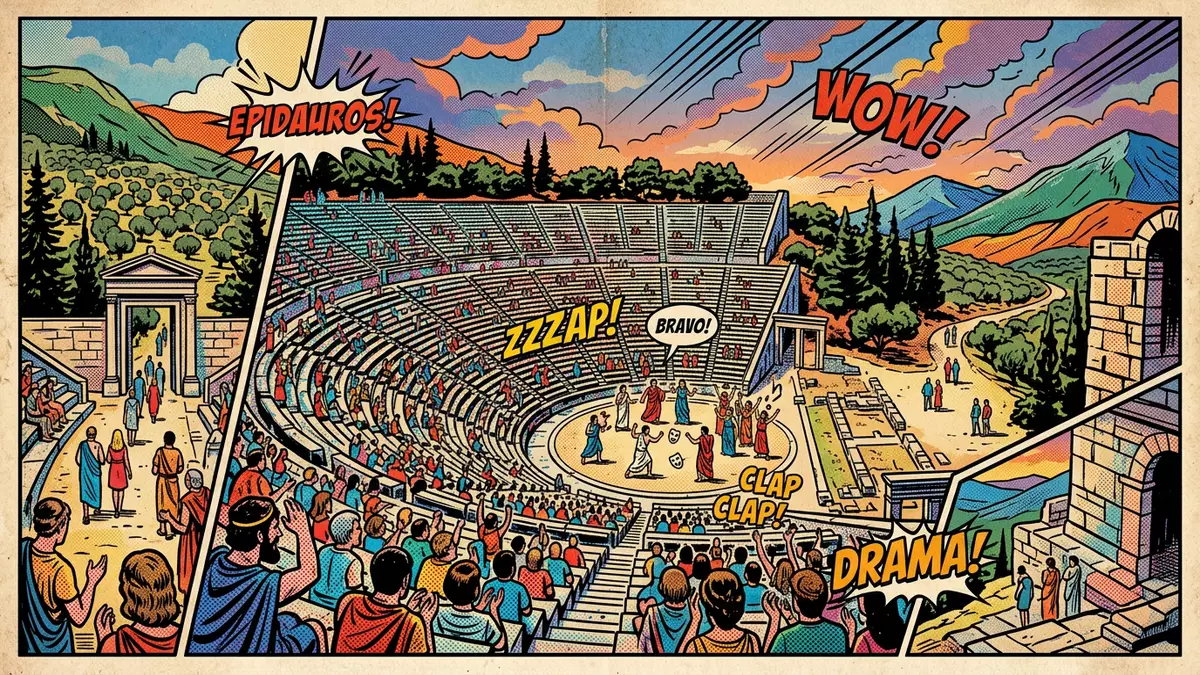
Theatro Epidavrou stands in the sanctuary of Asklepios at Epidauros, where a fourth-century BC theatre meets a hillside of pale stone. The name usually points to the ancient theatre, linked with Polykleitos the Younger and the Hellenic world’s drama tradition.
A theatre set into the slope
Theatre and hillside belong together here in a way that can be read at a glance. The seating rises in a broad curve, while the orchestra and stage area sit below within the sanctuary landscape.4th century
The stonework belongs to the larger sanctuary complex, not to a detached monument. UNESCO inscribed the Sanctuary of Asklepios at Epidaurus in 1988, and the theatre forms part of that designated whole.UNESCO inscribed
Polykleitos the Younger and a classical plan
Polykleitos the Younger is the name most closely associated with the theatre’s design. The attribution anchors the site in the classical Greek period and gives the building its historical weight.Polykleitos the Young
The theatre belongs to the sanctuary of Asklepios, the healing god of antiquity. That setting links drama, ritual and medicine in a single archaeological landscape that has survived in recognisable form.Sanctuary of Asklepios
Stone, symmetry and the surviving stage
The theatre’s power comes from its clear geometry and the contrast between the curved seating and the compact performance area. The remains are substantial enough to show how the cavea, orchestra and stage were arranged together.Ancient Theatre of Epidaurus
The site is part of a wider Peloponnese setting rather than an isolated ruin. Mt Kynortion forms the backdrop in the UNESCO description, and the theatre sits within the sanctuary’s long archaeological field.Mt Kynortion
Visiting Theatro Epidavrou: what travellers from Western Europe should know
- The theatre lies in Epidauros, in the Peloponnese of Greece, within the sanctuary of Asklepios. Public transport links the wider region, and the archaeological site is approached on foot once inside the sanctuary grounds.
- The seating rises across a hillside, so the place is experienced as both architecture and terrain. Stone steps and sloping rows dominate the layout.
- Theatre and sanctuary belong to a protected archaeological ensemble with classical remains around them. The monument is part of the UNESCO-listed Sanctuary of Asklepios at Epidaurus.
- The Greek language is used locally, and the currency is the euro.
Searching for Theatro Epidavrou on social platforms
These links open searches for Theatro Epidavrou on each platform.
Frequently asked questions about Theatro Epidavrou
Where is Theatro Epidavrou?
It stands in Epidauros, in the Peloponnese, inside the Sanctuary of Asklepios. The setting is part of its identity: theatre, sanctuary and hillside form one archaeological landscape.
What should be expected on a visit?
The place is an open ancient theatre with stone seating, a visible orchestra and a stage area. The walk through the sanctuary involves archaeological terrain rather than a sealed indoor monument.
What makes Theatro Epidavrou distinctive?
Its classical plan and hillside setting are the clearest features, together with the long association with Polykleitos the Younger and the Sanctuary of Asklepios. The theatre is part of the UNESCO-listed site at Epidaurus.


