
The Met’s Fifth Avenue facade and Great Hall
Published on 09/08/2026 at 07:56 | Editorial responsibility: Rafael Müller, Editor-in-Chief AD HOC NEWS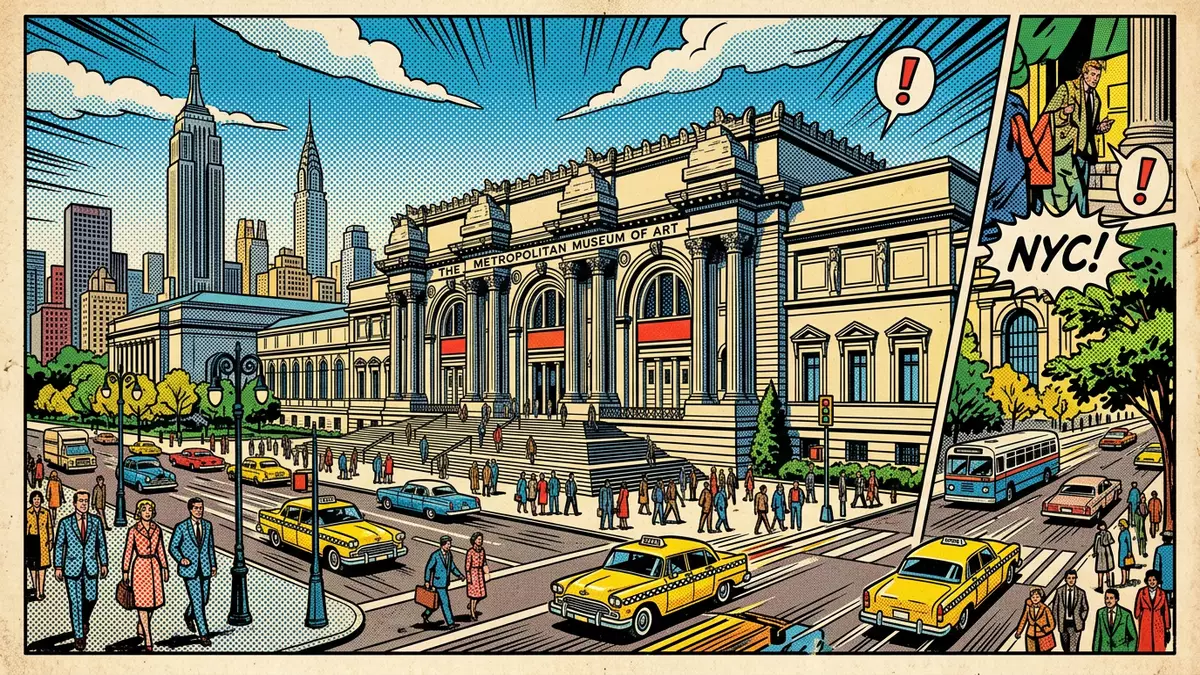
The Met in New York City combines two architectural personalities: an 1880 Gothic core and a Beaux-Arts front from 1902. That layered facade is the clearest way to read the museum at a glance.
The Met’s layered Fifth Avenue frontage
The museum occupies its current Fifth Avenue site at 82nd Street, beside Central Park on Manhattan’s Upper East Side. Its earliest permanent building opened in 1880, with later work adding a more formal public face to the street side.
Calvert Vaux and Jacob Wrey Mould were responsible for the first structure, which survives within the wider complex. Richard Morris Hunt designed the Fifth Avenue facade and the Great Hall, giving the museum a second architectural language in the 1902 frontage.
From Gothic mass to Beaux-Arts ceremony
The older part of the museum is red brick and stone, with the kind of vertical emphasis associated with Gothic Revival architecture. The later frontage is more formal and symmetrical, with a broad civic presence facing Fifth Avenue.
That contrast gives The Met an unusual reading experience from the outside. One side preserves the memory of an early museum building; the other presents the museum as a grand city institution. The title block of the complex is architectural, not decorative, and Richard Morris Hunt is central to that shift.
The museum as a layered civic landmark
The Met began in 1870 and opened to the public in temporary quarters before moving to its present location in 1880. The dates matter because they show how the institution grew in place rather than replacing its first home at once.
The museum’s identity rests on accumulation: one building phase after another, each retaining some trace of the one before. That makes the complex more than a single facade and more than a single period, and it keeps the Fifth Avenue side legible as an architectural sequence rather than a static monument. the museum’s 1870 foundation remains part of that story.
Visiting The Met: what travellers from Western Europe should know
- The museum stands on Fifth Avenue at 82nd Street in Manhattan, beside Central Park. The 4, 5 and 6 subway lines serve 86th Street nearby.
- The main building extends across a large city block, so the outside reads as a sequence of fronts and wings rather than a single compact hall.
- The Fifth Avenue side and the earlier core belong to different building phases. That makes the exterior useful for anyone interested in architectural layering.
- The official language is English and the currency is the US dollar.
Searching for The Met on social platforms
These links open searches for The Met on each platform.
Frequently asked questions about The Met
Where is The Met?
The Met stands on Fifth Avenue at 82nd Street in New York City, beside Central Park. It belongs to Manhattan’s Upper East Side and the wider Museum Mile corridor.
What does a visit there involve?
The exterior alone shows several building phases, from the original Gothic core to the later Beaux-Arts frontage. A visit therefore starts with architecture before moving into galleries.
What makes The Met distinctive?
The museum is distinctive because its street face is not from a single campaign. Calvert Vaux, Jacob Wrey Mould and Richard Morris Hunt all left visible traces in the same complex.


