
The Met as an encyclopedic window on world art
Published on 09/14/2026 at 18:40 | Editorial responsibility: Rafael Müller, Editor-in-Chief AD HOC NEWS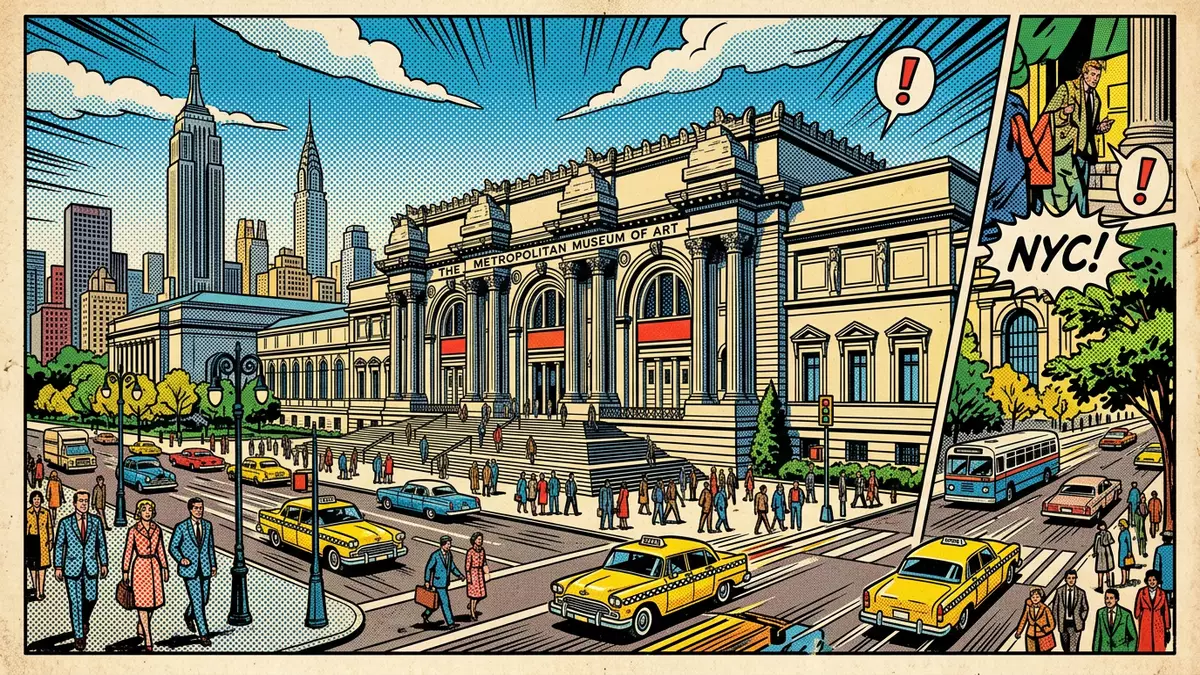
The Met in New York City is an encyclopedic art museum where thousands of years of human creativity are gathered inside a single monumental building on Fifth Avenue. Opened at its Central Park site in 1880, it grew from a late nineteenth-century initiative into one of the largest art museums in the world, with collections that span cultures and periods far beyond the United States.largest art museum in New York City
A museum shaped by nineteenth-century ambition
The Met was incorporated in 1870, founded by a group of American businessmen, financiers, artists and thinkers who wanted a public collection that matched the great museums of Europe in scope.incorporated in 1870 It opened to visitors in 1872, initially in more modest premises on Fifth Avenue and later at the Douglas Mansion on West 14th Street, before settling at its present address bordering Central Park in 1880.current site on Fifth Avenue and 82nd Street
The present complex at 1000 Fifth Avenue grew over successive building campaigns into a vast museum whose Beaux-Arts frontage faces the trees of Central Park along Museum Mile.1000 5th Ave, New York Behind the monumental steps and colonnade, galleries extend through wings and levels that house millions of objects, from small prehistoric tools to monumental architectural fragments. The scale is such that visiting feels less like entering a single building and more like moving through a stitched-together history of art.
Walking through global art history under one roof
The Met’s defining feature is the breadth of its permanent collection, which ranges from classical antiquity and ancient Egypt to Asian painting, African sculpture, Islamic art, European Old Master canvases and modern works.vast permanent collections Arms and armour, textiles, musical instruments and decorative arts sit alongside painting and sculpture, so that the visitor moves not only across geographies but also between everyday objects and ceremonial works.
One of the most striking spaces is the glass-roofed gallery that houses the Temple of Dendur, an ancient sandstone temple from Egypt dating to the first century BC, reassembled inside the museum during the 1970s.Temple of Dendur installed in 1978 Nearby, other galleries trace Egyptian history through carved reliefs, coffins and statues, while different wings lead to Greek and Roman rooms filled with marble figures, Asian galleries lined with screens and scrolls, and spaces devoted to European painting where works by major nineteenth-century and earlier artists hang closely together. The result is that a single circuit through the building becomes a condensed tour of many histories of art.
Two sites, one institution
The Met lives in two sites in New York City: the main building on Fifth Avenue and a branch in northern Manhattan known as The Met Cloisters.two iconic sites in New York City The Fifth Avenue building stands on the eastern edge of Central Park along Museum Mile, while The Met Cloisters occupies a hilltop setting in Fort Tryon Park, concentrating on medieval European art and architecture.branch called The Cloisters in northern Manhattan
Within the Fifth Avenue site, galleries are grouped broadly by culture and medium, but connections between them are visible in adjoining rooms and shared views. A visitor might pass from a hall of arms and armour into nearby European sculpture, or move from American paintings into decorative arts and period rooms that reconstruct interiors from different centuries. The building’s layout encourages long internal walks, and many visitors focus on one collection area, such as Asian art or European paintings, rather than trying to see everything in a single day.
Visiting The Met: what travellers from Western Europe should know
- The Met’s main building, The Met Fifth Avenue, stands at 1000 Fifth Avenue on Manhattan’s Upper East Side, along the stretch of Museum Mile bordering Central Park. It is reached by New York City Subway stations on the 4, 5 and 6 lines at 86th Street, as well as by several bus routes along Fifth and Madison Avenues.
- The Fifth Avenue building is a substantial structure with wide exterior steps leading up from the pavement to the entrance and long internal corridors linking its galleries, so a visit involves walking across extensive indoor spaces and using staircases or lifts between levels.
- The Met Cloisters lies in Fort Tryon Park in northern Manhattan, in more elevated terrain above the Hudson River, with paths and garden areas around the building in addition to the interior medieval galleries.
- The official language in New York City is English and the currency is the United States dollar (USD).
Searching for The Met on social platforms
These links open searches for The Met on each platform.Frequently asked questions about The Met
Where is The Met located in New York City?
The Met’s main building, The Met Fifth Avenue, stands at 1000 Fifth Avenue at 82nd Street on Manhattan’s Upper East Side, along the border of Central Park.
What can visitors expect to see inside The Met?
Visitors encounter an encyclopedic collection ranging from ancient Egyptian temples and classical sculpture to Asian art, African and Islamic works, European paintings, arms and armour and decorative arts under one roof.
What makes The Met distinctive among museums?
The Met is distinctive for combining a nineteenth-century Beaux-Arts building on Museum Mile with collections that cover thousands of years of global art history and a second site devoted to medieval Europe at The Met Cloisters.


