
The Met and its layered Fifth Avenue face
Published on 09/18/2026 at 21:59 | Editorial responsibility: Rafael Müller, Editor-in-Chief AD HOC NEWS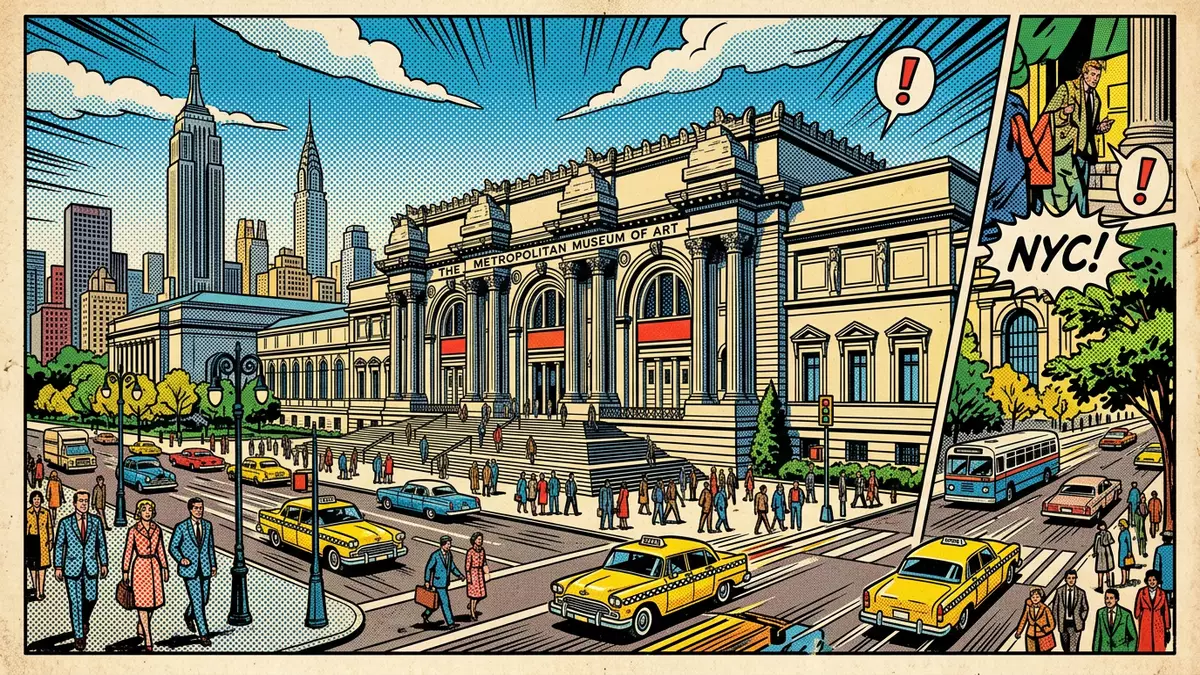
The Met in New York City is not a single facade but a layered museum complex whose Fifth Avenue face sits over an earlier Gothic core. Founded in 1870, it brings together Calvert Vaux, Jacob Wrey Mould and Richard Morris Hunt in one building history.
The museum’s layered Fifth Avenue front
The best-known public face is the Beaux-Arts front on Fifth Avenue, with its broad staircase and formal stone composition. Richard Morris Hunt’s design opened in 1902, and it remains the clearest first impression of the museum.
Behind that frontage lies the earlier structure by Calvert Vaux and Jacob Wrey Mould. The museum’s history on the site reaches back to 1870, when the institution was incorporated.
From Gothic core to Beaux-Arts frontage
The older part of the complex belongs to the Gothic Revival taste of the late nineteenth century. The present massing grew through additions, and the earlier fabric survives within the larger museum body.
The front facing Fifth Avenue belongs to a different phase and a different language. Hunt’s work gives the building its ceremonial urban presence, while the earlier structure keeps the museum tied to its first Central Park years.
What the building tells from the street
The Met can be read in layers rather than in a single glance. One part speaks in pointed Gothic forms, another in Beaux-Arts order, and both remain part of the same institution.
That contrast makes the museum a useful stop for travellers interested in architecture as much as collections. The building itself is a record of New York’s museum-making in the nineteenth and early twentieth centuries, with named architects and clearly separated phases.
Visiting The Met: what travellers from Western Europe should know
- The museum stands on Fifth Avenue in Manhattan, facing Central Park. The nearest well-known reference point is the Upper East Side.
- The building is spread across a large city block and includes substantial stairways at its main entrance. The old and new parts are visible in the fabric.
- The official language is English and the currency is the United States dollar.
- Entry requirements depend on your nationality; UK travellers can check the FCDO travel advice at gov.uk/foreign-travel-advice, Irish travellers the Department of Foreign Affairs at ireland.ie.
Searching for The Met on social platforms
These links open searches for The Met on each platform.
Frequently asked questions about The Met
Where is The Met?
The Met is on Fifth Avenue in Manhattan, beside Central Park on the Upper East Side. It is one of New York City’s major museum addresses.
What is a visit like?
The building presents a formal frontage, a broad entrance stair and a much older core inside the complex. The museum is large enough that the architecture forms part of the visit.
What makes The Met distinctive?
Its distinctiveness lies in the visible overlap of phases: Vaux, Mould and Hunt all belong to the same place. The museum reads as a built chronology in stone and brick.


