
The British Museum and its stone, glass and stories in Bloomsbury
Published on 09/10/2026 at 14:55 | Editorial responsibility: Rafael Müller, Editor-in-Chief AD HOC NEWS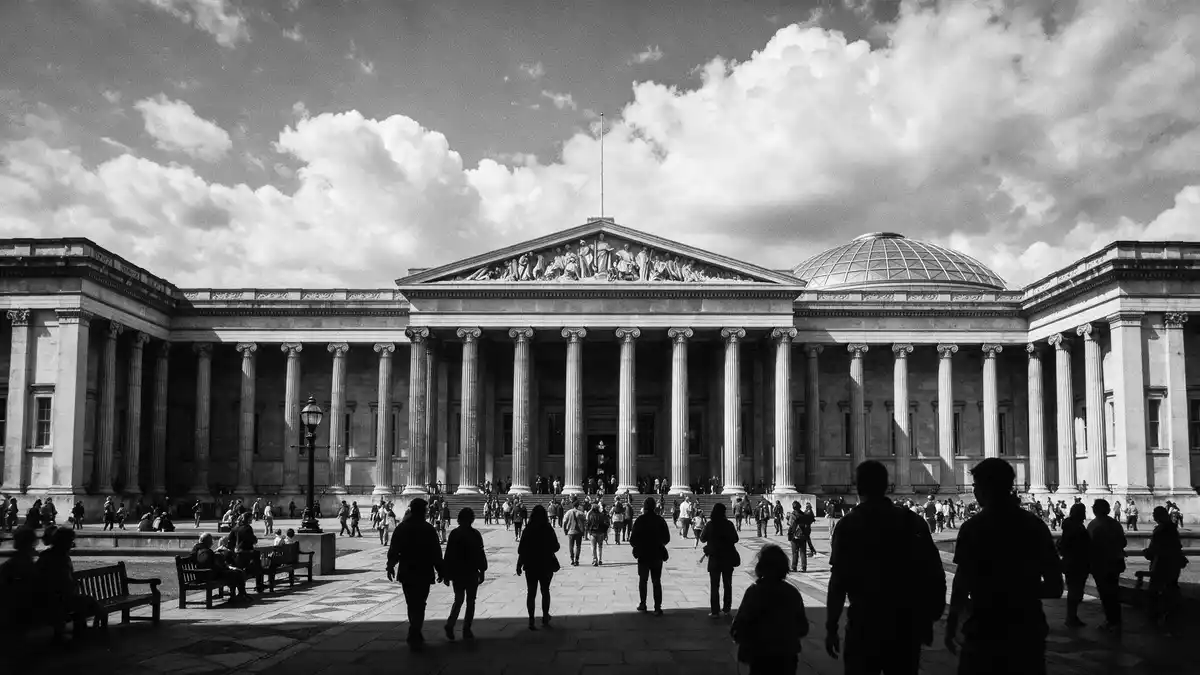
The British Museum in London is a museum of human history, art and culture, housed in a Greek Revival stone complex in Bloomsbury and centred on a vast roofed courtyard.
Greek Revival stone on Great Russell Street
The British Museum stands on Great Russell Street in the Bloomsbury district of central London, in the borough of Camden.
The main museum building takes the form of a broad quadrangle arranged around a central courtyard, with façades in the Greek Revival style designed by the English architect Sir Robert Smirke in the nineteenth century.Greek Revival style The most recognisable front is the south elevation, which presents a long colonnade of Ionic columns supporting a deep entablature and a triangular pediment filled with sculptural reliefs.long colonnade of Ionic columns
From Montagu House to a national museum
The institution now known as The British Museum was established by an Act of Parliament in 1753, based on the collections of the physician and collector Sir Hans Sloane and other major private libraries.Act of Parliament in 1753 The museum opened to the public in 1759 in Montagu House, a seventeenth-century mansion on Great Russell Street adapted to hold its early displays and reading rooms.opened to the public in 1759
During the nineteenth century the original house gave way to Smirke’s larger stone complex, built in stages between the 1820s and the middle of the century and incorporating galleries, courtyards and a monumental Reading Room at its centre.built between 1823 and 1852 Over the following generations the collections grew to encompass objects from many parts of the world and many periods, and the building was extended and reconfigured to accommodate them while keeping its neoclassical stone language.collections have grown to about eight million objects
The Great Court and the Reading Room
The most striking interior space at The British Museum is the Queen Elizabeth II Great Court, the covered courtyard that forms the heart of the quadrangle and gathers visitors around the historic Reading Room.
The Great Court was created at the turn of the twenty-first century when Foster + Partners enclosed the former open square with a glass and steel roof spanning the site between the outer façades and the cylindrical Reading Room at the centre.glass-and-steel roof The resulting space, completed in 2000, is regarded as one of the largest covered public squares in Europe and connects the surrounding galleries on multiple levels with broad stone staircases and balconies.Great Court completed in 2000
Visiting The British Museum: what travellers from Western Europe should know
- The British Museum occupies a block on Great Russell Street in Bloomsbury, north of Covent Garden and close to several Underground stations served by multiple lines.
- The complex is spread over several floors around the central Great Court, with long corridors, staircases and large galleries linked by wide stone steps and internal routes.
- The museum is surrounded by city streets and squares; nearby landmarks include Russell Square, the University of London buildings and other cultural institutions in Bloomsbury.
- The official language is English and the currency is the pound sterling.
Searching for The British Museum on social platforms
These links open searches for The British Museum on each platform.
Frequently asked questions about The British Museum
Where is The British Museum located in London?
The British Museum is in the Bloomsbury district of central London, with its principal entrance on Great Russell Street in the borough of Camden.
What can visitors expect on a visit to The British Museum?
Visitors move through neoclassical stone galleries and the glass-roofed Great Court, exploring collections of objects from many periods and regions of human history.
What makes The British Museum distinctive among museums?
The combination of Greek Revival architecture by Sir Robert Smirke, the modern Great Court roof by Foster + Partners and wide-ranging collections gives The British Museum a particular character.


