
The British Museum and its great courtyards of world history
Published on 09/01/2026 at 13:24 | Editorial responsibility: Rafael Müller, Editor-in-Chief AD HOC NEWS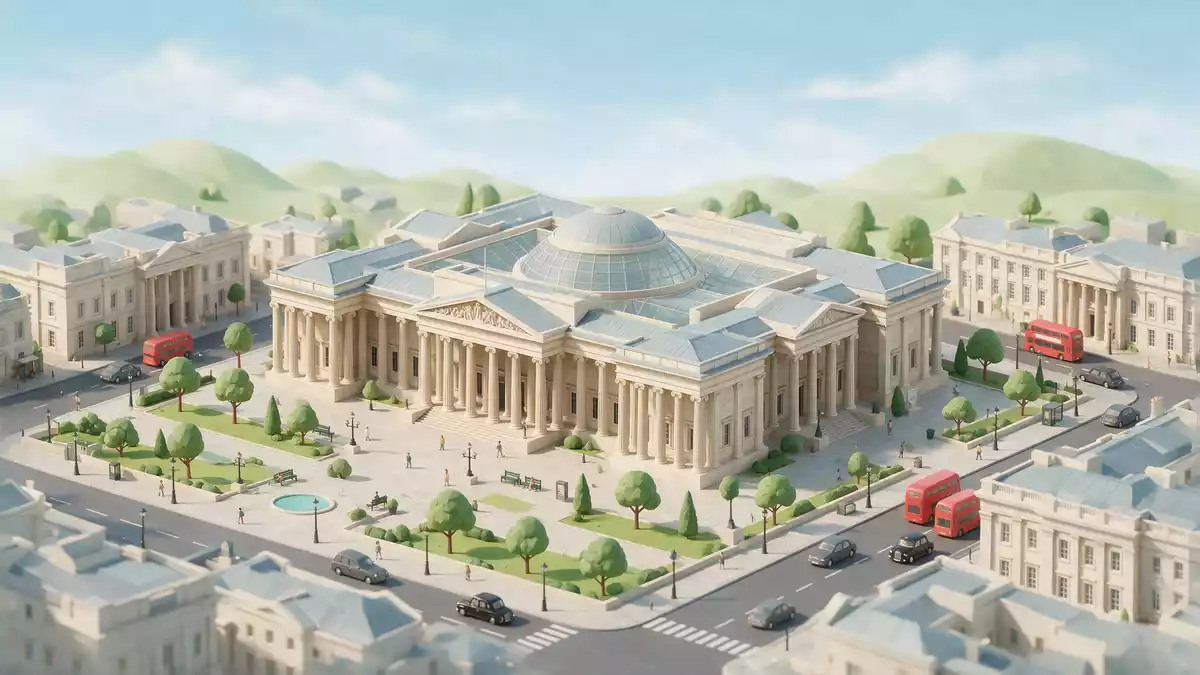
The British Museum in London brings a vast span of human history together behind Greek Revival colonnades and around a transformed internal courtyard. Founded in 1753 as a national public museum, it still occupies its historic site on Great Russell Street in Bloomsbury and continues to grow within the same city block.
From Hans Sloane to a Greek Revival palace
The story of The British Museum begins in 1753, when an Act of Parliament created a national museum from the collections of physician and collector Sir Hans Sloane. His bequest included tens of thousands of books, manuscripts, coins and natural curiosities that were brought under one roof as a public institution on Great Russell Street, forming what was described as the world’s first free national public museum.Act of Parliament in 1753
When the museum opened to the public in 1759, its collections were housed in Montagu House, a seventeenth-century mansion that once stood on the same site in Bloomsbury.Opening to the public in 1759 As the collections expanded through the late eighteenth and early nineteenth centuries, the old house proved too small, and the trustees turned to architect Sir Robert Smirke, a leading figure in Greek Revival design, to create a much larger, purpose-built museum.
Colonnades and reading rooms: architecture on Great Russell Street
Smirke’s redesign reshaped the block into a monumental quadrangle of stone galleries enclosing an open court, framed by a long façade on Great Russell Street. The main front, completed in the nineteenth century, is lined with a forest of Ionic columns that give the museum the character of a classical temple while housing galleries for sculpture, antiquities and later library spaces behind.Greek Revival façade on Great Russell Street The location places The British Museum at the centre of Bloomsbury’s grid of scholarly streets, close to colleges and bookshops that grew up around this academic quarter of London.Bloomsbury district of London
Behind the colonnades, the building has continued to evolve. In the 1850s the architect Sydney Smirke created the Round Reading Room, a domed circular hall for readers that became one of the most recognisable interiors in London, used for generations as the heart of the British Library’s printed collections.Round Reading Room in the 1850s At the turn of the twenty-first century, the practice Foster and Partners reimagined the open central courtyard as the Queen Elizabeth II Great Court, a two-acre space covered by a glass and steel roof that wraps around the Reading Room and creates an indoor piazza for visitors.Great Court designed by Foster and Partners
Collections that map global civilisations
The British Museum’s collections range across continents and millennia, with particular strengths in archaeology and ethnography. Galleries on the ground and upper floors display objects from the ancient Mediterranean, including sculptures from the Parthenon in Athens and works from other Greek and Roman sites that trace the development of classical art and civic life.Holdings in archaeology and ethnography Nearby rooms present the cultures of ancient Egypt and the Middle East, with monumental stone statues, carved reliefs and inscribed objects that carry royal names and scripts from the Nile and Mesopotamia.
Other galleries move north and west to tell the story of Britain and Europe from prehistory through the medieval period, drawing on archaeological finds and hoards recovered from fields, riverbeds and burial mounds. Further routes through the museum lead to Africa, the Americas, Asia and Oceania, where masks, textiles, ceramics, metalwork and everyday tools illustrate lives lived in different landscapes and belief systems.Collections representing cultures of the world A visitor walking from one wing to another moves between civilisations, with the architecture and display cases framing that journey across time and geography.
Visiting The British Museum: what travellers from Western Europe should know
- The British Museum stands on Great Russell Street in the Bloomsbury district of central London, within the borough of Camden and close to Russell Square and Holborn Underground stations.
- The approach from Great Russell Street leads through an external courtyard to the broad steps and terrace in front of the colonnaded main entrance, with security checks before the doors.
- Inside, the Queen Elizabeth II Great Court forms a large, open circulation space with staircases, escalators and lifts connecting the surrounding gallery levels and the Reading Room at its centre.
- The official language is English and the currency is the pound sterling.
Searching for The British Museum on social platforms
These links open searches for The British Museum on each platform.
Frequently asked questions about The British Museum
Where is The British Museum located in London?
The British Museum stands on Great Russell Street in the Bloomsbury district of central London, within the borough of Camden.
What can visitors expect inside The British Museum?
Visitors find galleries dedicated to civilisations from Europe, Africa, Asia, the Americas and Oceania, arranged around the glass-roofed Great Court and the historic Round Reading Room.
What makes The British Museum distinctive among museums?
Its origins in the 1753 Act of Parliament, its Greek Revival architecture with Ionic colonnades and its global archaeological collections together give The British Museum a particularly wide historical reach.


