
The British Museum and its Great Court of light
Published on 09/15/2026 at 06:44 | Editorial responsibility: Rafael Müller, Editor-in-Chief AD HOC NEWS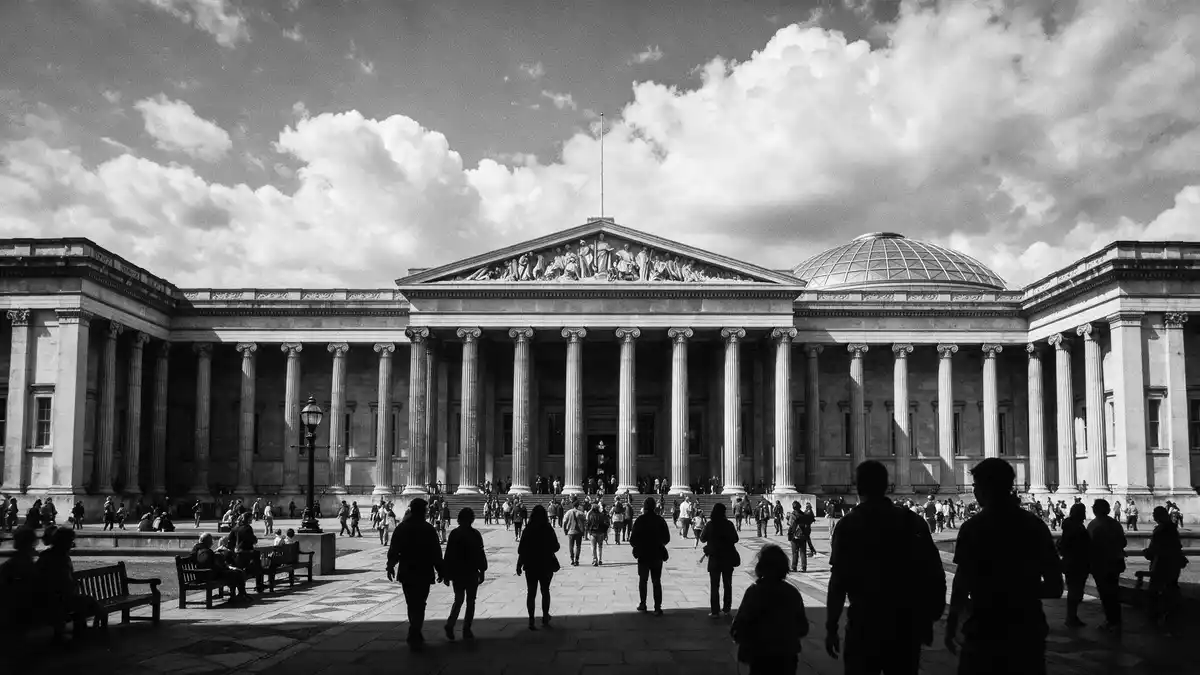
The British Museum in London is a vast encyclopaedic museum of human history, art and culture, set among the streets of Bloomsbury and arranged around a transformed central courtyard. Founded in 1753, it grew from the collections of Sir Hans Sloane into one of the largest assemblies of objects documenting human cultures across the world.
A national museum born from a private collection
The origin of The British Museum lies in the lifetime work of the physician and collector Sir Hans Sloane, who gathered tens of thousands of books, manuscripts, natural specimens and antiquities during the late seventeenth and early eighteenth centuries.Sir Hans Sloane bequeathed his collection to King George II for the nation, on condition that Parliament create a new public museum to house it, a requirement fulfilled through the British Museum Act of 7 June 1753.the British Museum Act 1753 The museum first opened to the public in 1759, when its founding collections were installed in Montagu House, a seventeenth-century mansion in Bloomsbury that was adapted as a repository for the new institution.Montagu House in Bloomsbury
From these beginnings, The British Museum developed into a national museum and library through the addition of major manuscript and book collections, including the Cottonian Library, the Harleian library and the Old Royal Library assembled by British monarchs.the foundation collections Over the following centuries its holdings expanded to around eight million objects covering around two million years of human history, ranging from ancient Egyptian sculpture and Mesopotamian cuneiform tablets to Asian ceramics, Islamic art, European prints and artefacts from Africa and the Americas.two million years of human history
Greek Revival façades around a Bloomsbury courtyard
The British Museum occupies a block bordered by Great Russell Street and neighbouring roads in Bloomsbury, a central London district associated with universities, libraries and learned societies.Great Russell Street in Bloomsbury Its principal frontage is a monumental Greek Revival façade completed in 1852, with a deep portico and an arrangement of columns leading to the Great Russell Street entrance, forming a classical screen to the complex of galleries and reading rooms behind.the main core of the Museum building The exterior employs stone and sculptural detail to present the museum as a temple-like institution, while its plan retains the footprint of an internal quadrangle around a central structure.
The building sits at the heart of British academia, its façades and wings forming an urban ensemble that faces narrow streets and small squares rather than large boulevards.Greek Revival style building Inside, long galleries radiate from staircases and landings, housing displays arranged by region, period or theme, while staircases connect lower archaeological rooms with upper floors devoted to prints, drawings and decorative arts. The classical vocabulary of the exterior contrasts with the more varied interior structures, where historic rooms sit alongside areas reshaped in the late twentieth century.
The Queen Elizabeth II Great Court: turning the museum inside out
At the core of The British Museum lies the Queen Elizabeth II Great Court, a covered courtyard that encloses the former open quadrangle around the circular Reading Room.the Queen Elizabeth II Great Court Redesigned in the late 1990s by Foster and Partners and opened in 2000, the Great Court is roofed by a tessellated glass structure engineered by Buro Happold and built by Waagner-Biro, which spans the entire courtyard and admits daylight across its stone paving and staircases.the tessellated glass roof The circular Reading Room stands at the centre as a self-contained pavilion, its bookshelves and interior now adapted for museum library and information uses.
The Great Court connects multiple entrances, galleries and visitor facilities, turning what was once a service courtyard into a central public space for orientation, informal gatherings and temporary displays.the Great Court within the Museum Escalators, staircases and balconies lead from the paving up to surrounding galleries, while the outer wall constructed around the Reading Room supports the roof and contains concealed services for the rooms below.the new outer wall Seen from above, the Great Court presents a contrast between the perfect circular form of the Reading Room and the more rectilinear outline of the surrounding museum ranges, a geometric centrepiece at the heart of the British Museum complex.
Visiting The British Museum: what travellers from Western Europe should know
- The British Museum stands on Great Russell Street in Bloomsbury, central London, within walking distance of several Underground stations and major rail termini.
- Visitors move through broad external steps to reach the Great Russell Street portico, followed by interior staircases and long corridors linking the galleries around the Great Court.
- Bloomsbury contains other cultural institutions, including the University of London and several specialist libraries, making the area a compact academic quarter surrounding the museum.
- The official language is English and the currency is the pound sterling.
Searching for The British Museum on social platforms
These links open searches for The British Museum on each platform.Frequently asked questions about The British Museum
Where is The British Museum located?
The British Museum is in the Bloomsbury district of central London, with its main entrance on Great Russell Street among university buildings and historic squares.
What should visitors expect inside The British Museum?
Visitors encounter long galleries arranged around a covered central courtyard, with collections ranging from ancient sculpture and manuscripts to decorative arts and artefacts from many regions.
What makes The British Museum distinctive among museums?
The British Museum combines an eighteenth-century foundation and a nineteenth-century Greek Revival exterior with the modern Queen Elizabeth II Great Court, creating a museum where historic reading rooms and contemporary structures meet around a single courtyard.


