
The British Museum and its glass-roofed Great Court
Published on 09/23/2026 at 22:28 | Editorial responsibility: Rafael Müller, Editor-in-Chief AD HOC NEWS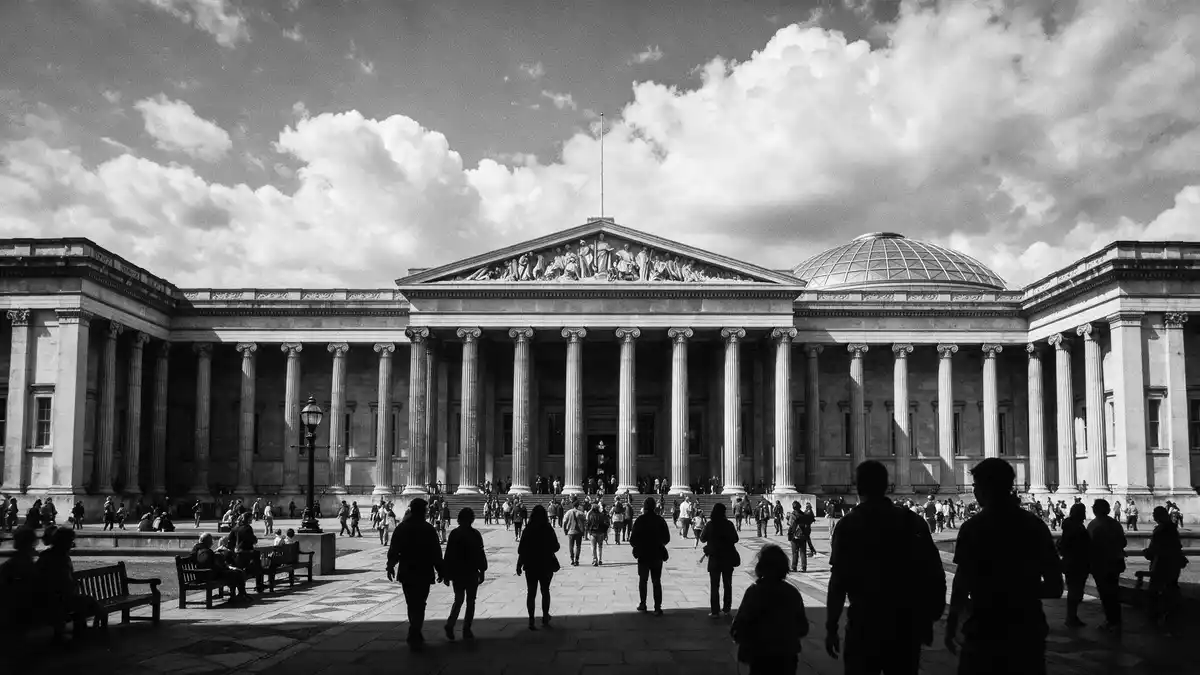
The British Museum is a museum of human history in Bloomsbury, London, organised around objects from two million years of cultural life. Its visible centre is the Queen Elizabeth II Great Court, where a glass roof spans the space around the Round Reading Room.
The building combines a nineteenth-century Greek Revival exterior with later spaces, including the Great Court opened in 2000. Sir Hans Sloane, Sir Robert Smirke and Foster + Partners belong to three different chapters of its history.
The British Museum’s Greek Revival envelope
An Act of Parliament created The British Museum in 1753, and the institution opened to the public in 1759. Its first collections came from Sir Hans Sloane, the Cotton Library and the Harleian Library.
The collections were first housed in Montagu House, a seventeenth-century mansion in Bloomsbury. Sir Robert Smirke’s replacement building was constructed between 1823 and 1852 in the Greek Revival style, with Portland stone on its exterior and a long classical portico.
The south entrance measures 112.7 m (370 ft), while its columns rise 13.7 m (45 ft). A triangular pediment above the colonnade carries sculpture by Sir Richard Westmacott, whose subject is the progress of civilisation as understood in Victorian Britain.
Inside the court beneath the glass roof
The Queen Elizabeth II Great Court occupies the centre of the museum. Foster + Partners designed its roof as a lattice of glass and steel surrounding the Round Reading Room, a domed nineteenth-century room by Sydney Smirke.
The Great Court opened in 2000. Its roof contains thousands of individual glass panels, and its broad floor connects galleries, halls and the central Reading Room. The space is an architectural room within the older quadrangle.
The Round Reading Room began in 1854 and opened in 1857. Cast iron, concrete, glass and mechanical systems formed part of its mid-nineteenth-century construction, while its dome remains a defining feature of the museum’s interior.
The Enlightenment Gallery occupies the former King’s Library. George IV gave George III’s library to the nation in 1823, and the long room later became a gallery about collecting and knowledge in the Age of Enlightenment.
Objects spanning continents and centuries
The museum’s collection extends across Africa, the Americas, Asia, Europe and Oceania. It includes archaeology, sculpture, manuscripts, coins, decorative arts and objects connected with everyday life.
The Rosetta Stone carries inscriptions in different scripts and is connected with the decipherment of Egyptian hieroglyphs. The Parthenon Sculptures come from the Athenian Acropolis and include architectural sculpture carved in ancient Greece.
The Lewis Chessmen are medieval playing pieces made from walrus ivory. Other named highlights include the Royal Game of Ur, the Lycurgus Cup, the shield from West Papua and the brass head of an Ooni of Ife.
The range of objects gives the museum a physical geography as well as a historical one. A visitor can move from Egyptian coffins to Greek pottery, from Central Asian material to African metalwork, and from illuminated manuscripts to works connected with living cultures.
The collection also carries the history of British collecting and empire. Objects entered through excavation, purchase, donation and bequest, while many came from regions affected by British colonial rule. That history forms part of the questions raised by the galleries.
Visiting The British Museum: what travellers from Western Europe should know
- The museum is on Great Russell Street in Bloomsbury, London. Tottenham Court Road and Holborn are the nearest Underground stations named for the site.
- The main entrance has a broad flight of steps beneath the Greek Revival portico. The Great Court then provides a large internal circulation space around the Reading Room.
- The building contains distinct architectural zones, from the stone-faced south entrance and Weston Hall to the glass roof of the Great Court.
- Nearby Bloomsbury includes Russell Square, while the museum sits north of Oxford Street and east of Tottenham Court Road.
Searching for The British Museum on social platforms
These links open searches for The British Museum on each platform.
Frequently asked questions about The British Museum
Where is The British Museum?
The British Museum is on Great Russell Street in Bloomsbury, London. The district lies in the borough of Camden, north of Oxford Street.
What can visitors expect inside?
The galleries contain archaeology, art, manuscripts and objects from cultures across the world. The Great Court, Round Reading Room and Greek Revival halls provide major architectural features between the displays.
What makes The British Museum distinctive?
Its identity joins a museum founded by Parliament in 1753 with a collection spanning two million years. The glass-roofed Great Court sits inside Sir Robert Smirke’s nineteenth-century quadrangle.


