

Temple of Edfu and the sandstone world of Horus
Published on 08/24/2026 at 15:04 | Editorial responsibility: Rafael Müller, Editor-in-Chief AD HOC NEWS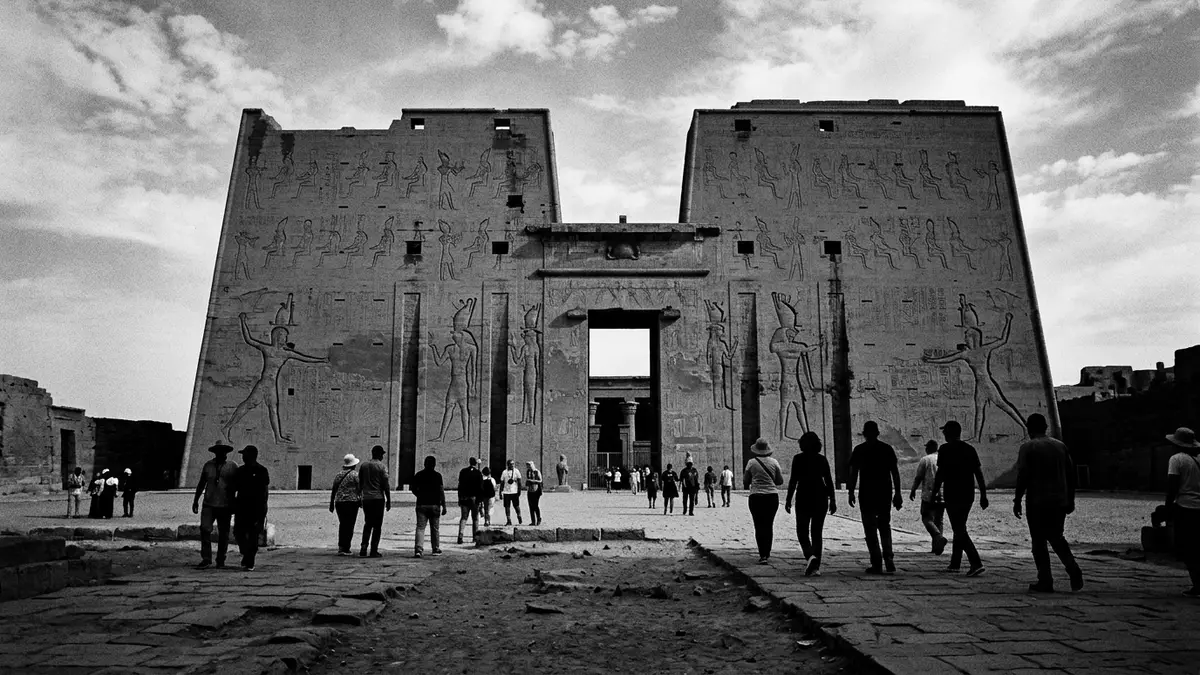
The Temple of Edfu in Upper Egypt is one of the clearest surviving visions of a grand Egyptian temple, its sandstone walls and towering gateways still standing much as they were in the Ptolemaic period. Built between 237 and 57 BC under a succession of Ptolemaic rulers and dedicated to the falcon god Horus, it rises on the western bank of the Nile at Edfu, between Luxor and Aswan.
A Ptolemaic temple that feels pharaonic
The Temple of Edfu was begun in 237 BC during the reign of Ptolemy III Euergetes I and completed in 57 BC under Ptolemy XII Auletes, stretching across almost two centuries of Greek rule in Egypt.Construction began under Ptolemy III in 237 BC and finished under Ptolemy XII in 57 BC The rulers were Macedonian in origin, yet the temple follows the established canon of Egyptian sacred architecture, echoing earlier sanctuaries from pharaonic times.The Temple of Horus at Edfu follows the widespread typology of Egyptian ceremonial temples
Although its date is late in ancient Egyptian history, the temple gives a strong sense of how large cult centres once looked, from monumental pylons and open courts to enclosed halls crowded with columns. The temple complex stands near the western edge of the modern town, aligned from south to north, with its entrance facing towards the Nile through a broad forecourt.The temple is oriented from south to north on the west bank of the Nile at Edfu
Sandstone towers, courtyards and inner sanctuaries
The material character of the Temple of Edfu is defined by sandstone, carved into remarkably crisp edges and deep reliefs. The outer gateway is framed by a pair of massive towers, forming the entrance pylon that dominates first impressions and rises high above the surrounding town.The temple is famous for its gigantic pylon consisting of two towers about 36 m high Passing between them leads into a rectangular court with colonnades along its sides, a space that introduces the rhythm of columns and the layering of walls and doorways.
Beyond this court, a series of halls step steadily inward, each slightly darker and more enclosed, towards the sanctuary of Horus and its surrounding chapels. The overall plan respects the axial arrangement familiar from major temples such as Karnak and Luxor, yet here the sequence is preserved in unusually complete form.The Temple of Horus at Edfu is a nearly perfectly preserved architectural organism built during the Ptolemaic Kingdom The hypostyle hall, with its rows of columns and decorated capitals, marks the transition from open court to inner chambers, continuing the procession towards the innermost shrine.
Horus of Behedet and the written stone
The temple honours Horus of Behedet, the falcon-headed god associated with the sky and royal protection, and this dedication shapes many of its visible details. Falcon imagery appears on reliefs, statues and carvings near the entrance and within the precinct, making the divine focus clear even before the inscriptions are read.Edfu Temple is dedicated to the worship of the god Horus The site at ancient Djeba, later known as Edfu, was traditionally linked to myths of conflict between Horus and Seth, and the reliefs record episodes of these stories alongside ritual scenes.
The walls are densely inscribed, providing one of the richest surviving archives of temple texts from the Ptolemaic period. Narratives, offering lists and architectural records are cut into the sandstone, and many remain legible, providing valuable detail on ceremonial life and building history.The complex contains a wealth of legible inscriptions on its walls and was constructed over about 180 years in the Ptolemaic period For visitors walking through the sequence of courts and halls, these carved texts reinforce the impression of a temple that is not only architecturally intact but also textually detailed.
Visiting Temple of Edfu: what travellers from Western Europe should know
- The Temple of Edfu stands on the west bank of the Nile in the town of Edfu in Upper Egypt, roughly between Luxor and Aswan along the river.
River cruises on the Nile commonly include Edfu among their stops, and road connections link the town with other settlements in the region. - Inside the temple, movement involves crossing wide stone courts and climbing some stairways within the towers and inner sections, with surfaces built from sandstone blocks rather than modern paving.
- In summer, temperatures in Upper Egypt are high, and the sandstone courts outside the shaded halls lie fully exposed to the sun.
- The official language is Arabic and the currency is the Egyptian pound.
- Entry requirements depend on your nationality; UK travellers can check the FCDO travel advice at gov.uk/foreign-travel-advice, Irish travellers the Department of Foreign Affairs at ireland.ie.
Searching for Temple of Edfu on social platforms
These links open searches for Temple of Edfu on each platform.Frequently asked questions about Temple of Edfu
Where is the Temple of Edfu located?
The Temple of Edfu stands on the west bank of the Nile in the town of Edfu in Upper Egypt, between Luxor and Aswan along the river.
What can visitors expect inside the temple?
Visitors encounter a sequence of sandstone courts, column-lined halls and inner sanctuaries, with extensive carved reliefs and inscriptions devoted to the falcon god Horus.
What makes the Temple of Edfu distinctive among Egyptian temples?
The Temple of Edfu is distinguished by its late Ptolemaic date combined with a remarkably complete preservation of traditional Egyptian temple architecture and inscriptions.


