
Temple of Edfu and the enduring stone temple of Horus
Published on 09/12/2026 at 07:41 | Editorial responsibility: Rafael Müller, Editor-in-Chief AD HOC NEWS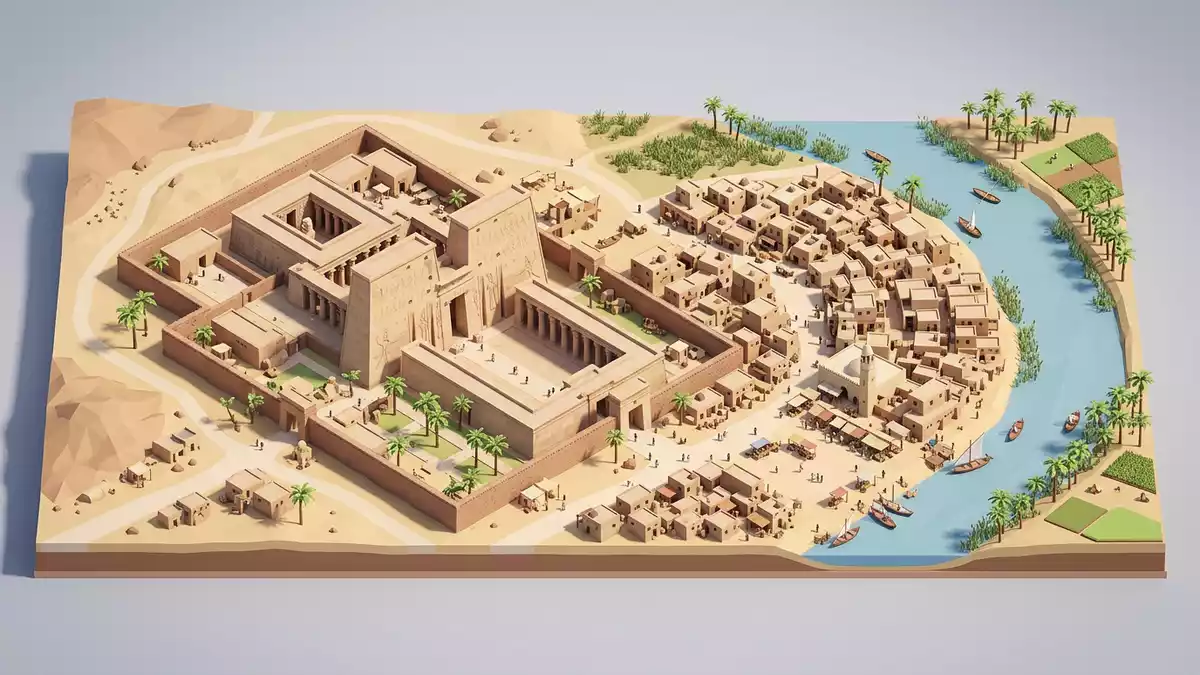
The Temple of Edfu in Upper Egypt is dominated by a vast sandstone complex dedicated to the falcon god Horus, one of the most complete surviving temple ensembles from the Ptolemaic period. Construction of the present temple began in 237 BC under Ptolemy III Euergetes I and was completed in 57 BC in the reign of Ptolemy XII Auletes, giving visitors an unusually coherent glimpse of Greco-Egyptian architecture and religion over nearly two centuries of work.
A Ptolemaic temple on the Nile at Edfu
The Temple of Edfu stands on the western bank of the Nile at the town of Edfu in Upper Egypt, between Luxor and Aswan, where the desert edge meets the riverplain. It occupies a substantial rectangular precinct, with the main temple extending for a little over 140 m (459 ft) in length within an area of around 7,000 m², laid out along a south–north axis that leads away from the river towards the inner sanctuary.little over 140 m long Built in sandstone blocks rather than mudbrick, the complex retains its towering pylons, enclosure walls and many of its subsidiary chambers, which together give an unusually complete impression of how a major temple functioned in the late pharaonic world.built from sandstone blocks
Although the standing building belongs to the Ptolemaic Kingdom, from the third to the first centuries BC, it follows long-established canons of Egyptian temple design, with a monumental entrance, open court, hypostyle hall and progressively restricted inner rooms culminating in the sanctuary of Horus.built in the Ptolemaic Kingdom The present temple replaces earlier sanctuaries at the same religious centre, although the older structures have largely disappeared beneath or behind the later stonework.
Architecture, spaces and the cult of Horus
The complex is dedicated to Horus of Behedet, a local form of the falcon-headed god whose cult made Edfu one of the principal sacred sites of Upper Egypt.Horus of Behedet From the great entrance pylons onward, stone reliefs and inscriptions present Horus receiving offerings, defeating hostile forces and participating in rituals that tied the local temple to the wider religious geography of Egypt. Within the first court and the surrounding colonnades, the decoration reflects processions, festivals and daily rites centred on the cult statue housed deeper within the building.Temple of Horus
Further inside, the hypostyle halls and subsidiary chapels are thickly inscribed, turning walls, doorframes and column shafts into written records of ritual and theology. Inscriptions at Edfu preserve building histories, lists of offerings and explanations of ceremonial routes, making the temple one of the richest epigraphic archives for the late pharaonic and Ptolemaic periods.wealth of legible inscriptions The sanctuary itself contains the base where the cult statue of Horus once stood, as well as a stone shrine that framed the god’s presence within the broader architectural and decorative scheme.
From Ptolemy III to Ptolemy XII: a long construction
The building history of the Temple of Edfu is unusually well documented, with foundation texts and later inscriptions recording its chronological stages. Work began on 23 August 237 BC under Ptolemy III Euergetes I and continued under a succession of Ptolemaic rulers, including Ptolemy VIII, who inaugurated the temple in 142 BC, and Ptolemy XII Auletes, who oversaw the completion of its outer courts and pylons.begun by Ptolemy III on 23 August 237 BC The final installation of the large wooden doors and other finishing elements in 57 BC marked the formal end of a construction phase that had lasted about 180 years.completed in 57 BC
Later additions by Roman emperors such as Augustus and possibly Tiberius continued the pattern of royal involvement, but without altering the essential layout of the Ptolemaic temple.additions by the emperor Augustus The site’s inscriptions record these phases with unusual detail, linking each architectural element to named rulers and specific dates. This combination of intact masonry and dated decoration makes the Temple of Edfu a key reference point for understanding how religious architecture developed under the Greek-speaking dynasty that ruled Egypt after the death of Alexander the Great.
Visiting Temple of Edfu: what travellers from Western Europe should know
- The Temple of Edfu stands in the town of Edfu in Upper Egypt on the west bank of the Nile, between Luxor and Aswan and reachable by road and river transport.
- Within the temple precinct, movement between the entrance, court and inner halls involves stone floors, steps and passageways, with some areas lying in relative shade beneath high roofing.
- The temple lies in a desert-edge environment beside the Nile, so exposure to sun on the approach contrasts with the more enclosed spaces inside the stone complex.
- The official language of Egypt is Arabic and the currency is the Egyptian pound. Entry requirements depend on your nationality; UK travellers can check the FCDO travel advice at gov.uk/foreign-travel-advice, Irish travellers the Department of Foreign Affairs at ireland.ie.
Searching for Temple of Edfu on social platforms
These links open searches for Temple of Edfu on each platform.
Frequently asked questions about Temple of Edfu
Where is the Temple of Edfu located?
The Temple of Edfu stands in the town of Edfu in Upper Egypt on the west bank of the Nile, between Luxor and Aswan.
What can visitors expect inside the Temple of Edfu?
Visitors move from a monumental sandstone entrance through an open court and hypostyle halls into a sequence of chapels and the sanctuary of Horus, all heavily inscribed.
What makes the Temple of Edfu distinctive among Egyptian temples?
The Temple of Edfu combines intact Ptolemaic architecture, extensive inscriptions and a well-documented construction history from Ptolemy III to Ptolemy XII, making it one of the most complete major cult temples in Egypt.


